




Fast Shipping
Carrier information

20k products
Payment methods

24/7 Support
Unlimited help desk

2-day Delivery
Track or off orders
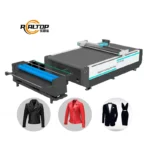
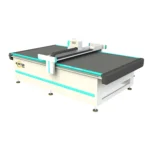
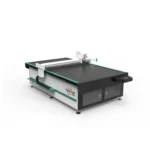
Precision-driven cutting configuration — The RT-D2516/RT-S2516 pairs a Swiss imported oscillating knife head with material-specific vacuum zoning, ensuring edge quality matches the fabric or composite being processed rather than defaulting to a generic setup.
Technical Specifications
| Parameter | Value |
|---|---|
| Model | RT-D2516/RT-S2516 |
| Product Type | CNC Oscillating Knife Cutting Machine |
| Working Area | 1600×2500mm |
| Overall Dimensions (L×W×H) | 3450×2300×1250mm |
| Rated Power | 9 kW |
| Table Type | Flat working table with vacuum and auto-feeding |
| Tool Head | Swiss imported knife with vibration full cutting, half cutting and cursor location |
| Translational Velocity | 800–1200 mm/s |
| Cutting Speed | 200–800 mm/s (basis to be confirmed per material and thickness) |
| Repeated Accuracy | ≤0.1 mm |
| Transmission System | Digital servo motor, linear guide, synchronous belt, ball screw (imported) |
| Servo Motor | Japanese Yaskawa |
| Guide Rail | Taiwan Hiwin |
| Conveyor Belt | Germany imported |
| Instruction System | HP-GL compatible format |
| Voltage | 380V±10% |
| Vacuum Pump | 7.5 kW |
| Safety Device | Infrared sensors |
| Warranty | 12 months for whole machine |
| Standards | CE |
Application Suitability
| Application | Material or Output |
|---|---|
| Garment and footwear production | Woven fabric, non-woven fabric, leather, sponge composite leather |
| Automotive interior trimming | Soft trim materials, foam, PU, EVA, XPE composites |
| Gasket and seal fabrication | Rubber, PTFE, ETFE, silicon, soft glass |
| Packaging sample making | Cardboard, corrugated paper, paper honeycomb |
| Signage and display | PVC, film, sticker, acrylic board (soft grades) |
Why Working Area Is the Wrong First Question for a CNC Oscillating Knife Cutting Machine Manufacturer
Matching the tool head and vacuum zoning to the material prevents more production loss than any other specification decision.
Buyers often open an inquiry by stating the sheet size they need to cut and stop there. When the machine arrives, the knife cannot penetrate the full material stack, or small parts lift off the table mid-cut because the vacuum zones are too large. I have watched garment factories run entire rolls of layered fabric only to find the bottom plies fused together from blade friction, a problem traceable to oscillation frequency and cutting speed rather than the machine footprint. [NEED_CITE: common fabric cutting defects in multi-ply layups]
Tool Head Selection Determines What You Can Actually Cut
The Swiss imported knife on this unit supports vibration full cutting, half cutting and cursor location in a single workstation. Full cutting handles multi-ply fabric stacks and composite leather, while half cutting scores crease lines on corrugated board without severing the bottom liner. Cursor location allows interactive trimming where the operator follows an on-screen guide for rework or one-off shapes. A CNC oscillating knife cutting machine manufacturer that only offers a single blade type forces buyers to compromise on edge quality across different materials.
Motion Components That Hold Tolerance at Production Speed
Yaskawa servo motors paired with Taiwan Hiwin linear guides and imported ball screws maintain ≤0.1 mm repeatability even at the upper translational velocity of 1200 mm/s. In garment nesting, where pattern pieces share tight boundaries, even slight positional drift produces mismatched seams downstream. The Germany-imported conveyor belt on the auto-feeding system keeps roll material tracking straight through the cutting zone, avoiding the lateral shift that causes scrap waste at the edges. [NEED_CITE: linear guide tolerance classes and their effect on cutting accuracy]
Reading the Specification Sheet Beyond Surface Numbers
The 7.5 kW vacuum pump must be evaluated against the table zoning layout. A flat working table with broad zones holds large sheets well but may release small gasket parts during cutting, requiring a multi-zone configuration to keep suction concentrated. The 9 kW rated power covers the spindle oscillation motor, servo drives and vacuum pump simultaneously; confirming the buyer’s supply can sustain 380V±10% prevents nuisance trips during peak draw. Cutting speed is listed as 200–800 mm/s, a wide range that reflects the difference between slicing a single ply of non-woven fabric and penetrating a dense foam composite. HP-GL compatibility means the control accepts standard plotter-format files, but buyers running DXF or PLT nesting output should verify import capability before placing the order.
The Hidden Cost of Skipping the Material Test
A cutting machine that performs cleanly on the vendor’s sample foam may tear the buyer’s specific sponge composite leather if the oscillation amplitude is not adjusted. Ragged edges on garment fabric lead to rejection at the sewing stage, and the cost appears weeks after the machine is accepted. Voltage mismatches compound the problem: a 380V unit shipped to a facility with only 220V three-phase supply sits idle while an electrician rewires the panel, delaying every downstream delivery commitment. [NEED_CITE: electrical supply mismatches in industrial equipment installation]
Why Procurement Through This CNC Oscillating Knife Cutting Machine Manufacturer Works
In-house design covering both knife and laser technologies means the buyer is steered toward the cutting method that fits the material, not pushed into a single platform. Tool head and vacuum table configurations are specified per production volume and material type rather than offered as a fixed package. CCD camera positioning is available for printed contour work on signage and garment panels, confirmed functional at line speed before shipment. Software file format compatibility is verified against the buyer’s existing nesting workflow during the pre-order stage. Sample cutting on the buyer’s own material is conducted before commitment, producing a report that documents edge quality, achievable thickness and recommended blade type.
Documentation & Verification
- Machine specification sheet listing RT-D2516/RT-S2516 working area, power and tool head options
- Electrical schematic confirming 380V±10% wiring, plug type and control cabinet layout
- Tool head and vacuum table configuration list matched to the buyer’s material
- Sample cutting report on buyer-supplied fabric, leather or composite stock
- Software licence and HP-GL file format compatibility confirmation note
- Factory test record documenting repeatability and cutting speed on actual material
Installation, Commissioning & Support
- Flat working table footprint of 3450×2300mm requires level concrete floor with clearance for auto-feeding roll entry
- Dedicated 380V±10% circuit rated for 9 kW continuous draw plus 7.5 kW vacuum pump inrush
- Machine ships fully assembled; buyer provides overhead clearance of at least 1250mm for uncrating
- First-run parameter setting includes vacuum zoning adjustment and oscillation frequency tuning for the buyer’s material
- Operator training covers tool head changeover between full cutting, half cutting and cursor location modes
- Spare parts list includes Swiss knife blades, conveyor belt segments and vacuum seals
What to Include in Your Inquiry
Send the material type, maximum thickness and whether you run rolls or sheets so the tool head and feeding system can be matched to the application. Confirm your facility voltage, frequency and plug standard along with the control panel language preference to avoid on-site delays. If you already run nesting software, provide a sample file so import compatibility is verified before the order is finalized.
Frequently Asked Questions
Q: How is the correct tool head chosen for my material?
A: The buyer sends a sample of the actual material, and test cuts are run using different blade types and oscillation frequencies. Edge quality, cutting depth and speed are recorded in a sample report, which becomes the basis for the tool head configuration listed on the order. This avoids guessing from a catalogue description.
Q: What voltage and control language options are confirmed before shipment?
A: The standard configuration is 380V±10%, but the exact plug type, cable entry and control panel language are confirmed with the buyer before the electrical cabinet is wired. This prevents the machine from sitting idle on arrival while a local electrician reworks the supply.
Q: How is cutting speed verified on my own material?
A: Sample cuts are performed at multiple speeds across the 200–800 mm/s range on the buyer’s material. The report documents which speed produces clean edges without fraying or delamination, and that value is recorded in the machine’s parameter preset before dispatch.
Q: Does the control accept my existing nesting files?
A: The instruction system natively reads HP-GL compatible format. Buyers using DXF, PLT or proprietary nesting output should provide a sample file during the inquiry stage so the software import path is tested and confirmed before the order is placed.
Q: Can the working area and head configuration be customized?
A: The RT-D2516/RT-S2516 platform supports working area adjustments and multi-head configurations based on production volume. Vacuum table zoning is reconfigured to match the typical part size, ensuring small pieces stay fixed during cutting.


商品评价
Clear filtersThere are no reviews yet.