
![[result]CNC Oscillating Knife Cutting Machine for PTFE Rubber Gasket – Manufacturer[/result] - Image 1](https://rtcnccut.com/wp-content/uploads/2026/03/H90d5cba740804c57a9ccb479dc63392bj.webp "H90d5cba740804c57a9ccb479dc63392bj.webp")
![[result]CNC Oscillating Knife Cutting Machine for PTFE Rubber Gasket – Manufacturer[/result] - Image 2](https://rtcnccut.com/wp-content/uploads/2026/03/H4d728d3ddce4493882d0bba3d13ad63bq.webp "H4d728d3ddce4493882d0bba3d13ad63bq.webp")
![[result]CNC Oscillating Knife Cutting Machine for PTFE Rubber Gasket – Manufacturer[/result] - Image 3](https://rtcnccut.com/wp-content/uploads/2026/03/H13f14f5d963f46c28c7e8e05a9a91cdfh.webp "H13f14f5d963f46c28c7e8e05a9a91cdfh.webp")
![[result]CNC Oscillating Knife Cutting Machine for PTFE Rubber Gasket – Manufacturer[/result] - Image 4](https://rtcnccut.com/wp-content/uploads/2026/03/Hdc898e57956c44bc9263634c864371f1X.webp "Hdc898e57956c44bc9263634c864371f1X.webp")
![[result]CNC Oscillating Knife Cutting Machine for PTFE Rubber Gasket – Manufacturer[/result] - Image 5](https://rtcnccut.com/wp-content/uploads/2026/03/Hbd53496a5b07447eb5c09be4084ff9bc5.webp "Hbd53496a5b07447eb5c09be4084ff9bc5.webp")
![[result]CNC Oscillating Knife Cutting Machine for PTFE Rubber Gasket – Manufacturer[/result] - Image 6](https://rtcnccut.com/wp-content/uploads/2026/03/H970e8a4c821f4914a8bd9f5a9a7a1576B.webp "H970e8a4c821f4914a8bd9f5a9a7a1576B.webp")
![[result]CNC Oscillating Knife Cutting Machine for PTFE Rubber Gasket – Manufacturer[/result]](https://rtcnccut.com/wp-content/uploads/2026/03/H90d5cba740804c57a9ccb479dc63392bj-150x150.webp)
![[result]CNC Oscillating Knife Cutting Machine for PTFE Rubber Gasket – Manufacturer[/result] - Image 2](https://rtcnccut.com/wp-content/uploads/2026/03/H4d728d3ddce4493882d0bba3d13ad63bq-150x150.webp)
![[result]CNC Oscillating Knife Cutting Machine for PTFE Rubber Gasket – Manufacturer[/result] - Image 3](https://rtcnccut.com/wp-content/uploads/2026/03/H13f14f5d963f46c28c7e8e05a9a91cdfh-150x150.webp)
![[result]CNC Oscillating Knife Cutting Machine for PTFE Rubber Gasket – Manufacturer[/result] - Image 4](https://rtcnccut.com/wp-content/uploads/2026/03/Hdc898e57956c44bc9263634c864371f1X-150x150.webp)
![[result]CNC Oscillating Knife Cutting Machine for PTFE Rubber Gasket – Manufacturer[/result] - Image 5](https://rtcnccut.com/wp-content/uploads/2026/03/Hbd53496a5b07447eb5c09be4084ff9bc5-150x150.webp)
![[result]CNC Oscillating Knife Cutting Machine for PTFE Rubber Gasket – Manufacturer[/result] - Image 6](https://rtcnccut.com/wp-content/uploads/2026/03/H970e8a4c821f4914a8bd9f5a9a7a1576B-150x150.webp)

Fast Shipping
Carrier information

20k products
Payment methods

24/7 Support
Unlimited help desk

2-day Delivery
Track or off orders
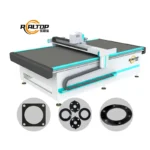
Customized cutting configuration — Tool head stroke, blade type and vacuum zoning are matched to your specific gasket compound and sheet thickness before quotation, rather than forcing a generic setup across all sealing applications.
Technical Specifications
| Parameter | Value |
|---|---|
| Model | RT-D2516/RT-S2516 |
| Product Type | CNC Oscillating Knife Cutting Machine |
| Working Area | 1600×2500 mm |
| Machine Size (L×W×H) | 3450×2300×1250 mm |
| Rated Power | 9 kW |
| Voltage | 380V±10% (frequency to be confirmed: 50/60 Hz) |
| Fixed Model | Flat working table (conveyor belt option available) |
| Multifunctional Tool Head | Swiss imported knife with vibration full cutting, vibration half cutting and cursor location; optional heads: pneumatic knife, high-power vibrating knife, circular knife, V cutting knife, drag knife, creasing wheel, dotted line knife, punching, brush |
| Visual Positioning | Small CCD camera mark point positioning, panoramic camera recognition positioning, projection positioning |
| Cutting Thickness | 20 mm–80 mm (basis material and density to be confirmed) |
| Translational Velocity | 800–1200 mm/s |
| Repeatability | ≤0.1 mm |
| Transmission System | Imported digital servo motor (Delta or Panasonic optional, IP67), linear guide, synchronous belt, ball screw; Taiwan Hiwin rail |
| Vacuum Table | Magnesium-aluminum alloy with PVDF powder spraying, anodic oxidation and hard oxidation treatment; 7.5 kW vacuum pump with aviation aluminum shell and built-in silencer sponge |
| Safety Device | Infrared sensor stop function, anti-collision on both sides of beam, emergency stop button with in-situ resume |
| Instruction System | HP-GL compatible format |
| Control Language Options | English, Russian, Italian, Chinese (special languages customizable) |
| Standards | CE |
Application Suitability
| Application | Material or Output |
|---|---|
| Industrial gasket and sealing pad cutting | PTFE, rubber, silicone, fiber-reinforced composite sheets, ETFE |
| Automotive interior sealing components | PU, EVA, XPE, PE, PP foam and composite layers |
| Packaging and carton sample making | Corrugated cardboard, sticker, film, soft board |
| Footwear and luggage production | Leather, PU, EVA, sponge, textile layers (multi-ply or single-ply) |
| Graphic advertising and printing | Vinyl, PVC, banner, printable magnetic sheet |
Why Generic Thickness Ratings Fail on Fiber-Reinforced Gaskets
A cutting depth figure without a material basis is a guess, not a specification.
When buyers size a machine on working area alone, they often discover the knife cannot cleanly shear through fiber-reinforced PTFE or that the vacuum zoning leaves small gasket shapes lifting at production speed. I have watched 3mm pure-rubber settings shred when the actual stock turned out to be glass-fiber reinforced. The CNC oscillating knife cutting machine for gasket material must be configured against the specific compound, density and reinforcement type, not a generic thickness chart [NEED_CITE: material hardness and reinforcement effect on blade wear].
Matching the Oscillating Stroke to Gasket Density
The Swiss-imported oscillating knife head supports both full-cut and half-cut modes, allowing the stroke length and frequency to be dialed in for the exact gasket compound. Pure silicone requires a different blade excursion than glass-fiber filled PTFE, and the wrong stroke produces delaminated edges or crushed core layers. This CNC oscillating knife cutting machine for gasket material can also mount a drag knife, punching tool and creasing wheel on the same carriage, so a single pass can contour-cut the gasket profile and punch bolt holes without repositioning the sheet.
Vacuum Zoning for Low-Mass Sealing Components
Small gasket shapes are prone to edge lift because they do not cover enough table area to create suction. The magnesium-aluminum alloy table is divided into controllable zones, and the 7.5 kW vacuum pump maintains consistent suction across active zones while unused zones remain closed. The PVDF powder-sprayed and hard-anodized surface prevents the porous rubber or composite stock from sticking to the table during part removal [NEED_CITE: vacuum zoning requirements for small part fixation on flatbed cutters].
How Frame Rigidity and Drive Components Affect Repeatability
The thick-walled seamless-steel welded frame undergoes high-temperature tempering and CNC-machined finishing, keeping the bed flat within tight tolerances across the full 1600×2500 mm surface. Taiwan Hiwin linear rails and imported IP67-rated digital servo motors (Delta or Panasonic) work together to deliver ≤0.1 mm repeatability. When cutting nested gasket patterns with bolt-hole arrays, this level of positional accuracy prevents cumulative drift that would cause mismatched flange alignments down the assembly line.
The Hidden Cost of Wrong Tool Head Selection
Specifying a machine on working area without locking the tool head configuration often means the oscillating knife is the only tool on the carriage. Gaskets requiring a mix of contour cuts, internal punches and crease lines then demand manual secondary operations. Ragged edges on fiber-reinforced PTFE compromise the seal face, leading to field leakage claims. Blade life on incorrectly specified stock can drop to a fraction of expected runs, inflating consumable costs and creating unplanned downtime for blade changes [NEED_CITE: secondary operations cost in gasket fabrication].
Why Procurement Works Better from a Knife-and-Laser House
Realtop builds both knife and laser platforms in-house, so the cutting method is selected by material behavior rather than by which machine happens to be on the showroom floor. For PTFE and fiber-reinforced rubber, oscillating knife is the correct process; for thin polyester gaskets, laser edge-sealing might be preferred. The design team specifies tool head stroke, blade type, punching diameter and vacuum zone map per material stack. Sample cutting is performed on the buyer’s own stock, generating a report that documents edge quality, cutting depth and cycle time before the order is confirmed [NEED_CITE: material-specific cutting method selection criteria].
Documentation & Verification
- Machine specification sheet listing the confirmed tool head and vacuum zone configuration for your gasket compound
- Electrical schematic with voltage, frequency and plug type locked to your local supply standard
- Sample cutting report on your own PTFE, rubber or composite stock showing edge photos and dimensional accuracy
- Software licence and file format compatibility note covering DXF, PLT, AI and PDF import verification
- Spare parts list with consumable blade SKUs matched to the specific knife and punching tools supplied
Installation, Commissioning & Support
- Foundation requires a level concrete slab accommodating the 3450×2300 mm machine footprint and 7.5 kW vacuum pump placement
- Dedicated 380V±10% circuit with confirmed frequency (50/60 Hz) and correct plug type installed before delivery
- Machine arrives fully assembled; commissioning includes vacuum zone mapping verification and servo axis calibration across the 1600×2500 mm bed
- On-site training covers CCD mark-point setup, tool head changeover and nesting workflow for your gasket files
- Consumable blade and punching tool inventory reviewed against your daily cutting volume to set reorder intervals
- Maintenance schedule aligned with Hiwin rail lubrication, vacuum pump filter checks and belt tension inspection
What We Need to Quote Accurately
Share your gasket compound type, reinforcement content, sheet thickness and daily cutting volume so the correct tool head and vacuum zoning can be specified. Confirm your workshop voltage, frequency and preferred control language to avoid on-site electrical mismatches. If your gasket artwork includes printed registration marks, send a sample file so CCD tracking can be validated against your actual production format before shipment.
Frequently Asked Questions
Q: How is the 20–80 mm cutting thickness figure verified for my gasket material?
A: The range is a general envelope; actual cutting depth depends on compound density, reinforcement type and single versus multi-ply layup. We run sample cuts on your specific stock to confirm achievable depth, edge quality and cycle time before finalizing the tool head configuration.
Q: Which tool heads are specified for PTFE versus fiber-reinforced rubber?
A: Pure PTFE typically uses a high-frequency oscillating knife with a specific blade geometry, while fiber-reinforced rubber often requires a higher-torque oscillating head and may add a punching tool for bolt holes. The exact combination is documented in the configuration list against your material sample.
Q: Does the CCD system track printed marks on my actual gasket artwork?
A: Yes, after we receive your sample printed sheet or artwork file. We test mark-point detection and panoramic recognition at the target production speed, confirming registration accuracy on your specific layout before the machine is configured for your file format workflow.
Q: How are vacuum zones configured for small gasket parts?
A: Zones are mapped to match your nesting pattern so suction concentrates under active cut areas. The configuration can be reprogrammed per job through the control software, ensuring low-mass gasket shapes remain flat without edge lift during high-speed traversal.
Q: What documentation ships with the machine?
A: You receive the machine specification sheet, electrical schematic, tool head and table configuration list, sample cutting report, CE declaration, operation manual, software licence, file format compatibility note and spare parts list with consumable blade SKUs.


![[result]CNC Oscillating Knife Cutting Machine for PTFE Rubber Gasket – Manufacturer[/result]](https://rtcnccut.com/wp-content/uploads/2026/03/H90d5cba740804c57a9ccb479dc63392bj-600x600.webp)
商品评价
Clear filtersThere are no reviews yet.