




Fast Shipping
Carrier information

20k products
Payment methods

24/7 Support
Unlimited help desk

2-day Delivery
Track or off orders
Configured per material stack — the oscillating knife head and vacuum zoning are matched to your declared leather, foam or fabric thickness before the order is locked, not forced from a default build.
Technical Specifications
| Parameter | Value |
|---|---|
| Model | RT-D2516/RT-S2516 |
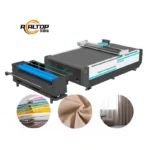
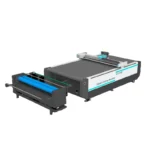
| Product Type | CNC Oscillating Knife Cutting Machine |
| Working Area | 1600×2500mm |
| Machine Size | 3450×2300×1250mm |
| Rated Power | 9kW |
| Table Type | Flat working table with vacuum suction |
| Tool Head | Swiss imported multifunctional head (vibration full cut, half cut, cursor location) |
| Safety Device | Infrared sensors |
| Translational Velocity | 800–1200mm/s |
| Cutting Thickness | ≤50mm (basis not stated in source) |
| Compatible Materials | Leather, clothing flexible materials, sponge composite leather, PVC, soft glass, silicon, rubber |
| Repeated Accuracy | ≤0.1mm |
| Transmission System | Digital servo motor, linear guide, synchronous belt, ball screw |
| Instruction System | HP-GL compatible format |
| Voltage | 380V±10% |
| Key Configuration | Delta servo motor, Germany imported conveyor belt, Taiwan Hiwin rail, 7.5kW vacuum pump |
| Standards | CE |
Application Suitability
| Application | Material or Output |
|---|---|
| Garment and footwear cutting | Single- and multi-layer woven fabric, technical textile, lining material |
| Leather goods and accessories | Cowhide, synthetic leather, PU and PVC sheet for bags and belts |
| Automotive interior trimming | Sponge composite leather, headliner fabric, door panel vinyl |
| Gasket and seal production | Rubber sheet, silicon, soft glass, foam composite for industrial seals |
Why "Cutting Thickness ≤50mm" Needs a Closer Look Before You Sign
Stack height is not a universal constant — it changes with every material and blade stroke combination.
I have seen buyers take a headline cutting depth figure and run their full production schedule against it, only to find that a dense leather stack compresses under the knife and leaves the bottom ply half-cut. The 50mm ceiling on the RT-D2516/RT-S2516 is a mechanical clearance figure, and the actual clean-cut depth depends on whether you are running a single hide of garment leather or a laminated foam composite [NEED_CITE: cutting depth verification for flexible sheet materials]. This CNC Oscillating Knife Cutting Machine specifications sheet is the starting point, not the final word. The only way to confirm your usable depth is a trial on your actual material stack, measured and recorded before the purchase order is issued.
Matching the Swiss Head to Your Specific Ply Stack
The Swiss imported multifunctional head on the RT-D2516/RT-S2516 supports vibration full cutting, half cutting and cursor location in one holder. Full cut handles through-cutting of leather and dense composite boards, while half cut scores kiss-cut patterns on adhesive-backed vinyl without penetrating the release liner. Cursor location reads printed registration marks on pre-printed hides, allowing the knife path to shift and follow the actual print rather than a fixed coordinate grid.
Vacuum Zoning and Small-Part Hold-Down
A 7.5kW vacuum pump pulls suction through the flat working table, but suction only works if the part covers enough surface area to create a seal. For small gasket blanks or narrow garment pattern pieces, the felt overlay must be dense enough to bridge gaps and maintain negative pressure underneath. The Germany imported conveyor belt surface on the RT-D2516/RT-S2516 is specified for continuous feeding cycles, and its permeability rating directly affects how well small cut parts stay flat during the final passes [NEED_CITE: vacuum hold-down requirements for small flexible parts].
Reading the Drive Train for Repeatability
The ≤0.1mm repeated accuracy figure rests on the combination of Delta digital servo motors, Taiwan Hiwin linear rails and synchronous belt transmission. In practice, repeatability on a 1600×2500mm bed depends on thermal stability during long shifts — the ball screw drive on the Z-axis maintains position under the vibration load of the oscillating head, while the linear guides on X and Y resist lateral deflection when the knife meets a dense leather seam. HP-GL instruction compatibility means the controller accepts nesting output from most mainstream CAD systems without a proprietary translator layer.
What Happens When the Head and Material Are Mismatched
Selecting an oscillating stroke that is too aggressive for a thin silicone sheet tears the top surface before the blade completes the pass, leaving a ragged edge that fails visual inspection. The wrong blade angle on sponge composite leather crushes the foam core instead of shearing it, and the crushed zone shows as a visible line on the finished automotive seat panel. These failures are not machine defects — they are configuration errors that surface only during production [NEED_CITE: oscillating knife selection for composite flexible materials]. Running a sample on your exact material stack before the order is confirmed removes the guesswork.
Why Procurement Teams Source This Build
The in-house design team covers both knife and laser cutting platforms, so the recommendation is driven by your material rather than by which machine needs to ship this month. Every RT-D2516/RT-S2516 leaves the factory with a tool head and table configuration list tied to your declared material, not a generic default. Electrical schematics and voltage confirmation are signed off before the control cabinet is wired, eliminating on-site transformer surprises. Sample cutting on your own leather, foam or fabric is recorded in a written report and shipped with the machine. Software file format compatibility — HP-GL and your nesting workflow — is verified during the factory test, not discovered at commissioning.
Documentation & Verification
- Factory test record cut on your specific leather or fabric stack before dispatch
- Electrical schematic confirming 380V±10% wiring and plug type for your facility
- Tool head and blade stroke configuration list matched to your declared material
- HP-GL and nesting file format compatibility note signed at order stage
- Sample cutting report showing edge quality on your material at production speed
- CE declaration documentation package for customs and local compliance
Installation, Commissioning & Support
- 3450×2300mm footprint requires level concrete slab with anchor bolt provisions
- 9kW rated power needs a dedicated 380V three-phase circuit with earth bonding
- Machine ships with table and gantry separated — reassembly requires overhead clearance
- First-power commissioning includes servo tuning and vacuum pump pressure verification
- Operator training covers HP-GL file import, tool offset setting and blade change procedure
- Spare parts list includes Swiss knife blades, felt overlay and vacuum pump consumables
What to Share When You Request a Quote
Send the exact material type, ply count and measured thickness of your production stack, along with your daily cutting volume and the largest single piece dimension you run. Include your workshop voltage and frequency, the control language your operators need, and a sample file in your standard nesting format so we can confirm software compatibility before the machine enters the build queue.
Frequently Asked Questions
Q: How is cutting thickness verified for my material before I commit?
A: We cut a sample stack of your actual material at your production thickness, measure edge quality and ply separation, and issue a written report. The ≤50mm figure is mechanical clearance — your usable depth depends on material density and blade stroke, confirmed only by physical trial.
Q: Can the vacuum table hold small gasket pieces without lift?
A: The 7.5kW pump and high-density felt overlay maintain suction on parts that cover enough table area. For very narrow blanks, we review your nesting layout and adjust felt permeability or add a sacrificial overlay to prevent lift during the final cut passes.
Q: How do I choose between oscillating knife and drag knife for my material?
A: Oscillating knife suits dense, thick or laminated stacks like sponge composite leather where a vibrating stroke shears cleanly. Drag knife is for thin vinyl and single-ply fabric. We specify the head based on your sample material, not a default setting.
Q: Is the machine ready for CCD contour recognition on printed leather?
A: The cursor location function on the Swiss multifunctional head reads printed registration marks. We confirm mark size, contrast and scan speed against your actual printed hide during the sample test to ensure reliable tracking at production feed rates.


商品评价
Clear filtersThere are no reviews yet.