





Fast Shipping
Carrier information

20k products
Payment methods

24/7 Support
Unlimited help desk

2-day Delivery
Track or off orders
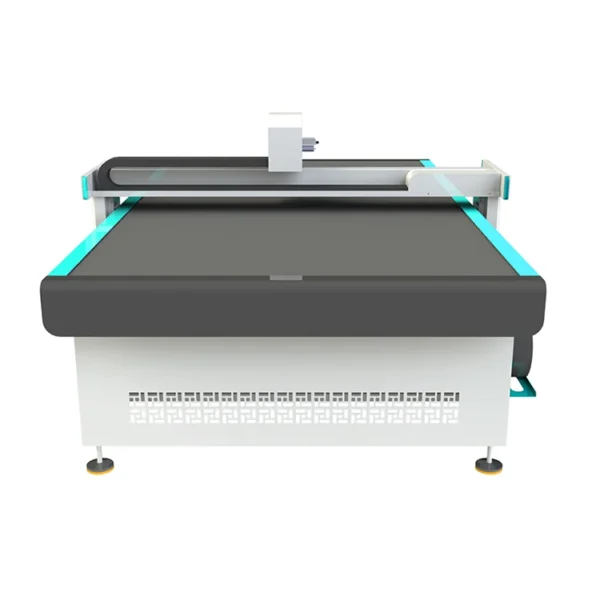
RT-D2516/RT-S2516 Composite Oscillating Vibrating Knife Cutter | Technical Guide
Oscillating knife and laser cutting under one roof — The RT-D2516/RT-S2516 is built on a platform where the cutting method is matched to the composite material rather than forced into a single process.
Technical Specifications
| Parameter | Value |
|---|---|
| Model | RT-D2516 / RT-S2516 |
| Product Type | CNC Oscillating Knife Cutting Machine |
| Working Area | 1600 × 2500 mm |
| Machine Size | 3450 × 2300 × 1250 mm |
| Rated Power | 9 kW |
| Servo Motor | Japanese Yaskawa digital servo |
| Linear Guide | Taiwan Hiwin rail |
| Transmission System | Digital servo motor, linear guide, synchronous belt, imported ball screw |
| Repeated Accuracy | ≤0.1 mm |
| Translational Velocity | 800–1200 mm/s |
| Cutting Speed | 200–800 mm/s (basis not stated in source — depends on material, layer count and thickness) |
| Multifunctional Head | Swiss imported knife with vibration full cutting, vibration half cutting and cursor location |
| Safety Device | Infrared sensors |
| Vacuum Pump | 7.5 kW |
| Table Type | Vacuum table with Germany imported conveyor belt |
| Feeding System | Auto feeding |
| Fixed Model | Flat working table |
| Instruction System | HP-GL compatible format |
| Voltage | 380V ±10% |
| Cutting Materials | Leather, flexible garment materials, sponge composite leather, PVC, soft glass, silicon, rubber |
| Standards | CE declaration where applicable |
Application Suitability
| Application | Material or Output |
|---|---|
| Multi-layer composite fabrication | Fiberglass, carbon fiber prepreg and layered technical textiles |
| Automotive interior and gasket production | Sponge composite leather, EPDM rubber and silicon sheets |
| Flexible packaging and sealing components | PVC, soft glass and silicon gasket stock |
| Leather goods and footwear | Natural and synthetic leather, flexible garment materials |
| Industrial rubber and silicon parts | Rubber sheets, silicon pads and composite foam panels |
Why "Cutting Thickness" Means Nothing Without the Material Name
CNC oscillating knife cutting machine specifications only matter when tied to the exact composite you are running. A number on a spec sheet means little if the material type, layer count and density behind it remain undefined. I have watched buyers compare cutting speed figures across quotations without ever confirming whether those figures were measured on the same material stack. The result is a machine that performs well in the factory test but struggles on the production floor when the actual composite layup arrives. Oscillating knife behaviour on a three-layer fiberglass stack is completely different from its behaviour on a single sheet of sponge composite leather, and no single cutting speed value captures both [NEED_CITE: oscillating knife cutting behaviour across composite material types].
Swiss Tool Head Configuration for Composite Layups
The Swiss imported oscillating knife on the RT-D2516/RT-S2516 delivers full cutting, half cutting and cursor location in a single head. For composite fabricators running multi-layer stacks, full cutting mode drives the blade through the entire layup in one pass, while half cutting is used for kiss-cut applications where only the top layers are scored. Cursor location supports manual alignment when printed registration marks are absent. The oscillating action reduces lateral drag on fibrous materials, which keeps the edges of fiberglass and carbon fiber prepreg from fraying during high-speed traverses.
Vacuum Hold-Down and Material Stability on Thin Composites
The 7.5 kW vacuum pump paired with the Germany imported conveyor belt is designed to hold flexible and semi-rigid composites flat during the cut. On multi-layer materials such as stacked fiberglass or sponge composite leather, vacuum pressure must be distributed across the table to prevent the bottom layers from shifting mid-cut. Auto feeding allows continuous roll or sheet stock to advance without manual repositioning, which matters when daily volume requires uninterrupted production runs. This CNC oscillating knife cutting machine configuration addresses the common problem of small parts lifting off the table when vacuum zoning is insufficient for the geometry being cut [NEED_CITE: vacuum table zoning requirements for small composite part geometry].
Reading the Specs That Actually Affect Your Cut Quality
Repeated accuracy of ≤0.1 mm is achieved through the combination of Japanese Yaskawa digital servo motors and Taiwan Hiwin linear guide rails. In composite cutting, this level of repeatability determines whether nested parts stay within tolerance across an entire sheet, which directly affects material yield when cutting expensive prepreg or technical textiles. The translational velocity range of 800–1200 mm/s governs how fast the head moves between cuts, while the actual cutting speed of 200–800 mm/s governs blade engagement with the material — these two figures should never be confused when evaluating throughput. The HP-GL compatible instruction system allows integration with common nesting software, so buyers can confirm file format compatibility with their existing workflow before the order is placed. The imported ball screw in the transmission system maintains positional accuracy over long production runs, which matters on the 1600 × 2500 mm working area where cumulative drift could otherwise push parts out of tolerance at the far end of the table.
The Cost of Specifying on Working Area Alone
Choosing a machine based only on table size is one of the most common mistakes in composite cutting procurement. A buyer working with multi-layer fiberglass may find that the standard vacuum configuration cannot hold the bottom layers in place, causing the material to shift and the entire batch to be scrapped. Wrong tool head selection produces ragged edges on fibrous composites or crushes foam cores instead of slicing cleanly through them. These problems rarely surface during the factory test because the test is often run on a single layer of convenient material rather than the buyer’s actual production stack [NEED_CITE: composite cutting defects caused by incorrect tool head and vacuum specification].
What Building Both Knife and Laser Platforms Changes for You
Realtop designs and produces both oscillating knife and laser cutting systems in-house, which means the RT-D2516/RT-S2516 is recommended based on your material rather than on what happens to be in stock. The tool head and table configuration is specified per composite type and production volume, not selected from a fixed catalogue page. Software compatibility is confirmed before the order is placed, so your existing HP-GL nesting workflow is validated against the machine’s instruction system. Voltage, control language and plug type are customised to the destination market before shipment rather than treated as an afterthought. Every machine can be tested on the buyer’s own composite material before commitment, producing a sample cutting report that documents edge quality, layer separation and dimensional accuracy under real conditions.
Documentation & Verification
- Machine specification sheet listing every configured parameter for the RT-D2516/RT-S2516
- Electrical schematic with voltage and frequency confirmed for your facility
- Tool head and vacuum table configuration list matched to your composite material
- Sample cutting report run on your own composite layup before dispatch
- Factory test record documenting accuracy and edge quality on your material
- Software licence and HP-GL file format compatibility confirmation note
Installation, Commissioning & Support
- Foundation must support 3450 × 2300 mm footprint with level tolerance for the flat working table
- Dedicated 380V ±10% circuit required to supply the 9 kW rated power and 7.5 kW vacuum pump
- Machine ships with conveyor belt and vacuum table pre-assembled; servo and guide rails calibrated on site
- First-run commissioning includes oscillating knife depth setting for your specific composite thickness
- Operator training covers HP-GL file import, nesting workflow and auto feeding system operation
- Spare parts list includes Swiss knife blades, conveyor belt sections and infrared sensor units
Preparing Your Inquiry
To receive an accurate configuration for the RT-D2516/RT-S2516, share your composite material type, layer count and individual layer thickness. Include your daily cutting volume and the largest sheet dimension you need to process. Confirm your local voltage and frequency, the control language your operators require, and whether your nesting software outputs in HP-GL format so that file compatibility can be verified before the quotation is issued.
Frequently Asked Questions
Q: How is cutting thickness verified for my specific composite material and layer count?
A: We run a sample cut on your actual composite layup before you commit. The sample cutting report documents edge quality, dimensional accuracy and whether the standard oscillating knife speed range handles your material stack. This eliminates the risk of discovering cutting capacity limits only after the machine arrives at your facility.
Q: Which tool head configuration matches my composite — oscillating knife or drag knife?
A: Oscillating knife suits fibrous and multi-layer composites where the vibrating action prevents fraying. Drag knife works on thinner, homogeneous sheets. We specify the tool head based on your material sample test rather than a generic recommendation, and the Swiss imported head on the RT-D2516/RT-S2516 supports both full and half cutting modes.
Q: Can the vacuum table handle small composite parts without lifting during the cut?
A: The 7.5 kW vacuum pump with Germany imported conveyor belt provides strong hold-down, but small part geometry may require customised vacuum zoning. We evaluate your part nesting layout during the specification phase and adjust table zoning if your part mix includes pieces too small for standard zone coverage.
Q: What file formats work with my existing nesting software?
A: The instruction system accepts HP-GL compatible format. Before your order is confirmed, we verify that your nesting software output integrates with the machine controller and provide a written file format compatibility note as part of the documentation package.
Q: Is CCD camera contour recognition available for printed marks on composite materials?
A: CCD camera positioning is available as a configuration option for printed contour work on composites. If your production requires tracking printed registration marks at speed, this should be specified during the inquiry stage so the camera system is integrated and tested before shipment.


商品评价
Clear filtersThere are no reviews yet.