




Fast Shipping
Carrier information

20k products
Payment methods

24/7 Support
Unlimited help desk

2-day Delivery
Track or off orders
Precision tool head selection — cutting depth and edge quality are verified on your actual gasket material before the machine configuration is locked, preventing the mismatch between quoted capacity and real production performance.
Technical Specifications
| Parameter | Value |
|---|---|
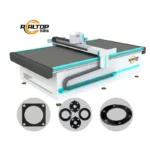
| Product Type | CNC Oscillating Knife Cutting Machine |
| Working Area | 1600×2500 mm |
| Overall Dimensions | 3450×2300×1250 mm |
| Rated Power | 9 kW |
| Voltage | 380V±10% |
| Tool Head | Swiss imported oscillating knife (vibration full cutting, vibration half cutting, cursor location) |
| Translational Velocity | 800–1200 mm/s |
| Cutting Thickness | 20–80 mm (basis not stated in source — confirm material type and format) |
| Repeatability | ≤0.1 mm |
| Transmission System | Digital servo motor, linear guide, synchronous belt, ball screw |
| Servo Motor Brand | Delta (Panasonic optional) |
| Vacuum Pump | 7.5 kW, aviation aluminum shell with built-in silencer sponge |
| Working Table | Magnesium-aluminum alloy vacuum adsorption table (fluorocarbon PVDF powder spraying, anodic oxidation, hard oxidation) |
| Safety Device | Infrared induction blocking, anti-collision sensors on beam sides, emergency stop button |
| Control Language Options | English, Russian, Italian, Chinese (special languages customizable) |
| Instruction System | HP-GL compatible format |
Application Suitability
| Application | Material or Output |
|---|---|
| Gasket and sealing pad cutting | Rubber, silicone, PTFE, ETFE, PP, PE sheet stock |
| Automotive sealing components | Composite foam, sponge, EVA, XPE, PU materials |
| Industrial gasket fabrication | Fiber-reinforced composite sheets, PTFE, graphite-filled materials |
| Non-metal contour cutting | PVC, soft glass, film, sticker and corrugated cardboard |
Why Material Thickness Alone Does Not Define Cutting Capacity
The oscillating knife must match both the density and the shore hardness of your gasket compound, not just the millimeter reading on the spec sheet.
A rubber compound rated at 80 Shore A behaves completely differently under a vibrating blade than a 30 Shore A silicone foam of the same thickness. When buyers specify a machine based only on working area and quoted cutting depth, they often discover during installation that the standard tool head produces ragged edges on hard fluorine rubber or crushes soft silicone instead of shearing it cleanly [NEED_CITE: material shore hardness impact on oscillating knife selection]. The CNC oscillating knife gasket cutting machine specifications must therefore be read alongside the actual material sample, not treated as a universal guarantee. This gap between the quoted thickness range and real cutting performance is where most field commissioning delays originate.
Oscillating Knife Frequency and Gasket Edge Quality
The Swiss imported oscillating knife on this CNC oscillating knife gasket cutting machine operates with high-frequency vibration that shears through elastomeric and composite sealing materials rather than dragging through them. Full-cut mode handles solid rubber and PTFE sheets where the blade must penetrate the entire thickness in a single pass, while half-cut mode supports kiss-cut applications on pre-laminated gasket stock. The cursor location function allows the system to register reference points for multi-pass contour work, which matters when cutting complex flange profiles with tight internal radii.
Vacuum Table Zoning for Small Sealing Parts
Small gasket profiles and O-ring shapes tend to lift at the edges during high-speed knife traversal, especially when the vacuum pull is distributed across the entire table surface. The magnesium-aluminum alloy table on this system uses a zoned adsorption layout with PVDF fluorocarbon coating and hard oxidation treatment, so suction concentrates only beneath the active cutting area. The 7.5 kW vacuum pump with built-in silencer sponge maintains consistent hold-down without the noise level typical of open-port blower systems [NEED_CITE: vacuum zoning requirements for small-part CNC cutting]. This prevents the material shift that causes dimensional drift on thin-walled gasket profiles.
Translational Velocity, Servo Drive and Profile Accuracy
The 800–1200 mm/s translational velocity range is driven by a Delta digital servo motor (Panasonic available as an option) running on linear guides and ball screws. For intricate gasket geometries — such as multi-lobe flange seals or automotive exhaust manifold gaskets with closely spaced bolt holes — the servo response directly affects corner accuracy. A repeatability of ≤0.1 mm means that nested gasket arrays cut in sequence hold their positional tolerance, which matters when the finished parts must align with machined metal flanges in assembly. The synchronous belt and linear guide combination keeps beam deflection within tolerance across the full 1600×2500 mm working area.
The Cost of Skipping Material-Specific Tool Head Verification
When the tool head is selected based on material category alone rather than a physical sample cut, the consequences surface after the machine arrives. Hard composite gasket materials with fiber reinforcement can dull a standard oscillating blade within hours, while soft silicone can fold ahead of the knife edge and produce a rolled burr that fails the sealing face inspection [NEED_CITE: tooling wear rates on fiber-reinforced gasket materials]. Buyers who did not send actual production stock for pre-order sample cutting often spend days on-site adjusting blade amplitude, feed rate and vacuum pressure to compensate for a configuration that was never matched to their material in the first place.
Why This Build Approach Fits Gasket Production
The in-house design and production team covers oscillating knife technology in depth, so the tool head and table configuration are specified per gasket material type and daily cutting volume rather than offered as a fixed package. Sample cutting on your own rubber, silicone or PTFE stock is completed before the order is confirmed, giving you a physical cut report to evaluate edge quality and dimensional accuracy. Electrical schematics and voltage are verified against your site supply before the machine enters assembly. Software compatibility with HP-GL format is checked against your existing nesting workflow, and control language is set to match your operators. Optional CCD camera positioning — available in small mark point or panoramic configuration — extends the system to pre-printed gasket sheets where contour tracking is required.
Documentation & Verification
- Machine specification sheet listing confirmed tool head and vacuum table configuration for your gasket stock
- Electrical schematic with voltage confirmation matched to your site supply before production
- Sample cutting report produced on your actual rubber, silicone or composite sealing material
- Factory test record documenting repeatability and cutting edge quality before dispatch
- Operation and maintenance manual with spare parts list and recommended blade replacement intervals
Installation, Commissioning & Support
- 9 kW rated power requires a dedicated 380V±10% circuit with appropriate breaker rating at your facility
- Overall dimensions of 3450×2300×1250 mm and fully assembled delivery require verified doorway and floor space clearance
- Magnesium-aluminum vacuum table leveling and 7.5 kW pump commissioning performed during first startup on site
- Servo drive calibration and Delta or Panasonic motor parameters tuned to your gasket material feed rate
- Operator training covers HP-GL file import, tool head changeover and vacuum zone selection for nested parts
- Infrared safety blocking and beam anti-collision sensor function verified before production handover
What to Prepare Before Requesting a Quote
Send the exact gasket material type, compound name, shore hardness and sheet thickness you run in daily production. Specify your largest gasket profile dimensions and typical nesting quantity per sheet, along with the voltage and frequency available at your workshop. If you work with pre-printed gasket stock or require contour recognition, indicate the mark type and print registration method so the appropriate CCD configuration can be included in the evaluation.
Frequently Asked Questions
Q: How is cutting thickness verified for my specific gasket material and what is the maximum achievable depth?
A: The 20–80 mm thickness range listed in the CNC oscillating knife gasket cutting machine specifications is a general reference that varies by material density and shore hardness. Your actual gasket compound is sample-cut before order confirmation, and the resulting cut report documents achievable depth, edge quality and recommended blade amplitude. This prevents a situation where the machine is rated for a thickness your specific rubber compound cannot support at production speed.
Q: Which tool head is recommended for rubber versus PTFE versus fiber composite gasket stock?
A: The Swiss imported oscillating knife handles most rubber, silicone and PTFE profiles in full-cut mode, while fiber-reinforced composites may require adjusted amplitude and blade geometry to manage fiber pull-out at the cut edge. Optional drag knife and V-cutting knife heads are available for specific gasket geometries. The correct head is selected based on your sample material test, not on generic material category charts.
Q: How is vacuum table zoning configured for small gasket parts that tend to lift during cutting?
A: The magnesium-aluminum alloy table uses a zoned vacuum adsorption layout with PVDF fluorocarbon coating, so suction concentrates beneath the active cutting zone rather than spreading across the entire surface. This targeted hold-down prevents thin-walled O-rings and small flange gaskets from lifting at high translational velocity, maintaining the ≤0.1 mm repeatability across nested arrays.
Q: What voltage, plug type and control language are confirmed before shipment?
A: The standard electrical specification is 380V±10% with configurable control language options including English, Russian, Italian and Chinese, plus special languages on request. Your site voltage, frequency, plug type and operator language preference are confirmed against the electrical schematic before the machine enters final assembly, ensuring the unit arrives ready for connection without field rewiring.
Q: Can I send my gasket material for sample cutting before committing to the order?
A: Yes. Sending your actual rubber, silicone, PTFE or composite sealing stock for sample cutting is standard procedure before any order is finalized. The sample cutting report documents the tool head used, cutting parameters, edge quality and dimensional accuracy achieved on your specific material, giving you a physical basis for evaluating machine fit before production commitment.


商品评价
Clear filtersThere are no reviews yet.