




Fast Shipping
Carrier information

20k products
Payment methods

24/7 Support
Unlimited help desk

2-day Delivery
Track or off orders
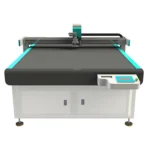
Tool Head Configuration Matched to Material — Each flute and honeycomb grade gets its own oscillating or drag knife setup verified on buyer stock before shipment.
Technical Specifications
| Parameter | Value |
|---|---|
| Model | RT-D2516/RT-S2516 |
| Working Area | 1600 × 2500 mm |
| Machine Size | 3450 × 2300 × 1250 mm |
| Rated Power | 9 kW |
| Working Table | Flat aluminum alloy honeycomb platform with auto-following area adsorption |
| Tool Head | Swiss imported knife with vibration full cutting, vibration half cutting and cursor location |
| Safety Device | Infrared sensors |
| Translational Velocity | 800–2000 mm/s |
| Cutting Thickness Range | Configured per corrugated flute and honeycomb cell size (sample verification required) |
| Repeated Accuracy | ≤0.1 mm |
| Transmission System | Digital servo motor, linear guide, synchronous belt, ball screw |
| Instruction System | HP-GL compatible format |
| Voltage | 380V ±10% |
| Servo Motor | Delta |
| Vacuum Pump | 7.5 kW |
| Vacuum Table | Aluminum alloy honeycomb structure with zoned adsorption |
| Linear Rail | Taiwan Hiwin |
| Conveyor Belt | Germany imported |
| Software | Professional carton nesting software (free, multi-format import, language customization) |
Application Suitability
| Application | Material or Output |
|---|---|
| Carton sample and short-run production | Single, double and triple-wall corrugated board |
| Honeycomb board packaging | Paper honeycomb panels for protective and structural packaging |
| V-grooving and creasing in one setup | Corrugated flute and honeycomb cell board for folding carton structures |
| Sticker and tag die-cutting | Self-adhesive vinyl, coated paper and label stock with printed contours |
| Billboard and display production | Corrugated plastic and lightweight foam board for point-of-sale displays |
| Large electrical and express packaging | Heavy-duty corrugated and honeycomb board for appliance and logistics cartons |
| High-end gift box packaging | Multi-layer flute board and specialty coated cardboard |
Why Working Area Alone Does Not Guarantee a Clean Cut on Corrugated Board
A flatbed sized for sheet dimensions does not automatically handle the flute profile or honeycomb cell density you run every day.
I once walked into a packaging plant where a freshly installed digital cutter sat idle because the oscillating knife could not push through a double-wall flute the buyer ran most often. The machine area fit the sheet perfectly, but the tool head and vacuum zoning had been matched to a lighter grade. The buyer had to add a second pass, doubling cycle time and leaving ragged edges on the heavier board [NEED_CITE: oscillating knife cutting force requirements by corrugated flute type]. That is the gap between a spec sheet and a production-ready configuration — and it is the reason I now insist on cutting your actual material before any order is confirmed.
Knife Tooling Selection by Flute and Honeycomb Grade
The Swiss imported knife head on this CNC oscillating knife cutting machine specifications package delivers vibration full cutting, half cutting and cursor location in a single pass. For standard B and C flute corrugated board, the oscillating frequency slices cleanly through the liner and medium without crushing the flute structure. Honeycomb panels require a different blade geometry and stroke amplitude so the knife enters the cell wall without tearing the facing sheet. Drag knife modules handle thinner sticker stock and creasing wheels score fold lines without cutting through — each tool head is specified after we see the material and thickness you actually process.
Vacuum Zoning That Holds Small Carton Parts Flat
The 7.5 kW vacuum pump feeds an aluminum alloy honeycomb table with auto-following area adsorption. This means the system activates only the zones where material is present rather than pulling air across the entire bed. For short-run carton samples with many small cutouts and tabs, zoned adsorption prevents parts from lifting during the final cuts — a common failure point when the full table is active and small pieces have too little surface area to stay down [NEED_CITE: vacuum table zoning principles for digital flatbed cutters]. The conveyor belt option moves sheet stock in and out for continuous feed production, reducing manual loading time between sheets.
What the Spec Numbers Mean on the Shop Floor
The Delta servo motors paired with Taiwan Hiwin linear rails deliver repeated accuracy of ≤0.1 mm, which matters most when you are cutting interlocking tab-and-slot joints in carton structures — even a small drift across a 2500 mm travel path turns a press-fit joint into a loose flap. Translational velocity of 800–2000 mm/s is the travel range between cuts; actual cutting speed depends on flute density and board thickness, which is why we treat that figure as a travel envelope rather than a production rate. The 9 kW rated power covers the spindle drive, vacuum assist and control systems running simultaneously, and the 380V ±10% electrical specification must be confirmed against your facility supply before the control cabinet is wired [NEED_CITE: three-phase voltage tolerance standards for industrial CNC equipment]. HP-GL compatible instruction format and the included professional carton nesting software accept files from common packaging design platforms, so your existing workflow does not need a full software migration to run this table.
The Hidden Cost of Skipping Material Verification
When a machine is ordered on working area alone and the tool head is not matched to the board grade, the consequences show up as crushed flute edges on heavier stock, incomplete cuts that leave the operator tearing parts free by hand, or vacuum zones that cannot hold small sticker and tag pieces flat. Software incompatibility surfaces later — your design files will not import cleanly, nesting routines waste more board than necessary, and the operator spends hours re-drawing geometry that should have transferred automatically. These problems are fixable after delivery, but the downtime, rework and frustration cost more than a sample cut before commitment [NEED_CITE: common digital cutter configuration mismatches in packaging production].
What You Get When You Source From the Factory Floor
Both knife cutting and laser cutting technologies are designed and built under one roof, so the cutting method is chosen to fit your material rather than forcing corrugated board onto a laser or acrylic onto a knife. Tool head and table configurations are specified per material type and production volume — not pulled from a default package. CCD camera positioning for printed contour work is available and validated on your actual printed carton stock before the machine leaves the factory. Software file format compatibility is confirmed in writing before your order enters production. Voltage, plug type and control panel language are locked in during the specification stage, not left as a surprise at commissioning. Every machine is sample-tested on your own board grade, and you receive the cutting report before shipment.
Documentation & Verification
- Machine specification sheet listing confirmed tool head and table configuration for your board grade
- Electrical schematic and voltage confirmation matched to your facility three-phase supply
- Sample cutting report on your corrugated or honeycomb board at target thickness
- Factory test record documenting travel accuracy and vacuum adsorption performance
- Software licence and file format compatibility note for your packaging design workflow
- CE declaration where applicable to your export market requirements
Installation, Commissioning & Support
- 3450 × 2300 × 1250 mm machine footprint requires level concrete floor with clearance for sheet loading on both sides
- 380V ±10% three-phase dedicated circuit with 9 kW capacity and proper earthing for servo drive stability
- Table and gantry arrive partially assembled; rail alignment and vacuum hose connections completed on site
- First-run calibration includes vacuum zone mapping, tool offset setting and software file import test
- Operator training covers tool head changeover between oscillating knife, drag knife and creasing wheel
- Spare parts list includes Swiss knife blades, vacuum cups and Hiwin rail carriages with reorder references
What to Include With Your Inquiry
Send us the corrugated flute type or honeycomb cell size you run most often, along with the board thickness range and typical sheet dimensions. Let us know your daily volume expectation and whether your current design files come from ArtiosCAD, AutoCAD or another packaging platform. Tell us your facility voltage and frequency, and the language your operators need on the control interface. If you can ship a stack of your actual board stock, we will run sample cuts and send back the results with the configuration recommendation.
Frequently Asked Questions
Q: How do you confirm cutting thickness for different corrugated flute types before I order?
A: We ask you to send representative board samples or specify the exact flute profile and honeycomb cell size. Our team then runs test cuts on that material, documenting edge quality, cut-through completeness and cycle behavior. You receive a sample cutting report showing the results before any purchase commitment, so you know the tool head and stroke settings work on your actual stock.
Q: Can the CCD camera track printed marks on carton stock at full production speed?
A: CCD contour recognition is available as a configuration option and is tested on your printed material before shipment. We validate mark detection at the translational speeds your production volume requires, not just at slow calibration passes. If your print contrast or mark placement falls outside reliable detection, we flag that during the sample stage rather than after delivery.
Q: Will the vacuum table hold small carton tabs and sticker parts without lifting?
A: The aluminum honeycomb platform uses auto-following area adsorption, activating only the zones where material sits. For small parts like sticker die-cuts or carton interlocking tabs, this zoned approach maintains suction where it matters. We verify holding performance on your smallest part geometry during the sample cutting phase to confirm the zoning covers your layout.
Q: Does the nesting software work with my existing packaging design file formats?
A: The professional carton nesting software supports multiple file format imports and is compatible with HP-GL instruction output. Before your order is finalized, we confirm that your specific design files — whether from ArtiosCAD, Illustrator, DXF or another platform — import and nest correctly. A written compatibility note is included with your documentation.
Q: How are voltage, plug type and control language handled for my market?
A: The standard electrical specification is 380V ±10%, but voltage, plug configuration and control panel language are confirmed during the specification stage to match your local supply and operator requirements. We provide an electrical schematic showing the exact wiring before the control cabinet is assembled, preventing mismatches at commissioning.


商品评价
Clear filtersThere are no reviews yet.