





Fast Shipping
Carrier information

20k products
Payment methods

24/7 Support
Unlimited help desk

2-day Delivery
Track or off orders
In-house cutting design — we test every configuration on your actual fabric before the machine ships, matching tool head frequency and vacuum seal to the weave and layer count you run in production.
Technical Specifications
| Parameter | Value |
|---|---|
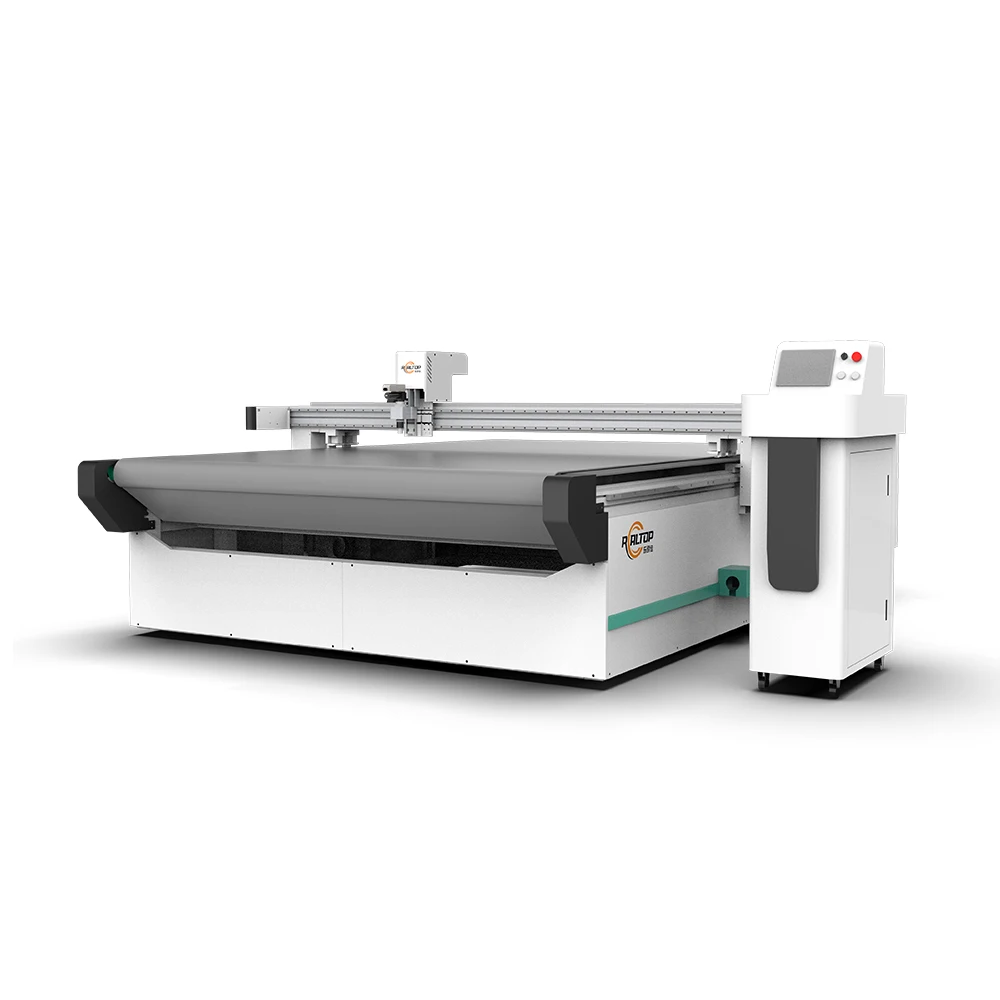
| Product Type | CNC Oscillating Knife Cutting Machine |
| Working Area | 1600×2500 mm |
| Tool Head Options | Oscillating knife, Driven rotary knife, Creasing wheel, Kiss cutting tool, Pneumatic knife, Milling tool, V groove knife |
| Cutting Thickness | ≤ 30 mm (basis not stated in source — confirm material type and layer count) |
| Cutting Speed | 0–2000 mm/s (basis not stated in source — confirm material type and thickness) |
| Cutting Accuracy | ±0.1 mm |
| Vacuum Pump | 9 kW |
| Vacuum Table | Aluminum bellows vacuum table |
| Voltage | 110V / 220V / 380V (frequency to be confirmed) |
| Control System | PLC control panel |
| Servo Motors | Panasonic, Delta, or Dorna (configure per order) |
| File Formats | PLT, DXF, AI, PDF |
| Safety Device | Infrared sensor and emergency stop |
| Machine Size | 3300×2100×1350 mm |
| Software Language | English, Russian, Italian, Chinese (custom available) |
| Certification | CE |
Application Suitability
| Application | Material or Output |
|---|---|
| Apparel manufacturing | Suits, knitwear, lace, complex pattern-matching fabrics in multi-layer stacks |
| Automotive interiors | Seat fabrics, carpets, PVC mats requiring burr-free edges |
| Home textiles | Sofa fabrics, curtains, rugs cut in multi-layer stacks with vacuum hold |
| Composite material processing | Carbon fiber prepreg, aramid, specialty technical textiles |
Why "Cutting Speed" Means Nothing Without Material Context
The rated speed on a specification sheet only applies to a specific fabric weight and layer height — outside that window, the machine either stalls or produces ragged edges.
I have watched garment factories in South Asia receive CNC oscillating knife cutting machines configured for lightweight cotton, then attempt to run multi-layer denim stacks at full speed. The blade deflects, the bottom layers shift, and the entire batch requires manual trimming. The speed figure of 0–2000 mm/s on this machine is achievable under controlled conditions, but your actual production throughput depends on fabric density, layer count, and contour complexity [NEED_CITE: cutting speed variables by textile composition].
Matching the Tool Head to the Fabric Structure
The oscillating knife handles most woven and knit textiles, but driven rotary tools cut through tightly woven synthetics with less edge distortion. Pneumatic knife heads manage thicker stacks where blade pressure must remain constant across the full cutting depth. Choosing the wrong CNC oscillating knife cutting machine tool head is one of the most common reasons buyers experience edge fraying or incomplete cuts on their first production run.
Vacuum Table Integrity Across the Cutting Area
The aluminum bellows vacuum table on this system maintains flatness within tight tolerances, and the 9 kW pump generates sufficient suction to hold lightweight knits as well as heavier upholstery textiles. However, vacuum zoning matters: when you cut small pattern pieces near the table edge, inadequate zone isolation allows air leakage that lifts the material. Confirming zone layout against your nesting pattern is a step that prevents days of troubleshooting on the factory floor [NEED_CITE: vacuum hold-down principles for flexible materials].
Reading Between the Specification Lines
The ±0.1 mm positioning accuracy relies on the servo drive system maintaining synchronization across both axes — this is where the choice between Panasonic, Delta, or Dorna servos matters for long-term repeatability. File format compatibility (PLT, DXF, AI, PDF) determines whether your existing nesting workflow transfers directly or requires intermediate conversion that introduces geometry errors. The PLC control panel with configurable language means operators in different regions can run the machine without translation delays, but this must be specified at order, not assumed at delivery.
The Cost of Skipping a Fabric Sample Test
When a buyer orders based on working area alone and the machine arrives to find the vacuum table cannot hold their specific material at the intended layer count, the result is production downtime while retrofitting suction zones or upgrading pump capacity. I once saw a multi-layer cutting installation stall for three days because the fabric’s porosity was not accounted for in the vacuum specification — the air pulled straight through the weave and the material drifted during cuts [NEED_CITE: material porosity and vacuum adhesion in textile cutting].
Why Configuration Matters More Than Catalog Pages
We build both knife and laser cutting platforms in-house, which means a buyer working with mixed materials can select the correct method rather than forcing one technology across incompatible fabrics. Every tool head and table combination is specified against the buyer’s material sample and production volume, not pulled from a standard build list. Sample cutting on the buyer’s actual fabric happens before the order is finalized, so edge quality and cutting depth are verified against real conditions. Voltage, plug type, and control language are confirmed against the destination facility’s electrical supply. Software compatibility — including nesting workflow and file format — is validated before the machine enters production.
Documentation & Verification
- Machine specification sheet listing confirmed tool head and table configuration for your material
- Electrical schematic with voltage and frequency matched to your facility supply
- Factory test record documenting cutting performance on your fabric sample at target layer count
- Software license and file format compatibility note confirming nesting workflow integration
- Operation and maintenance manual with safety procedures and consumable replacement intervals
- Spare parts list identifying wear items and recommended stock quantities
Installation, Commissioning & Support
- Floor space planning for the 3300×2100 mm footprint with clearance for material loading
- Dedicated electrical circuit matching confirmed voltage (110V, 220V, or 380V) and local frequency
- Machine arrives pre-assembled; vacuum table leveling and belt tension checked during commissioning
- First-run parameter calibration on your fabric, including blade frequency and vacuum zone adjustment
- Operator training covering nesting software, tool head changeover, and safety device testing
- Spare blade and vacuum seal inventory recommended based on your daily cutting volume
What We Need to Specify Your Machine
To configure this CNC oscillating knife cutting machine for your production, provide your fabric type, weight per square meter, maximum layer count, and daily cutting volume. Include your facility’s voltage, frequency, and plug standard, along with your preferred control language. If you use specific nesting software or file formats, share samples so we can verify compatibility before build.
Frequently Asked Questions
Q: How do I determine which tool head my fabric requires?
A: The selection depends on weave structure, weight, and layer count. Oscillating knives suit most knits and wovens, driven rotary tools handle tightly woven synthetics with minimal edge distortion, and pneumatic heads maintain consistent pressure on thick stacks. We test your material sample to confirm the correct match before order.
Q: What determines the real cutting thickness I can achieve?
A: The ≤30 mm figure varies by fabric density and stacking method. A loose knit compresses differently than a woven technical textile. We cut your sample at your intended layer count and document the result, so you know the working capacity before committing to the order.
Q: Will the vacuum table hold small pattern pieces securely?
A: Zone isolation determines this. If your nesting layout places small pieces near table edges, insufficient zoning causes air leakage and material lift. We review your pattern files to confirm the vacuum zone configuration matches your production layout.
Q: Is your nesting software compatible with my existing workflow?
A: The system accepts PLT, DXF, AI, and PDF formats, and we confirm file integrity before production. If your workflow relies on third-party nesting software, we verify export and import compatibility during the specification stage to avoid conversion errors.


商品评价
Clear filtersThere are no reviews yet.