




Fast Shipping
Carrier information

20k products
Payment methods

24/7 Support
Unlimited help desk

2-day Delivery
Track or off orders
Multi-Method Configuration — Knife versus laser matched to board grade and flute profile, with tool head selection confirmed by sample cutting on your actual corrugated stock before production begins.
Technical Specifications
| Parameter | Value |
|---|---|
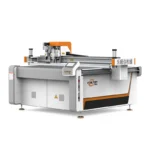
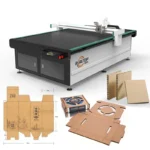
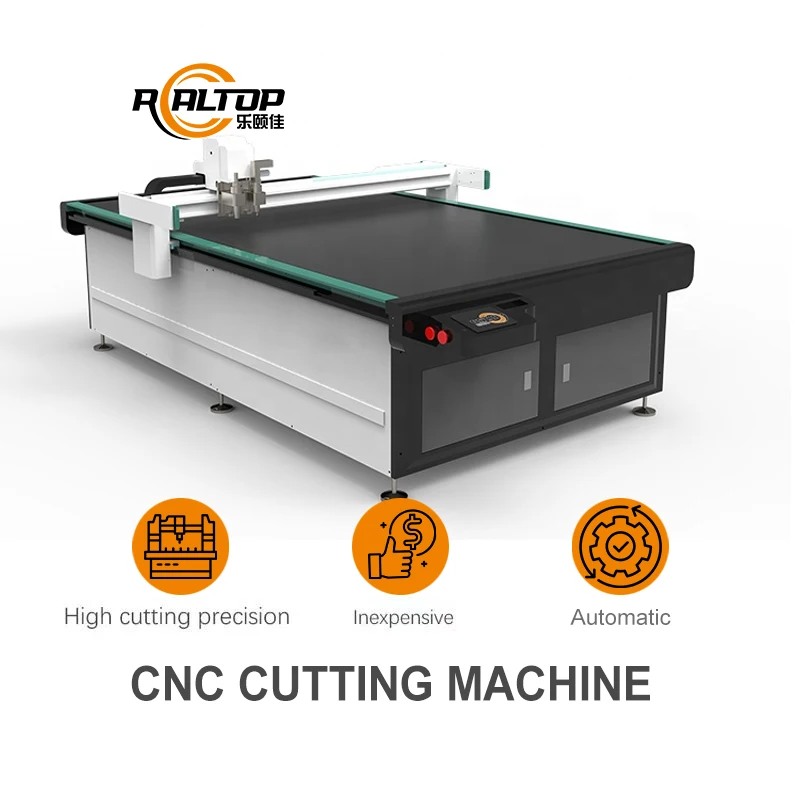
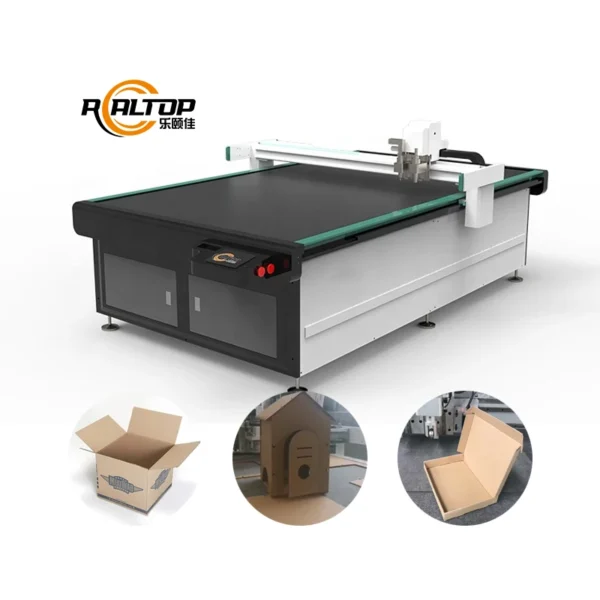
| Product Type | CNC Oscillating Knife Flatbed Cutting Machine for Corrugated Cardboard and Packaging |
| Working Area | 1600 × 2500 mm |
| Overall Dimensions | 3450 × 2300 × 1250 mm |
| Rated Power | 9 kW |
| Vacuum Pump | 7.5 kW |
| Working Table | Aluminum alloy honeycomb structure with vacuum adsorption |
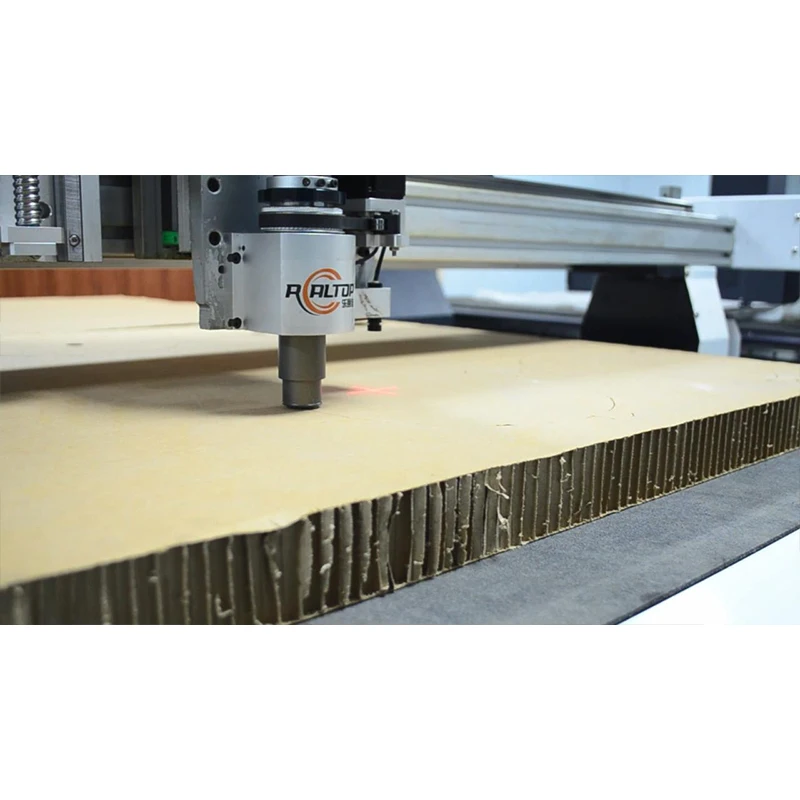
| Tool Head | Swiss imported oscillating knife — vibration full cutting, half cutting, cursor location |
| Translational Velocity | 800–1200 mm/s |
| Cutting Speed | 200–800 mm/s (varies by material type and thickness) |
| Cutting Thickness | Up to 100 mm (basis not stated in source — confirm with board grade and flute type) |
| Repeated Accuracy | ≤ 0.1 mm |
| Transmission System | Digital servo motor, linear guide, synchronous belt, ball screw |
| Servo Motor | Taiwan Delta |
| Linear Rail | Taiwan Hiwin |
| Instruction System | HP-GL compatible format |
| Voltage | 380V ± 10% |
| Frame | Welded thick square seamless steel structure, high temperature treated |
| Conveyor Belt | Germany imported |
| Feeding | Auto feeding |
| Safety Device | Infrared sensors and emergency stop |
Application Suitability
| Application | Material or Output |
|---|---|
| Carton sample making and short-run prototyping | Single-face, double-wall and micro-flute corrugated board |
| Custom corrugated box production | E-flute, B-flute, BC-flute and greyboard up to rated thickness |
| Express paper box and snack food packaging | Coated and uncoated kraft, folding carton stock |
| High-end gift box and POS display cutting | Laminated board, foam board, honeycomb paper panels |
| Sticker, label and business card contour cutting | Self-adhesive vinyl, coated paper, synthetic label stock |
Why Flute Profile Matters More Than Working Area on a CNC Oscillating Knife Cutting Table for Packaging
The tool head must be specified against the actual board grade, flute height and cutting depth — not the machine bed size.
I once configured a cutting table for a corrugated packaging plant based on working area alone. The customer ran five-layer double-wall board, but the knife oscillation stroke was set for three-layer stock. Every cut left compressed flutes and ragged edges. The line stood idle for days while replacement tooling was shipped [NEED_CITE: CNC cutting tool head selection by flute profile]. A CNC oscillating knife cutting table for packaging delivers clean results only when the vibration amplitude, blade angle and penetration depth match the material passing across the bed.
Oscillating Knife Tooling for Corrugated Grades
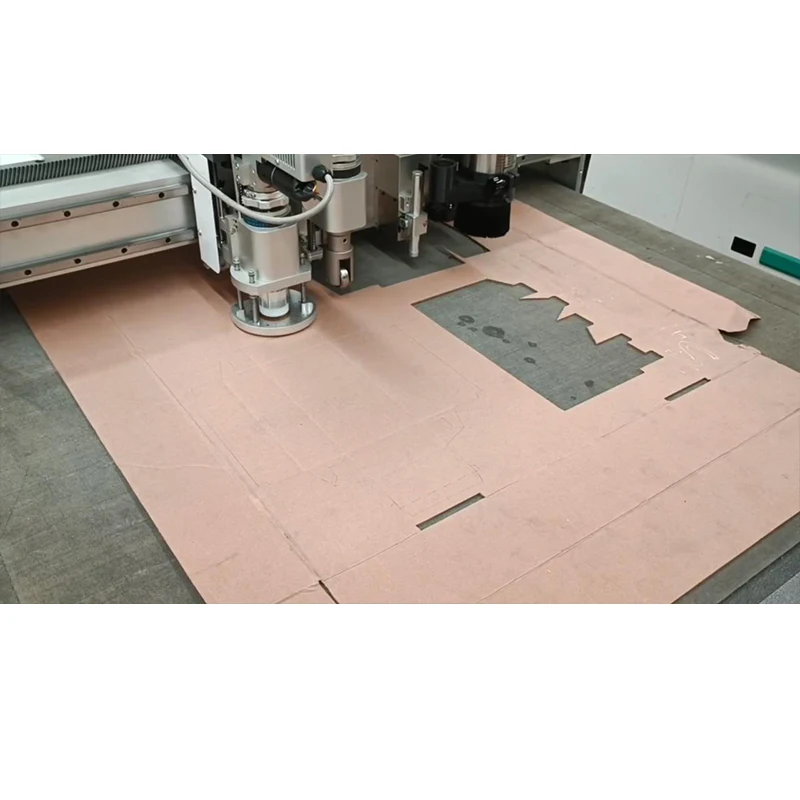
The Swiss imported knife head on this flatbed cutter delivers both vibration full cutting and half cutting in a single pass. Full cutting handles through-cuts on double-wall corrugated and solid fibreboard, while half cutting scores crease lines without severing the bottom liner. Switching between modes is controlled through the software, so a single carton blank with both cut and crease paths completes without a tool change. The oscillation frequency is matched to board density, reducing flute crush on micro-flute and E-flute stocks where static drag knives tend to tear the face paper.
Vacuum Zoning Across the Honeycomb Table
The aluminum alloy honeycomb vacuum table is divided into adsorption zones that can be activated independently. This matters when cutting small carton blanks nested across a 1600 × 2500 mm bed — full-bed vacuum would bleed air through uncovered areas, reducing hold-down force on the parts that need it. Zoned suction keeps lightweight corrugated pieces flat at cutting speeds up to 800 mm/s without edge lift or vibration chatter [NEED_CITE: vacuum table zoning for small part hold-down on CNC flatbed cutters]. The 7.5 kW vacuum pump provides the suction volume required to maintain grip across the working area even when cutting porous corrugated materials.
Drive Components and Positioning Tolerance
The Taiwan Hiwin linear rail and Delta servo motor combination holds repeated positioning accuracy within 0.1 mm across the full travel range. For packaging die-lines where tab slots and glue flaps must register within tight tolerances, this precision prevents accumulated drift over long nesting runs. The synchronous belt and ball screw transmission eliminates the backlash common in rack-and-pinion systems, which is noticeable when the knife head reverses direction at corners and tight radii on complex carton geometries.
The Cost of Skipping a Material Test
When a packaging producer orders a CNC oscillating knife cutting table for packaging without submitting board samples, the tool head and vacuum configuration are guessed from a description. Wrong oscillation stroke on five-layer board produces crushed flutes. Insufficient vacuum zoning on small label stock causes lift and miscuts. Software that cannot import the buyer’s DXF or PLT die-line library forces manual re-drawing of every carton profile [NEED_CITE: CAD file format compatibility in packaging CNC cutting software]. These problems surface during commissioning, not during quotation — which is why sample cutting on the buyer’s own corrugated stock before order confirmation is non-negotiable.
Why Buyers Source This Equipment from the Jinan Production Facility
Tool head and table configuration are specified per declared material thickness, flute type and daily production volume — not quoted as a standard package. The in-house design team covers both knife and laser cutting technologies, so a buyer processing corrugated board alongside acrylic display stands can match each material to the correct cutting method rather than force one method across all substrates. Software compatibility with existing carton CAD formats is confirmed before the order is released to the shop floor. Voltage, control language and plug type are locked in during the specification stage, preventing mismatches at the destination port [NEED_CITE: voltage and frequency standards by export market]. Every machine runs a factory test cutting the buyer’s submitted material before crating.
Documentation & Verification
- Sample cutting report on your corrugated board grade, documenting edge quality and crease depth at production speed
- Tool head and vacuum table configuration list matched to your declared flute profile and blank dimensions
- Software licence with confirmed compatibility for your DXF, PLT or AI die-line file formats
- Electrical schematic and voltage confirmation sheet matching your facility supply specifications
- Factory test record showing repeated positioning accuracy across the full 1600 × 2500 mm working area
Installation, Commissioning & Support
- 380V ± 10% three-phase supply with dedicated circuit rated for the combined 9 kW machine and 7.5 kW vacuum pump load
- Level floor area of approximately 3450 × 2300 mm with clearance for auto-feeding conveyor and material staging
- First-run parameter tuning on your corrugated stock, adjusting oscillation frequency and vacuum zone mapping
- Operator training covering HP-GL file import, nesting layout and crease/cut path separation in the carton software
- Spare blade and conveyor belt wear parts list included with recommended replacement intervals
Preparing Your Inquiry
To move past generic quotation and into a configuration that actually runs your board, share the corrugated flute type, board thickness and maximum sheet dimensions you process daily. Confirm your facility voltage and whether the control interface needs to run in a specific language. If you already use carton design software, send a sample die-line file so the nesting import can be verified before the CNC oscillating knife cutting table for packaging enters production.
Frequently Asked Questions
Q: How is the correct tool head selected for different corrugated flute profiles and board thicknesses?
A: The oscillation stroke, blade geometry and cutting depth are matched to the flute height and board density. Buyers submit physical board samples, and test cuts verify edge quality and flute integrity before the tool head is finalized for production.
Q: What vacuum table zoning is needed when cutting small carton blanks that tend to lift?
A: The honeycomb table is divided into independently controlled zones. Only the zones under active material are activated, concentrating suction on the blanks being cut and preventing edge lift at high translational speeds.
Q: Can the CCD camera track printed registration marks at full production speed on pre-printed corrugated?
A: CCD contour recognition is available as a configuration option. Its tracking speed and mark contrast requirements are validated on your printed stock during the sample cutting stage, not assumed from specification sheets alone.
Q: Which file formats does the nesting software accept, and can it import existing die-line libraries?
A: The professional carton nesting software imports standard formats including DXF, PLT and AI. Compatibility with your existing die-line library is confirmed by test import before the order is released to the factory floor.
Q: What cutting speed and depth can be verified on the buyer’s specific board grade before order commitment?
A: Cutting speed ranges from 200 to 800 mm/s depending on material. The buyer’s own board sample is run at target production speed, and the sample cutting report documents the verified speed, edge quality and crease accuracy achieved.


商品评价
Clear filtersThere are no reviews yet.