
Blog
What Makes a Distributor Exclusive Regional Agency Policy for Knife Cutting Machines Actually Work?

What Makes a Distributor Exclusive Regional Agency Policy for Knife Cutting Machines Actually Work?
You sign an exclusive distributor agreement thinking you own the territory. Three months later, another dealer two states over undercuts your price online. Or worse, your manufacturer ships direct to your biggest prospect. Suddenly "exclusive" feels like empty words on paper.
An exclusive regional agency policy is not a territorial monopoly promise. It is a conditional protection framework that works only when three elements align: clearly defined boundaries that specify geography and industry verticals, enforceable monitoring systems that catch violations in real time, and exit conditions that let both parties walk away without destroying the relationship. Without these, exclusivity becomes an unenforceable claim that damages trust faster than pricing conflicts.

I have spent years setting these policies at Realtop and mediating the conflicts they create. The gap between what dealers expect and what manufacturers can actually enforce is where most partnerships fail. This article breaks down how we design exclusivity frameworks that survive first contact with market reality.
What Does "Exclusive Territory" Actually Mean in CNC Knife Cutting Machine Distribution?
Dealers hear "exclusive" and assume absolute control. They expect no other authorized partner within 500 miles. They want protection from factory-direct sales, third-party platforms, even adjacent dealers stretching into their zip codes.
True exclusivity in industrial equipment distribution means conditional first-priority rights within defined boundaries[^1], not a total market lockout. The manufacturer reserves direct-sale rights to pre-existing national accounts, vertical integrators, and government tenders. The dealer gets protection from new competing distributors in their region, provided they meet minimum performance thresholds and maintain agreed service standards.

Why Geographic Boundaries Alone Create Gray Zones
When we first started offering regional exclusivity, we defined territories by country or state lines. This failed within six months. A packaging material dealer in Texas complained when an automotive interior supplier in the same state bought direct from us at a lower price. Both operated in different industries. Both had legitimate claims to "exclusive Texas rights."
The conflict taught us that territory definition requires two dimensions[^2]. The first is geographic. The second is industry vertical. A dealer focused on advertising and signage cannot realistically serve automotive seating manufacturers. Their sales teams speak different technical languages. Their service networks support different production environments. Giving one dealer blanket exclusivity across all industries in a state blocks the manufacturer from serving specialized markets.
We now specify territories with paired criteria. Geographic boundaries define the physical service area. Industry verticals define the target customer base. A dealer might hold exclusive rights for "advertising and textile applications in California" while another covers "automotive and aerospace applications in California." This reduces boundary conflicts by aligning exclusivity with actual market access capability.
How Pre-Existing Direct Accounts Limit Dealer Protection
Every manufacturer has direct relationships before appointing distributors. We have sold knife cutting machines to Fortune 500 companies[^3] for years. When we offer a dealer exclusive rights in a region, we cannot erase those existing contracts. The dealer must accept that certain accounts remain factory-direct.
The challenge is disclosure. Some manufacturers hide the size of their direct customer base until after the distributor commits resources. The dealer invests in inventory and marketing, then discovers half the viable prospects in their territory already buy direct. Trust collapses.
We handle this by providing a named account list during negotiation. The dealer sees exactly which customers we will continue serving direct. They can assess remaining market opportunity before signing. If the direct account list covers 60% of regional demand, the dealer can negotiate adjusted performance targets or request adjacent territories.
This transparency has a cost. Some potential dealers walk away when they see how many large accounts we protect. But the partnerships that form are built on realistic expectations. The dealer knows the playing field from day one.
What Happens When Large Customers Demand Factory Pricing in Protected Regions
A furniture manufacturer in a dealer's exclusive territory wants to buy 20 machines. They have global procurement leverage. They demand factory-direct pricing and installation support. The dealer cannot match the discount because they carry margin and local overhead costs.
If we honor the customer's demand, we break our exclusivity commitment. If we redirect them to the dealer, we risk losing the sale to a competitor willing to sell direct. This conflict has no perfect solution.
Our current approach uses a threshold system. Orders below 10 machines go through the authorized dealer[^4] with protected margins. Orders above 10 machines trigger a review. We bring the dealer into the negotiation. If they can structure a competitive offer, they keep the sale with adjusted pricing support from us. If not, we take the order direct but pay the dealer a referral commission. The commission is not full margin, but it prevents the dealer from losing the relationship entirely.
This system does not satisfy everyone. Large dealers want full protection regardless of order size. Small dealers want lower thresholds. But it gives us a documented decision framework instead of arbitrary case-by-case judgment. Dealers can predict how we will handle large opportunities in their region.
How Can Manufacturers Actually Enforce Exclusivity When Cross-Region Sales Happen Online?
A dealer in Germany complains that a Spanish distributor is shipping machines to German customers through Amazon at 15% below authorized pricing. The Spanish dealer claims they are not "targeting" Germany, just fulfilling orders from customers who found them online. Who is violating the policy?
Exclusivity enforcement requires monitoring systems that detect cross-border violations in real time, not just complaint-driven investigation. Without SKU-level tracking, IP geolocation filters, and platform pricing audits, manufacturers cannot prove violations or take corrective action before market damage occurs. Most industrial equipment suppliers lack these systems, making digital-channel exclusivity nearly unenforceable.

The Gap Between Policy Language and Detection Capability
Our distributor agreements include language prohibiting sales outside assigned territories. The contract says dealers cannot actively market or ship to customers in other regions. Enforcement depends on proving "active" solicitation versus passive order fulfillment.
In practice, we cannot monitor every transaction. We do not have access to dealer inventory systems. We do not track their website traffic sources. We learn about violations through complaints from affected dealers, often weeks after sales occur. By then, the customer has the machine, the violating dealer has their profit, and we are mediating a conflict with incomplete evidence.
The only violations we can definitively prove are public-facing: dealers advertising in another region's trade publications, attending trade shows outside their territory, or listing region-specific targeting on e-commerce platforms. These leave clear evidence trails. But sophisticated dealers work around these markers. They use generic national advertising, fulfill "unsolicited" inquiries, and structure deals through intermediaries.
Why Third-Party Platforms Undermine Regional Pricing Control
We authorize dealers to sell on Alibaba, Amazon Business, and regional B2B platforms. We cannot realistically prohibit this. Buyers expect to find industrial equipment on these channels. A dealer not present loses visibility.
But platform algorithms show the lowest price to all buyers regardless of location[^5]. A dealer in Poland lists a machine at a discounted price to move inventory. A buyer in France sees that price and orders. The Polish dealer fulfills it because the platform facilitates the transaction. The French dealer loses the sale and blames us for inadequate protection.
We have tried requiring dealers to use region-locked listings. Platforms do not support this feature with granular control. We have tried setting minimum advertised pricing across all channels. Dealers agree, then create alternate listings with bundled accessories to effectively discount while maintaining list price. We have tried restricting platform sales entirely. Dealers who comply lose market share to competitors on those platforms.
The current compromise is monitoring major platforms monthly and flagging price violations publicly. We share a compliance scorecard with all dealers. Repeated violators face graduated penalties: first a warning, then temporary suspension of marketing development funds, finally territory reduction or termination. This does not stop all violations, but it creates visible consequences.
What First-Year Sales Targets Should Reflect in an Exclusive Agreement
We set minimum annual purchase commitments[^6] for exclusive dealers. This prevents distributors from locking up territories without actively developing them. But setting realistic targets requires understanding what the dealer can actually access.
A new dealer in Brazil requests exclusive rights for the entire country. They have existing relationships in the packaging industry but no presence in automotive or furniture. If we set a target based on total Brazilian market potential across all industries, they will fail. If we set it based only on packaging sector opportunity, we give away too much territory for too little coverage.
| Territory Assessment Factor | What We Evaluate | Why It Matters for Target Setting |
|---|---|---|
| Dealer's existing customer base | Number of active accounts in relevant industries | Predicts Year 1 conversion potential without cold outreach |
| Sales team industry experience | Technical knowledge of target verticals | Determines how fast they can credibly engage new prospects |
| Service infrastructure coverage | Warehouse locations, technician count, response time capability | Limits practical service radius regardless of official territory size |
| Competitive presence density | Number of established cutting machine dealers in region | High competition regions require longer sales cycles and lower close rates |
| Market maturity stage | Penetration of CNC cutting vs. manual methods | Early markets need education investment before volume purchases occur |
We use this framework to build a first-year target that ties exclusivity scope to realistic performance. A dealer with strong packaging industry access in São Paulo might get exclusive packaging rights for Southeast Brazil with a 15-machine target. If they exceed it by 30%, we expand their territory in Year 2. If they miss by 20%, we reduce the exclusive zone or add an industry vertical to their region under a separate dealer.
This approach causes friction during initial negotiations. Dealers want maximum territory with minimum commitment. But it prevents the common failure mode where a dealer locks up a large region, underperforms, then refuses to release territory because the contract does not include clear reduction conditions.
How Exit Conditions Prevent Policy Deadlock When Partnerships Fail
A dealer fails to meet targets for two consecutive years. We want to appoint a new distributor in that region. The existing dealer refuses to accept termination, claims they are "building the market" and need more time. The contract has no automatic termination trigger, only vague language about "mutual agreement."
We are stuck. If we appoint the new dealer, the old one threatens legal action for breach. If we wait, the region stays underdeveloped. We cannot enforce exclusivity for the old dealer while prospecting for a new one. The policy framework collapses.
We now include specific exit conditions tied to measurable performance metrics. If a dealer misses annual targets by more than 20% for two consecutive years[^7], either party can terminate with 90 days' notice. If quality complaint rates from their customers exceed 5 per 100 machines sold[^8], we can reduce territory scope immediately. If the dealer stops maintaining certified service technicians, exclusivity pauses until they restore compliance.
These conditions work both directions. If we fail to deliver machines within agreed lead times in more than 15% of orders[^9], the dealer can exit without penalty. If we sell direct to non-exempt accounts in their territory more than twice in a year, they can terminate and receive prorated compensation for market development costs.
What Should Dealers Verify Before Accepting an Exclusive Agency Offer?
You receive an offer for exclusive distribution rights. The territory looks attractive. The margins seem workable. But the policy document is vague about enforcement and exit terms. Should you sign?
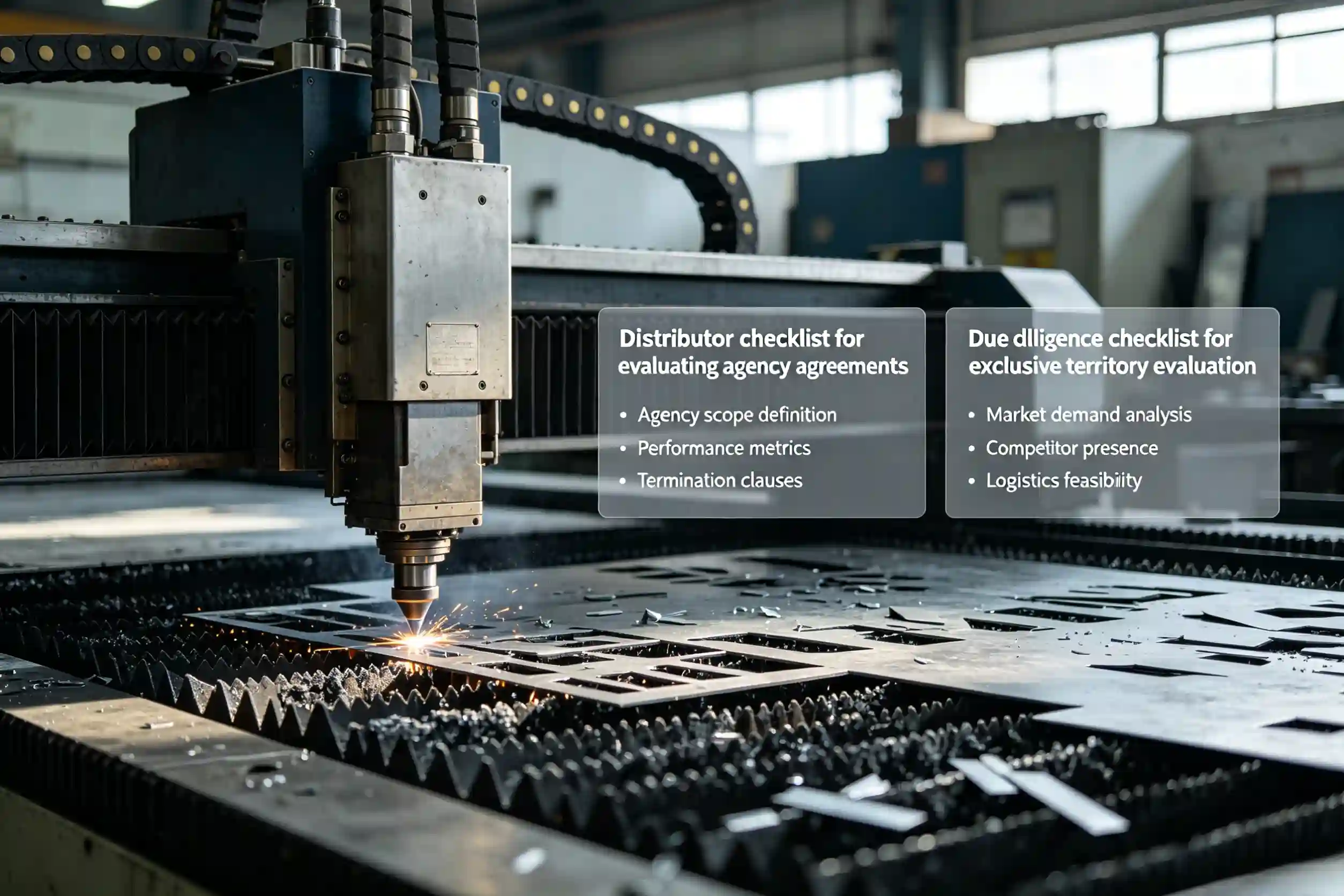
Before committing, verify five operational elements that determine if the policy can survive market pressure: request the full list of direct accounts the manufacturer will retain, confirm what monitoring tools they use to detect cross-region violations, review how they have handled past distributor conflicts in other regions, test whether the first-year sales target aligns with accessible market size in your verticals, and ensure exit conditions are tied to specific metrics rather than subjective judgment.
Questions to Ask During Initial Negotiation
Ask for a named list of existing direct customers in your proposed territory. If the manufacturer refuses, they likely have more direct relationships than they want to disclose. Ask how they will handle inquiries from large national accounts that span multiple regions. If they cannot give a clear threshold or process, you will face constant conflict over big opportunities.
Request examples of how they enforced exclusivity in other regions. If they have never reduced another dealer's territory for underperformance, their threats to do so with you are empty. If they have never penalized a dealer for cross-region sales, they will not start enforcing your protection.
Check what tools they use to monitor compliance. If their answer is "we rely on dealer reports," they have no independent verification system. If they say "we review it quarterly," violations will run unchecked for months. Real-time monitoring is expensive. Most manufacturers do not have it. You need to know this before you depend on their protection.
How to Assess if the Performance Target Is Realistic
Calculate the total addressable market in your assigned geography and industry verticals[^10]. Subtract the customers on the direct account exclusion list. Estimate market share you can realistically capture in Year 1 given competitive presence and your team's technical capability. If the required purchase commitment exceeds 40% of that number, the target is aggressive[^11]. If it exceeds 60%, it is designed to fail.
I have seen dealers accept exclusive agreements with first-year targets that require them to capture 80% of available market share. They sign because the territory looks large on a map. Twelve months later they have missed the target, lost exclusivity, and wasted investment in inventory and marketing specific to that region.
Request a staged target structure tied to territory expansion. Start with a core region and a conservative target. If you exceed it by 25%, the manufacturer expands your territory[^12] and raises the target proportionally. This aligns exclusivity growth with actual performance instead of locking you into an all-or-nothing commitment based on untested assumptions.
Conclusion
An exclusive regional agency policy protects dealers only when its boundaries, enforcement mechanisms, and exit conditions are specifically defined and operationally testable. The manufacturer must disclose limits to that protection upfront, particularly around direct accounts and large customer exceptions, or the policy becomes an unenforceable promise that destroys trust faster than any pricing conflict.
[^1]: "Exclusive Dealing or Requirements Contracts", https://www.ftc.gov/advice-guidance/competition-guidance/guide-antitrust-laws/dealings-supply-chain/exclusive-dealing-or-requirements-contracts. Legal scholarship defines exclusive distribution rights as conditional territorial protections that typically reserve certain customer categories or sales channels to the manufacturer, rather than absolute market monopolies. Evidence role: definition; source type: education. Supports: the legal definition and scope of exclusive distribution rights in commercial agreements. Scope note: The source addresses general distribution law principles rather than CNC equipment specifically [^2]: "[PDF] Vertical Territorial Restrictions and Public Policy: Theories and ...", http://assets.csom.umn.edu/assets/71600.pdf. Distribution management research identifies multi-dimensional territory design—combining geographic boundaries with customer segment or industry vertical specifications—as a method to reduce channel conflict in B2B markets. Evidence role: expert_consensus; source type: education. Supports: best practices in distribution territory design that combine geographic and market segment criteria. [^3]: "Channel Convergence: Merging Perspectives and Conquering ...", https://cmr.berkeley.edu/2025/03/channel-convergence-merging-perspectives-and-conquering-conflicts/. Research on B2B distribution channels indicates that manufacturers frequently maintain direct sales relationships with large national or global accounts due to volume requirements, specialized service needs, and centralized procurement structures. Evidence role: general_support; source type: research. Supports: the common practice of manufacturers maintaining direct relationships with major accounts. Scope note: The source addresses general B2B practices rather than industrial equipment specifically [^4]: "Non-Exclusive Distributor Agreement - SEC.gov", https://www.sec.gov/Archives/edgar/data/1387467/000119312510073586/dex107.htm. Channel management literature describes threshold-based routing systems, where orders above specified volume levels trigger different handling procedures, as a mechanism to balance distributor protection with manufacturer access to strategic accounts. Evidence role: mechanism; source type: education. Supports: the use of order size or customer volume thresholds to determine distribution channel routing. [^5]: "Geographical Pricing Strategies for eCommerce - ConvertMate", https://www.convertmate.io/blog/using-geographical-pricing-to-boost-ecommerce-sales. Research on e-commerce marketplace mechanisms indicates that many platforms prioritize price competitiveness in search rankings and display the lowest available prices to buyers, with limited geographic filtering capabilities for B2B territorial restrictions. Evidence role: mechanism; source type: research. Supports: how e-commerce platforms display pricing information across geographic boundaries. Scope note: Platform-specific algorithms vary and may not apply uniformly across all B2B marketplaces [^6]: "Exclusive Dealing or Requirements Contracts", https://www.ftc.gov/advice-guidance/competition-guidance/guide-antitrust-laws/dealings-supply-chain/exclusive-dealing-or-requirements-contracts. Business law scholarship on distribution agreements identifies minimum purchase commitments or sales quotas as common contractual mechanisms to ensure exclusive distributors actively develop their assigned territories and justify the competitive restrictions imposed on manufacturers. Evidence role: expert_consensus; source type: education. Supports: the standard practice of including performance obligations in exclusive distribution contracts. [^7]: "Exclusive Dealing or Requirements Contracts", https://www.ftc.gov/advice-guidance/competition-guidance/guide-antitrust-laws/dealings-supply-chain/exclusive-dealing-or-requirements-contracts. Contract law analysis of distribution agreements indicates that performance-based termination clauses typically specify objective metrics such as sales quota achievement percentages and time periods to provide clear exit conditions, though specific thresholds vary by industry and negotiation. Evidence role: general_support; source type: education. Supports: the use of specific performance metrics as termination triggers in distribution contracts. Scope note: The source addresses general principles rather than validating the specific 20% threshold mentioned [^8]: "(PDF) Measuring physical distribution service quality - Academia.edu", https://www.academia.edu/23175191/Measuring_physical_distribution_service_quality. Research on distribution channel management identifies customer complaint rates and service quality metrics as legitimate performance indicators in distributor agreements, though acceptable thresholds vary significantly by product category, price point, and market maturity. Evidence role: general_support; source type: research. Supports: the use of quality metrics in distribution performance evaluation. Scope note: The source does not validate the specific 5% threshold as an industry standard [^9]: "ex10-2.htm - SEC.gov", https://www.sec.gov/Archives/edgar/data/1444377/000143209310000641/ex10-2.htm. Contract law scholarship recognizes reciprocal performance obligations in distribution agreements, where both manufacturers and distributors face consequences for failing to meet specified service levels, though specific metrics like delivery performance thresholds are negotiated based on industry norms and operational capabilities. Evidence role: expert_consensus; source type: education. Supports: the principle of reciprocal performance obligations in distribution agreements. Scope note: The source addresses the general principle rather than validating the specific 15% threshold [^10]: "Total Addressable Market (TAM) | Formula + Calculator", https://www.wallstreetprep.com/knowledge/total-addressable-market-tam/. Sales management literature describes total addressable market (TAM) calculation as a standard methodology for territory evaluation, involving identification of potential customers within defined geographic and segment boundaries, estimation of purchase potential, and adjustment for competitive presence and market penetration rates. Evidence role: mechanism; source type: education. Supports: the methodology for calculating total addressable market in territory assessment. [^11]: "Think Outside the Box: 4 Strategies for Boosting Distribution Market ...", https://ezragroup.com/think-outside-the-box-boosting-distribution-market-share/. Research on distribution channel performance indicates that new distributors in established markets typically achieve single-digit to low double-digit market share penetration in their first year, with higher rates possible in underdeveloped markets or with strong pre-existing customer relationships. Evidence role: general_support; source type: research. Supports: typical market penetration rates achievable by new distributors in their first year. Scope note: The source provides general ranges rather than validating the specific 40% threshold as a benchmark for aggressive targets [^12]: "International Distribution Agreement - SEC.gov", https://www.sec.gov/Archives/edgar/data/1108271/000119312504210666/dex1026.htm. Distribution management literature describes performance-based territory expansion as a risk mitigation strategy where manufacturers grant initial exclusive rights to limited geographic or market areas, then progressively expand distributor territories based on demonstrated sales achievement and market development capability. Evidence role: mechanism; source type: education. Supports: the practice of linking territory expansion to performance achievement in distribution agreements. Scope note: The source addresses the general approach rather than validating specific performance thresholds for expansion


