
Blog
How distributors handle after-sales complaints for knife cutting machines?

How distributors handle after-sales complaints for knife cutting machines?
Distributors receive a complaint call: "Your machine ruined my production batch." The customer demands immediate compensation. The distributor faces a choice—send a technician now, offer a refund, or call the manufacturer. Most choose wrong because they lack a method to diagnose the real problem first.
Effective complaint handling separates operator issues from equipment failures through diagnostic triage before determining response depth. Distributors who investigate problem nature first—rather than making instant promises—resolve complaints faster while controlling costs and protecting manufacturer relationships.
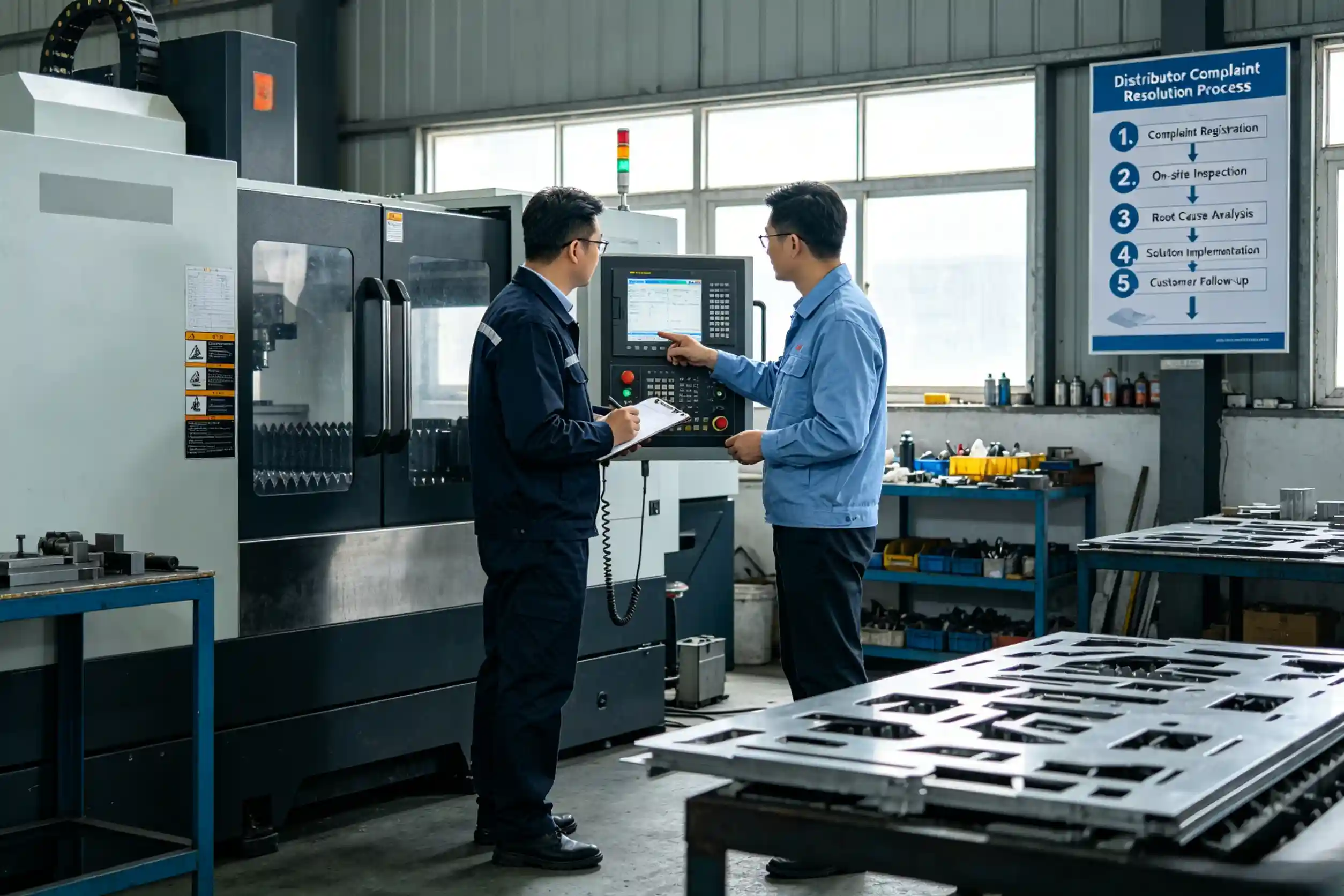
I work at Realtop's technical support team. Distributors escalate cases to us after their initial response fails. I see the same pattern: they commit to solutions before understanding what went wrong. This creates expectations they cannot meet and problems we cannot fix remotely.
Why do most distributor complaint responses fail to satisfy customers?
Distributors promise solutions that sound reassuring but do not match the actual problem. A customer calls about uneven cutting. The distributor immediately offers blade replacement. The real cause turns out to be incorrect material placement. The customer remains unsatisfied because the suggested fix did not address their concern.
Distributor responses fail because they target assumed problems rather than diagnosed conditions. Without understanding whether the issue stems from operation error, environmental factors, or genuine equipment malfunction, any proposed solution becomes a guess that wastes time and erodes trust.
I track complaints escalated to our manufacturer support line. Three failure patterns repeat across different distributors and regions:
Immediate appeasement without investigation. The distributor tells the customer "we will handle everything" before collecting basic information. They do not ask what material was being cut, what settings were used, or when the problem started. When they call us, they cannot answer our diagnostic questions. We cannot provide remote guidance without this baseline data.
Blanket warranty policy application. The distributor checks the purchase date and declares "still under warranty" or "warranty expired." They treat this as the primary decision factor. But warranty coverage depends on failure cause, not just elapsed time. Operator damage is not covered. Environmental issues like voltage fluctuation are not covered. The distributor creates conflict by promising coverage before confirming eligibility.
Generic technical suggestions. The distributor offers standard advice: "clean the machine," "restart the system," "check the blade." These steps might help, but they do not follow diagnostic logic. The customer already tried obvious fixes. They called because standard troubleshooting failed. Generic suggestions signal that the distributor does not understand the specific situation.
What information do distributors miss during initial complaint contact?
| Critical Data Point | Why It Matters | How to Collect It |
|---|---|---|
| Material type and thickness | Different materials require different cutting parameters | Ask customer to describe material and measure thickness with calipers |
| Cutting file source | Imported files may contain incompatible parameters | Request the actual file used when problem occurred |
| Environmental conditions | Temperature and humidity affect material behavior | Ask about workshop conditions and recent weather changes |
| Operator experience level | New operators may misinterpret normal machine behavior | Confirm who operated the machine and their training status |
| Problem onset timing | Gradual degradation suggests wear; sudden failure suggests specific incident | Establish whether issue started immediately or developed over time |
In cases we have tracked, distributors who collect this information during the first call resolve complaints in one-third the time compared to those who start investigating only after initial solutions fail.
What are the three most common customer misconceptions that create impossible service expectations?
Customers hold assumptions that shape their complaint behavior. They believe certain things should work in certain ways. When reality differs, they conclude the equipment or service is defective. Distributors face pressure to meet expectations based on these misconceptions.
The three misconceptions are: distributors possess unlimited technical capability to solve all problems independently, any equipment malfunction automatically justifies full compensation for production losses, and machines should operate perfectly without training or environmental adjustment. These beliefs create service demands that exceed reasonable support boundaries.
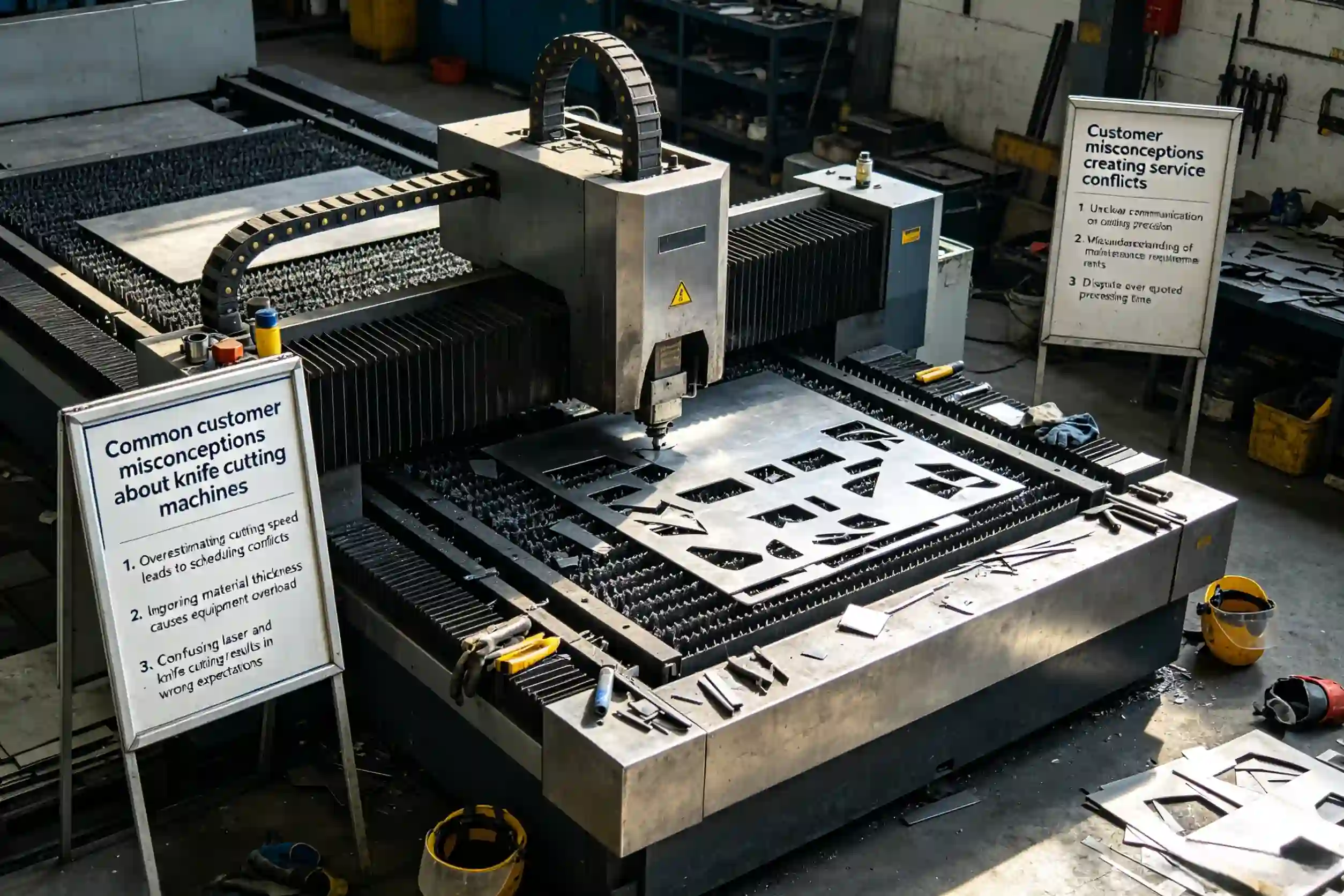
We receive escalation calls where distributors feel trapped. The customer insists on something unreasonable, but relationship pressure prevents direct refusal. Understanding the misconception behind each demand helps distributors respond without either accepting impossible obligations or damaging customer relationships.
Misconception one: Distributors should resolve all technical issues without manufacturer involvement. Customers expect their local distributor to diagnose and fix any problem independently. They view manufacturer escalation as distributor incompetence. This expectation ignores technical complexity. Some issues require access to engineering specifications or software source code. Distributors cannot reasonably maintain this expertise in-house.
When a customer complains that "you should know how to fix this without calling the factory," the underlying belief is that sales and service should be completely decoupled from manufacturing. Distributors can address this by explaining their role: they provide local responsiveness and handle common issues, while manufacturers provide engineering expertise for complex problems. Frame escalation as accessing specialized resources, not admitting failure.
Misconception two: Equipment failure always warrants compensation for production downtime. Customers calculate revenue lost during machine downtime and present this figure as compensation demand. They believe that any non-operational period represents financial damage the distributor must cover. This logic ignores failure cause and reasonable service timelines.
In one case escalated to us, a customer demanded payment for three days of lost production because they waited for a replacement part. Investigation revealed the part failed due to incorrect voltage supply in the customer's facility. The equipment manufacturer bore no responsibility, but the customer maintained that "the machine was not working, so someone must pay." Distributors face this demand frequently.
The misconception stems from confusion between operational guarantee and performance guarantee. Equipment warranties cover manufacturing defects, not business continuity. Distributors can clarify this by distinguishing between equipment malfunction compensation and consequential damage claims. The former may be covered under warranty terms; the latter requires separate business interruption insurance.
Misconception three: Machines require no training or environmental accommodation. Customers treat knife cutting machines like consumer appliances. They expect to unpack the equipment, plug it in, and begin production immediately. When results do not meet expectations, they conclude the machine is defective. They do not consider that successful operation requires learned skills and specific facility conditions.
We supported a case where a customer cut foam materials immediately after installation without attending the training session. The cuts showed tearing rather than clean edges. The customer complained about blade quality. The actual issue was incorrect cutting speed for that material density. The customer assumed the machine would automatically adjust all parameters.
This expectation creates service burden for distributors. They must either provide extensive operator training themselves or manage customer frustration when results do not match assumptions. Distributors who clearly communicate training requirements before sale face fewer post-sale complaints based on this misconception.
How do distributor service boundaries differ from manufacturer responsibilities?
| Service Category | Distributor Scope | Manufacturer Scope | Gray Zone Issues |
|---|---|---|---|
| Initial setup | Installation, basic calibration, operator orientation | Factory calibration, system architecture design | Custom integration requirements |
| Operator training | Basic operation, common materials, safety procedures | Advanced features, complex nesting, specialized applications | Industry-specific cutting techniques |
| Routine maintenance | Blade replacement, cleaning, tension adjustment | Firmware updates, precision recalibration, component redesign | Preventive maintenance schedules |
| Troubleshooting | Parameter adjustment, common error codes, consumable checks | Software diagnostics, electronic system testing, mechanical engineering analysis | Intermittent problems without clear cause |
| Parts replacement | Standard consumables, basic mechanical components | Control system boards, precision drive components, structural modifications | Warranty coverage determination |
Distributors who define these boundaries explicitly in their customer agreements reduce misconception-based complaints by providing clear expectation frameworks.
What diagnostic criteria determine whether a complaint requires remote guidance, on-site visit, or manufacturer escalation?
Distributors waste resources by choosing the wrong response level. They send technicians for problems solvable over the phone. They attempt remote guidance for issues requiring physical inspection. They escalate cases to manufacturers that they could handle locally with proper diagnosis.
Response level selection depends on four diagnostic factors: problem reproducibility, symptom specificity, customer technical capability, and potential failure cost. Distributors should escalate only after exhausting their diagnostic scope, not after exhausting customer patience.
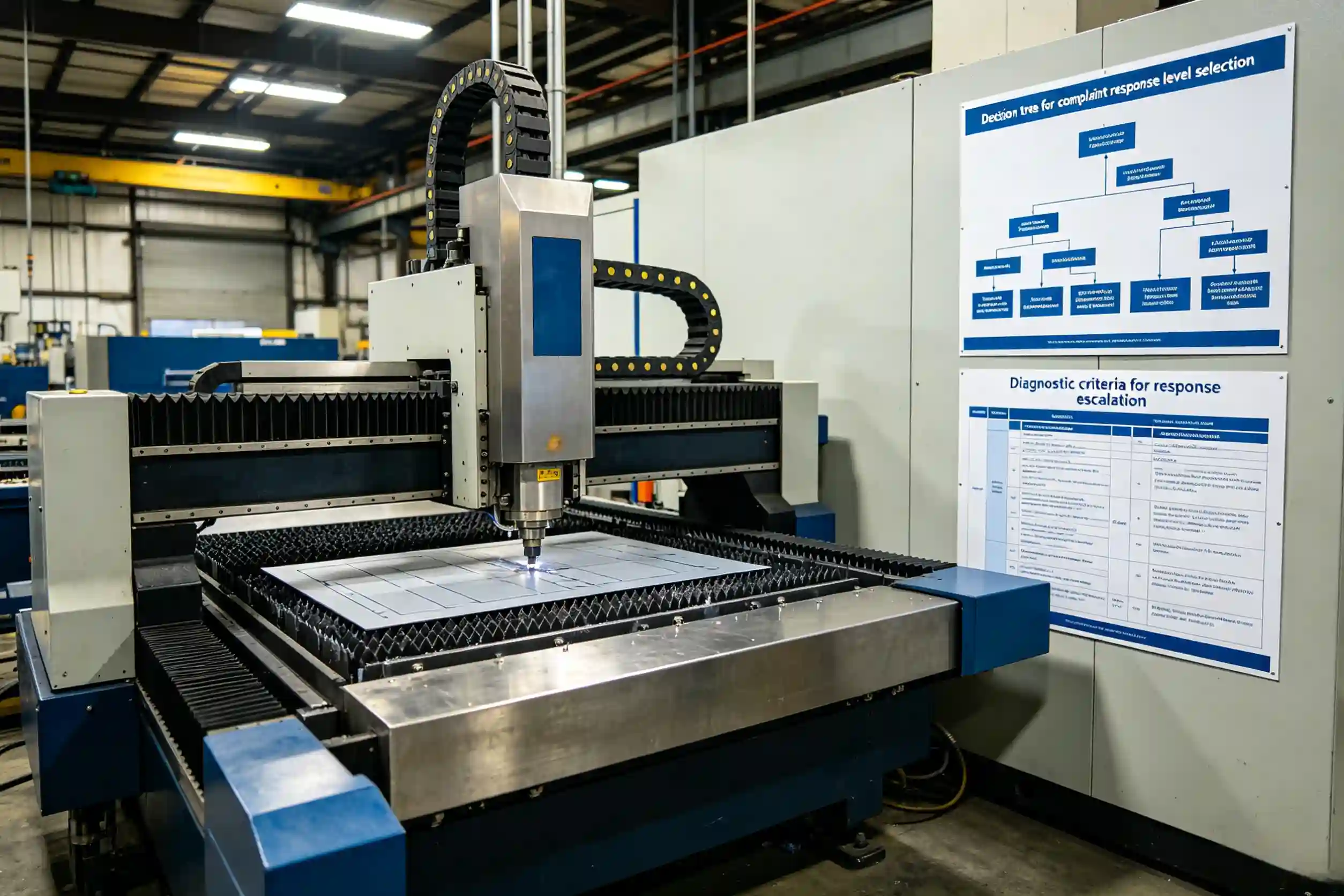
I guide distributors through this decision process daily. They call us uncertain whether to dispatch their technician or ask for our remote support. We have developed criteria that help them choose effectively based on information available during initial complaint contact.
Remote guidance is appropriate when the problem is reproducible and the customer can follow technical instructions. The customer describes a consistent symptom that occurs under specific conditions. They possess basic technical literacy to check settings, measure components, and report observations accurately. The suspected cause falls within common parameter adjustment or operator technique issues.
For example, a customer reports that curved cuts show rippling. This happens consistently on all curved paths above a certain radius. The customer can access the control software and read current settings. This complaint profile suits remote guidance. The distributor or manufacturer support can walk the customer through feed rate and acceleration adjustments while the customer tests results.
Remote guidance fails when the customer cannot articulate specific symptoms or lacks ability to implement suggested changes. If they describe the problem as "just not working right" or cannot locate software menus, remote troubleshooting becomes inefficient. The distributor should offer on-site assistance rather than prolonging frustrating phone support.
On-site visits are necessary when diagnosis requires physical inspection or hands-on testing. The problem occurs intermittently without clear trigger conditions. Symptoms suggest mechanical component wear or alignment issues that cannot be evaluated remotely. The customer lacks technical capability to gather detailed diagnostic information independently.
We supported a case where a customer reported occasional sudden stops during operation. The pattern seemed random. Remote diagnosis stalled because the customer could not describe any commonality between incidents. The distributor sent a technician who observed that stops occurred only when cutting near specific table positions. Physical inspection revealed a loose cable that flexed during gantry movement, causing intermittent connection loss. No remote diagnostic process would have identified this specific failure mode.
On-site visits become inefficient when the problem stems from software configuration or operator technique. If the issue can be reproduced consistently and symptoms point to settings rather than physical components, remote guidance resolves the complaint faster. Technician dispatch should target problems that specifically require presence at the machine.
Manufacturer escalation is justified when problems exceed distributor technical scope or require engineering judgment. Symptoms suggest control system malfunction, software bugs, or design limitation issues. The problem persists after distributor technicians have verified all mechanical components and parameter settings. Resolution may require firmware updates, hardware modifications, or application engineering support.
I see inappropriate escalations where distributors call us before completing basic checks. They have not verified that the customer is using correct material settings. They have not confirmed blade condition. They have not checked if the problem occurs with different cutting files. We cannot provide meaningful guidance when fundamental diagnostic steps remain incomplete.
What questions determine appropriate response level during initial complaint contact?
- Can you make the problem happen right now while we talk? (Tests reproducibility)
- Does it happen on every cut or only sometimes? (Indicates systematic vs. intermittent issue)
- When did you last get good cutting results? (Establishes timeline and possible trigger)
- What changed between the last good cut and the first bad cut? (Identifies potential cause)
- Can you access the control software settings screen? (Assesses customer technical capability)
- What material are you cutting and what settings are you using? (Verifies basic parameter match)
- Have you replaced any consumable parts recently? (Checks for incorrect component installation)
Distributors who ask these questions systematically during the first call select the correct response level over eighty percent of the time based on our escalation tracking data.
How should distributors balance customer satisfaction, cost control, and manufacturer relationship during complaint resolution?
Distributors face conflicting pressures. Customers want instant solutions at no cost. Distributors want to minimize service expenses. Manufacturers want to avoid warranty claims for non-covered issues. Each party has legitimate interests, but optimizing for only one damages the others.
Effective complaint handling treats these three factors as constraints on a solution space rather than competing priorities. Distributors achieve this balance by making problem diagnosis the shared foundation for all parties rather than negotiating positions before understanding the actual issue.
We work with distributors who have mastered this balance. They resolve complaints efficiently while maintaining profitability and manufacturer cooperation. Their approach differs from distributors who experience constant conflict across all three dimensions.
Customer satisfaction is maximized through competent investigation, not through instant promises. Customers value responsiveness, but they ultimately want their equipment working correctly. Distributors who commit to unrealistic timelines or solutions create temporary satisfaction that collapses when commitments cannot be met. Customers who receive thorough diagnosis may accept longer resolution times because they understand the logic.
I supported a case where a distributor told their customer, "I do not know yet what is causing this, but I will find out within two days." The customer accepted this timeline because the distributor demonstrated active investigation. The distributor collected detailed information, consulted with us on diagnosis, and identified the root cause within the promised timeframe. The customer expressed satisfaction despite the delay because they observed competent handling throughout.
Contrast this with distributors who promise "we will fix it today" without diagnosis. When the hastily attempted solution fails, customer satisfaction drops below the starting point. The customer loses confidence in the distributor's capability. Managing expectations based on diagnostic findings protects satisfaction better than making unsupported promises.
Cost control depends on accurate problem diagnosis before committing resources. Distributors lose money by dispatching technicians for issues solvable remotely or by attempting multiple ineffective solutions. Each incorrect intervention adds cost without moving toward resolution. Investment in thorough initial diagnosis reduces total resolution cost even though it delays action.
We calculated resolution costs for complaints escalated to our support team. Cases where distributors completed systematic diagnosis before taking action averaged forty percent lower total cost than cases where distributors immediately dispatched technicians or shipped replacement parts. The diagnostic investment returned its cost through first-time resolution accuracy.
Distributors should budget time for investigation as a standard complaint handling cost rather than viewing it as delay. Phone support time, remote diagnostic software sessions, and consultation with manufacturer technical teams cost less than repeated site visits or unnecessary parts replacement. Upfront diagnostic investment controls downstream cost.
Manufacturer relationship is preserved by providing complete information when escalating issues. Manufacturers can support distributors effectively when they receive comprehensive diagnostic data. They cannot help when distributors simply forward customer complaints without investigation. Escalations that include what has been checked, what was found, and what has been ruled out get faster, more accurate manufacturer response.
I receive escalation calls that demonstrate the difference. One distributor says, "The customer reports bad cutting quality." This gives us almost nothing to work with. We must start diagnosis from the beginning, asking questions the distributor could have collected. Another distributor says, "Customer cuts 3mm PVC foam. Uses default settings from material library. Gets rippled edges on curves but straight cuts are clean. I verified blade is new and properly installed. I checked that feed rate matches material specification. Problem started after customer moved machine to new facility." This second escalation enables us to immediately focus on potential environmental factors or table leveling issues.
Manufacturers prioritize support for distributors who demonstrate diagnostic competence. They provide faster response and more detailed guidance because they trust the reported information. Distributors who repeatedly escalate cases without adequate investigation receive slower, more guarded manufacturer support because verification becomes necessary.
What diagnostic information should distributors collect before escalating to manufacturers?
| Information Category | Specific Data Points | Collection Method |
|---|---|---|
| Equipment identification | Model, serial number, firmware version, installation date | Read from machine nameplate and control system info screen |
| Problem description | Specific symptoms, occurrence pattern, affected operations | Structured interview with customer using diagnostic questions |
| Operating conditions | Material type/thickness, cutting file characteristics, parameter settings | Screen capture of software settings, sample of material being cut |
| Recent changes | New materials, moved location, different operator, software updates | Timeline conversation with customer |
| Troubleshooting completed | Settings checked, components inspected, tests performed | Checklist documentation of verification steps |
| Customer capability | Technical knowledge level, available measurement tools, ability to implement solutions | Assessment during initial contact conversation |
Manufacturers can provide effective guidance when distributors supply this complete diagnostic picture. Incomplete escalations result in back-and-forth information gathering that delays resolution and frustrates all parties.
What decision logic distinguishes between problems requiring parameter adjustment, operator retraining, or genuine part replacement?
Distributors face pressure to conclude quickly whether a complaint represents equipment defect or user error. Customers want validation that they operated correctly. Manufacturers want to avoid unjustified warranty claims. The distributor stands between these positions without clear determination criteria.
Problem categorization follows diagnostic evidence from observable symptoms, not from predetermined assumptions about customer competence or equipment reliability. Systematic elimination testing identifies whether the issue persists across different operators, materials, and parameter sets.
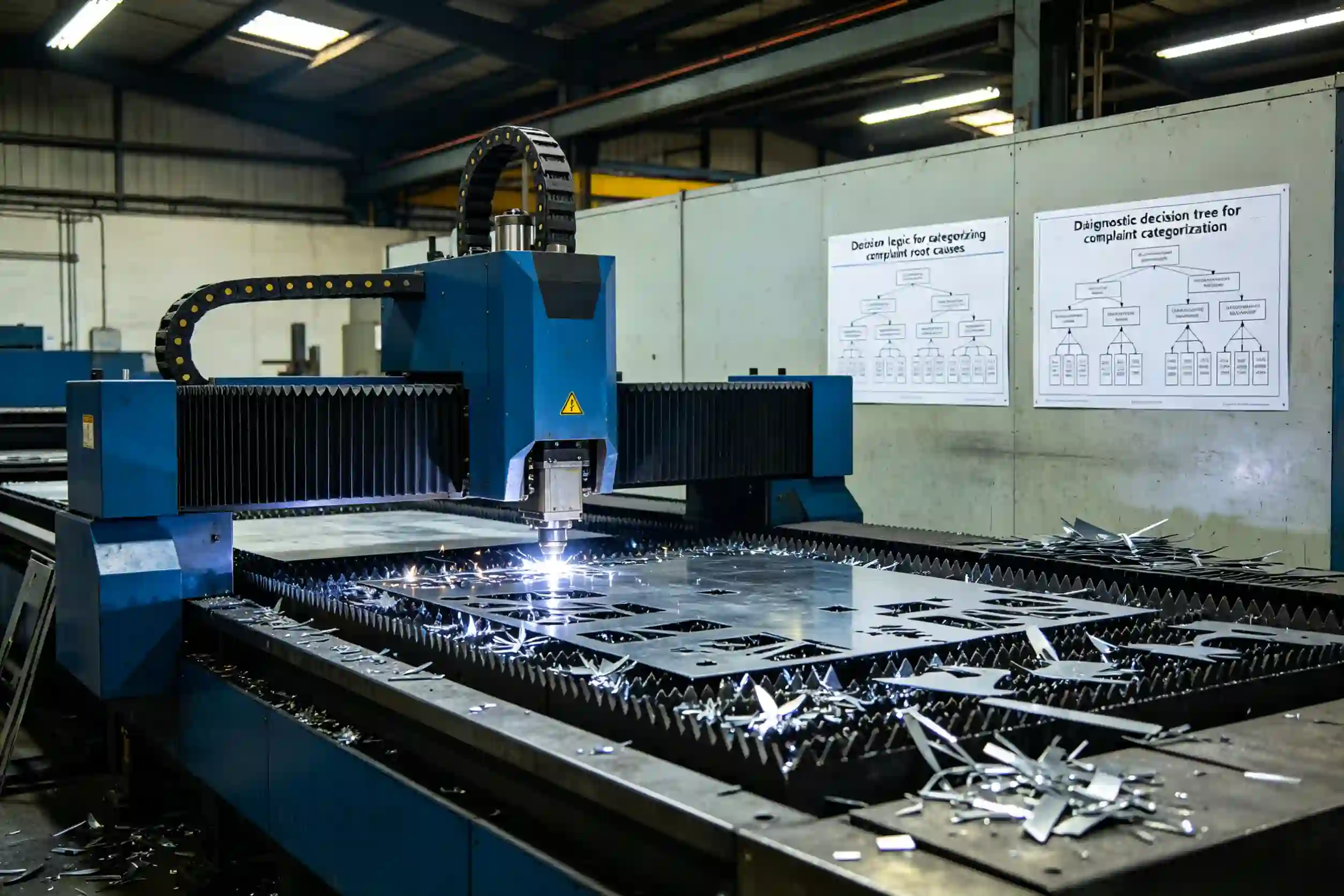
I guide distributors through cases where the category is not obvious. The customer insists the equipment is broken. The symptom could plausibly result from incorrect operation. Neither party has definitive proof. We use structured testing to establish the actual cause rather than negotiating based on assumptions.
Parameter issues create problems that resolve immediately when settings change. The customer experiences consistent poor results. A specific parameter adjustment produces immediate improvement. The problem does not return if correct parameters are maintained. This pattern indicates


