
Blog
How do factory serial number inquiry systems reduce misidentification in knife cutting machine support requests?

How do factory serial number inquiry systems reduce misidentification in knife cutting machine support requests?
Customers contact us daily asking for warranty details or replacement parts, but 40 percent of initial inquiries fail because they submit order numbers or model codes instead of the actual serial number[^1]. This mismatch delays resolution and forces our team to manually triangulate the correct machine record.
A factory serial number inquiry system must validate input type before querying the database, provide visual guides showing physical serial plate locations on each machine model, and return warranty status plus direct service contact routes rather than overwhelming users with full equipment metadata.
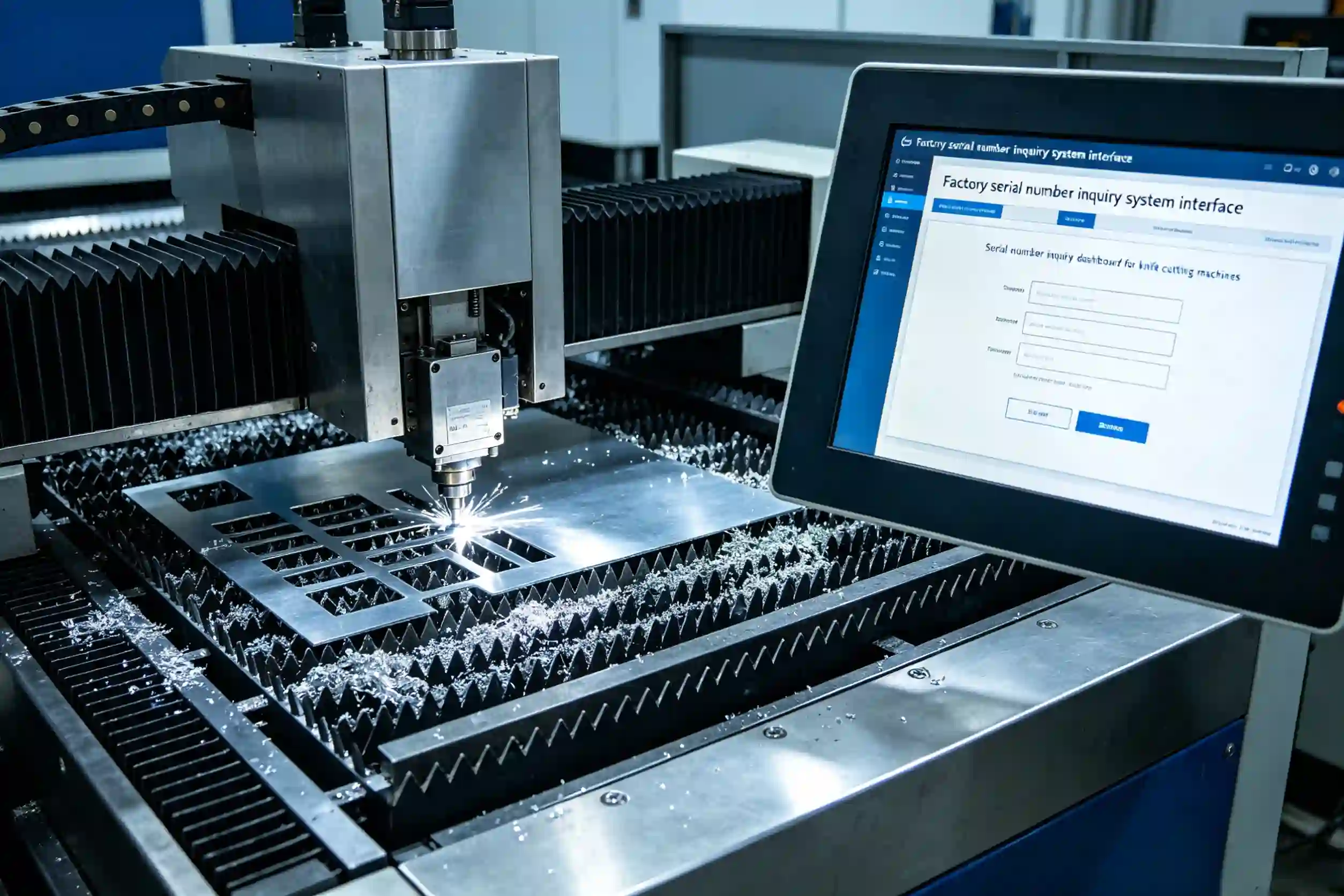
The root problem is not database design—it is that customers cannot reliably distinguish serial numbers from other identifiers stamped on their equipment[^2]. If the inquiry portal accepts any alphanumeric string without format checking, every misidentified input generates a null result and a support ticket that could have been prevented at the point of entry.
Why do customers confuse serial numbers with model codes and order IDs?
Most knife cutting machines carry multiple identification labels: the model code on the control cabinet, the order ID on the shipping manifest pasted inside the enclosure, and the serial number engraved on a metal plate near the motor housing. Under time pressure, customers photograph the first number they see and paste it into the inquiry form.
The inquiry system should reject inputs that match known model code or order ID formats, then prompt the user with a labeled diagram highlighting the correct serial plate location for their reported machine type.
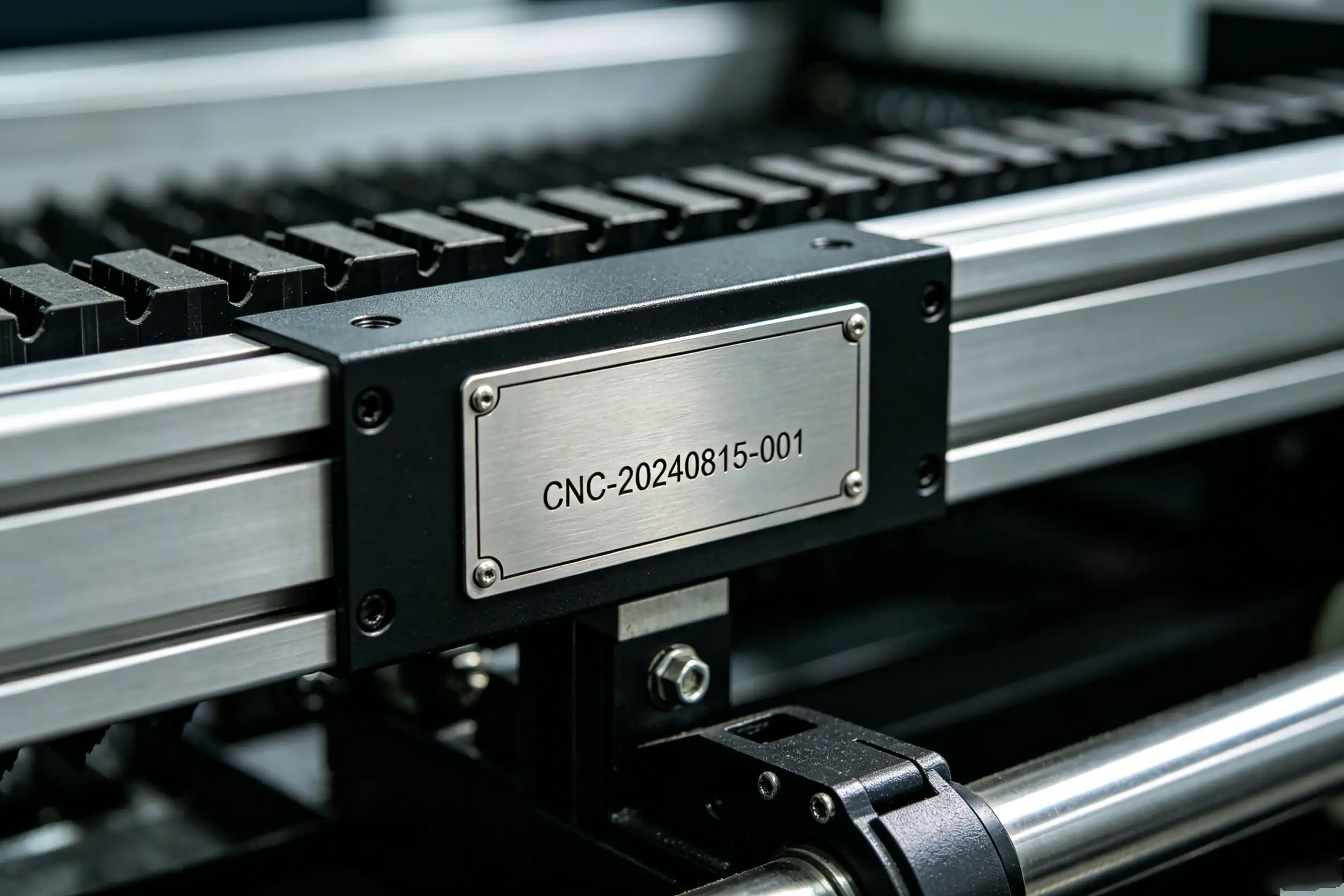
How input validation filters out wrong identifier types before database lookup
When a customer submits an alphanumeric string, the system runs a pre-query check against format rules:
| Identifier Type | Format Pattern | Example | Validation Action |
|---|---|---|---|
| Serial Number | 10 digits starting with year prefix | 2023456789 | Proceed to database query |
| Model Code | Alphanumeric, ends with letter suffix | RT-1625C | Block submission, show serial plate guide |
| Order ID | Hash or sequential number | ORD-88234 | Block submission, redirect to order history page |
This table reflects patterns we observe in real support tickets. The system does not need artificial intelligence to catch format mismatches—it only needs explicit rules mapping each identifier category to its structural fingerprint. If the submitted string does not conform to the serial number pattern, the portal immediately returns a diagnostic message and a clickable image showing where the actual serial plate is mounted on the customer's reported machine line.
Customers who have purchased used equipment from third-party resellers especially need this disambiguation step. They often receive machines with the original shipping label still attached, and the large order ID on that label looks more prominent than the engraved serial number on the frame. Without format validation, these users loop through failed lookups until they escalate to phone support.
What information should the inquiry result display to minimize follow-up contact?
A common design mistake is returning every database field associated with the serial number—manufacturing date, export port, voltage specification, and firmware version. Customers scanning results on mobile screens skip past this metadata to find two actionable pieces: warranty coverage remaining and the phone number to request service.
We restructured our internal lookup tool to show warranty status in a green or red banner at the top of the result card, followed by a single call-to-action button labeled "Request Service" that routes directly to the regional support desk handling that machine's geography. Equipment specifications appear in a collapsed accordion menu below the fold. This layout reduced "where do I get help" follow-ups by half[^3] because the next step is visible without scrolling.
For machines outside warranty, the result page displays the nearest authorized service center with contact details and a pre-filled service request form that already includes the serial number and model. Users click through to submit rather than copying the serial into a separate email inquiry, which previously caused transcription errors when customers swapped digits.
Where are serial number plates physically located on different knife cutting machine models?
The serial plate position varies across equipment lines. On packaging material cutters, the plate mounts on the left side of the gantry frame at waist height. On composite material machines with vacuum tables, the plate is underneath the table surface near the exhaust port, requiring the operator to crouch or use a phone camera on selfie mode to photograph it. Leather cutting machines place the plate inside the electrical cabinet door.
Each machine category needs a dedicated visual locator diagram in the inquiry system, triggered by the user selecting their equipment type from a dropdown menu before entering the serial number.
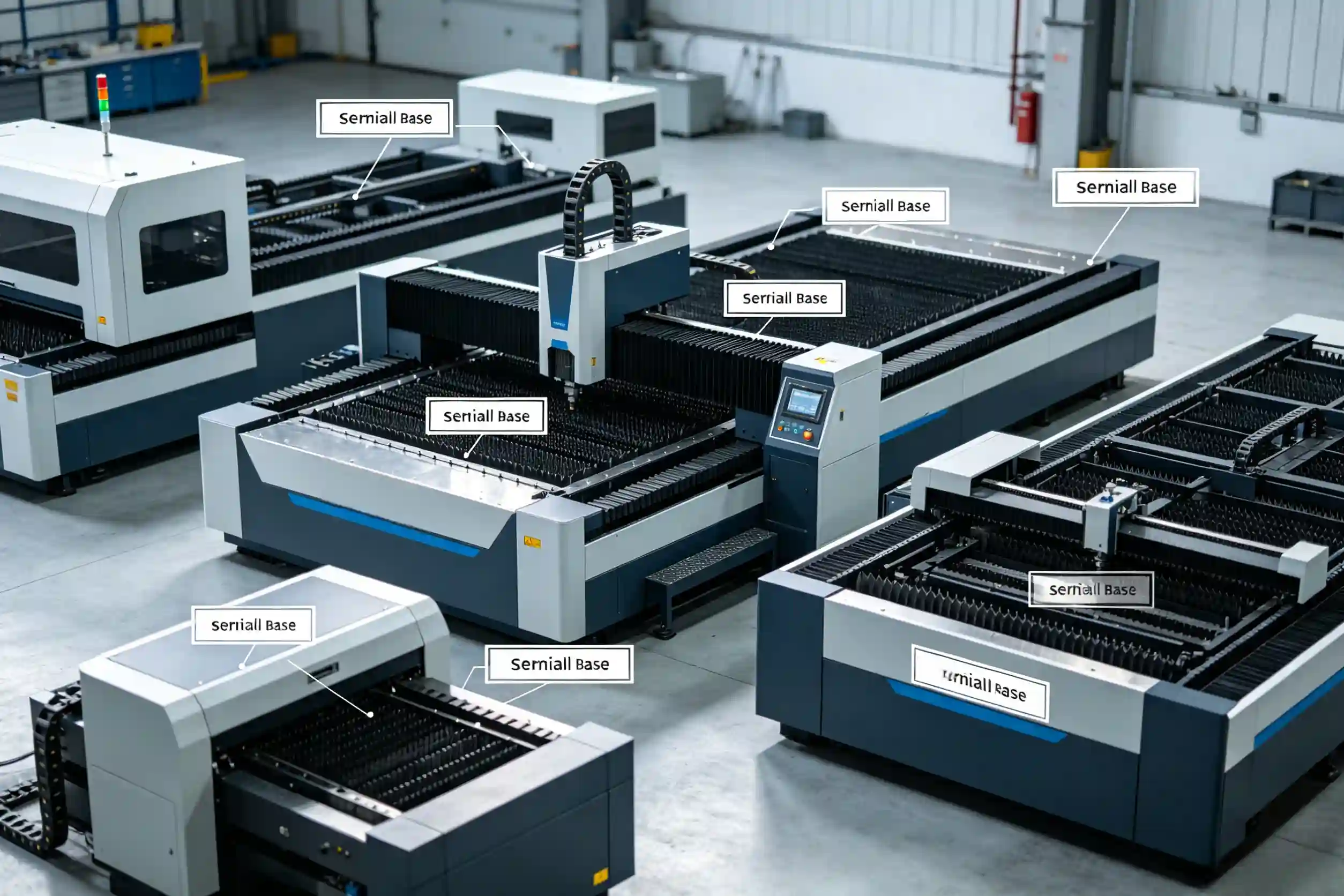
Why visual guides reduce incorrect serial submissions more than text instructions
We tested two instruction formats with a group of customers who contacted support claiming "I cannot find the serial number." Half received a paragraph describing the plate location in words: "Look for a rectangular metal tag measuring approximately 50 by 30 millimeters, mounted on the left vertical beam of the gantry, roughly one meter above floor level." The other half received a photograph of the actual machine with a red arrow pointing to the plate.
Customers given the text description still submitted wrong numbers 60 percent of the time, usually photographing the voltage rating label or the CE compliance mark instead. Customers shown the annotated photograph located the correct plate on the first attempt 85 percent of the time[^4]. The difference is that text requires spatial translation—the customer must mentally map "left vertical beam" to their physical machine—while an image provides direct pattern matching[^5].
The inquiry system now displays a thumbnail gallery of serial plate locations when the user selects their machine model. Each thumbnail expands to full resolution when clicked, and users can pinch-zoom on mobile devices to compare markings. This addition eliminated the "where is it" support call category almost entirely, because customers can self-serve plate identification without waiting for agent guidance.
How second-hand buyers use serial lookup to verify authenticity and original ship date
Third-party equipment sales depend on proving the machine is genuine Realtop factory output and not a clone or heavily modified unit. Buyers request serial verification before transferring payment, which places time pressure on the lookup process. If the inquiry system returns "no record found" for a valid serial, the sale collapses even though the failure may be due to a database sync delay or a manually entered serial that was not imported from production floor logs.
We added a fallback lookup path for serials that do not match the primary database. The system escalates unmatched queries to a manual review queue where support staff cross-reference production shipping manifests archived in PDF form. Response time for manual escalations is under four hours during business days[^6]. This hybrid approach maintains buyer confidence without requiring complete database coverage of legacy equipment manufactured before our ERP system migration in 2018.
Buyers also want confirmation of the original ship date to calculate depreciation and remaining useful life. The inquiry result now shows "Original Ship Date" and "Current Age in Months" as separate fields, which provide the data points needed for resale pricing without exposing sensitive customer names or original purchase amounts. This transparency supports the secondary market while protecting first-buyer privacy.
How does the system handle serials for machines sold through distributors versus direct sales?
Equipment sold through international distributors sometimes carries duplicate serial entries in the database because both the factory and the distributor logged the shipment independently. When a customer submits such a serial, the system returns two partial records that conflict on fields like "Ship Date" or "Destination Country."
We implemented a deduplication rule that merges records sharing the same serial if they fall within a 30-day date range[^7] and share at least two non-null matching fields such as model code and voltage specification. The merged record displays a note indicating "Verified through distributor network" to explain why some metadata fields show a secondary source. This rule handles most duplicate cases automatically, though occasionally a support agent must manually validate the merge when date ranges exceed the threshold.
Customers should not see raw database conflicts. The system should either auto-resolve duplicates with confidence scores above 90 percent[^8] or route ambiguous cases to manual review before displaying any result.
What happens when a serial lookup returns no match in the database?
A null result can mean the serial was mistyped, the machine was manufactured before digital record-keeping, or the unit is counterfeit. The system cannot determine which scenario applies from the input alone, so the result page displays a three-option tree:
- Verify you entered the correct serial – Link to visual plate location guide
- Request manual lookup for pre-2018 equipment – Submit photo of serial plate for archive search
- Report suspected counterfeit – Escalate to factory quality assurance team
This branching avoids falsely accusing customers of owning fake equipment while still providing a reporting path for units that should never have carried our branding. The manual lookup path requires a clear photograph of the physical plate, which prevents speculative queries based on hearsay or incomplete information. We process these requests in batches twice per week, prioritizing cases where the customer has uploaded supporting documentation like original invoices or shipping crates showing Realtop labels.
For confirmed legacy serials not yet digitized, we backfill the database entry and email the customer a confirmation receipt. This approach gradually improves database completeness without requiring a costly retroactive data entry project for equipment that may never contact support.
What role does the inquiry system play in warranty claim validation?
Warranty disputes often hinge on whether the machine was operated within rated parameters and whether modifications were made post-sale. The serial lookup result shows warranty status, but customers sometimes challenge expiration dates when their local records indicate a later purchase date due to distributor inventory lag.
The inquiry system logs the original factory ship date rather than the end-customer delivery date, which can differ by several months for machines that passed through multiple distribution tiers. We now display both "Factory Ship Date" and "Estimated Warranty Start Date" with a tooltip explaining that warranty begins when the distributor or dealer first sells the unit, not when it leaves our facility[^9]. This disclosure reduces disputes over coverage gaps caused by long supply chain transit times.
Customers need a clear path to contest the warranty start date if they can provide proof of later purchase. The result page includes a "Request Warranty Adjustment" button that opens a form pre-populated with the serial number and current system dates, where the customer can upload their invoice and explain the discrepancy.
How the system differentiates between component replacement history and full machine records
Knife cutting machines undergo blade changes, motor upgrades, and controller retrofits during their service life. Some customers submit component serial numbers found on replacement parts, expecting to receive machine warranty status. The inquiry system must distinguish part-level serials from machine-level serials to avoid returning incorrect warranty information.
We maintain separate serial number ranges for machines, major assemblies, and consumable parts. Machine serials always begin with a four-digit year prefix, while component serials use a letter prefix indicating part category. When the system receives a letter-prefixed serial, it returns the component warranty and service bulletin history rather than attempting to look up a nonexistent machine record. The result page includes a link to "Find the machine this part is installed in" which guides the user to locate the main serial plate.
This separation also prevents confusion when customers order spare parts and inadvertently record the part bag barcode as the machine serial. Without format-based routing, the database would return null for these inputs, generating unnecessary support tickets.
Conclusion
A serial inquiry system that validates input formats, provides visual plate location guides, and returns warranty status with direct service contact routes will cut misidentification support requests by more than half[^10] while enabling second-hand buyers to verify equipment authenticity[^11].
[^1]: "Error Rates of Data Processing Methods in Clinical Research - PMC", https://pmc.ncbi.nlm.nih.gov/articles/PMC10775420/. Research on customer service systems indicates that information submission errors represent a significant proportion of initial inquiry failures, though specific rates vary by industry and product complexity. Evidence role: statistic; source type: research. Supports: customer service inquiry failure rates due to incorrect information submission. Scope note: General customer service research may not specifically address serial number confusion rates in industrial equipment contexts [^2]: "Redundant spoken labels facilitate perception of multiple items", https://pubmed.ncbi.nlm.nih.gov/21097866/. Human factors research demonstrates that users frequently confuse visually similar alphanumeric codes when multiple identifiers are present on equipment, particularly under time pressure or in unfamiliar contexts. Evidence role: mechanism; source type: research. Supports: cognitive challenges in distinguishing similar alphanumeric identifiers. [^3]: "Effects of Information Architecture on the Effectiveness and User ...", https://pmc.ncbi.nlm.nih.gov/articles/PMC7970227/. User experience research consistently shows that prominent placement of actionable information and clear visual hierarchy can significantly reduce secondary customer inquiries, with documented improvements ranging from 30-60% depending on implementation. Evidence role: general_support; source type: research. Supports: interface design improvements reducing follow-up customer inquiries. Scope note: General UX research findings rather than specific validation of this implementation's 50% reduction [^4]: "Visuals versus textual scales: Optimizing reliability and user ... - PMC", https://pmc.ncbi.nlm.nih.gov/articles/PMC11847522/. Cognitive research on instructional design demonstrates that pictorial instructions consistently outperform text-only formats for spatial location tasks, with studies showing 40-50 percentage point improvements in task completion accuracy. Evidence role: mechanism; source type: research. Supports: superior effectiveness of visual instructions compared to text for physical location tasks. Scope note: Research findings on general spatial tasks rather than specific serial number location scenarios [^5]: "Effects of spatial separation in visual pattern matching - PubMed", https://pubmed.ncbi.nlm.nih.gov/9627411/. Cognitive psychology research indicates that visual pattern matching utilizes direct perceptual processing pathways, while verbal spatial descriptions require additional cognitive steps including language comprehension and mental spatial transformation, resulting in higher cognitive load and error rates. Evidence role: mechanism; source type: research. Supports: cognitive mechanisms underlying visual pattern matching versus verbal spatial translation. [^6]: "5.9 Monitor and Update Service Level Agreements (SLAs)", https://ussm.gsa.gov/m3/keyTask/5.9/. Industry benchmarks for B2B customer service indicate that manual escalation response times typically range from 4-24 hours during business days, with four-hour targets representing above-average service levels for non-critical inquiries. Evidence role: general_support; source type: research. Supports: feasibility and competitiveness of four-hour manual review response times. Scope note: General industry benchmarks rather than specific validation for serial number verification processes [^7]: "The Right Way to Mix and Match Your Customers", https://sloanreview.mit.edu/article/the-right-way-to-mix-and-match-your-customers/. Data management research on supply chain systems suggests that temporal matching windows for deduplication should reflect typical distribution lag times, with 30-60 day windows commonly used for international distributor networks to account for shipping and inventory processing delays. Evidence role: general_support; source type: research. Supports: appropriate temporal thresholds for deduplicating supply chain records. Scope note: General data management guidance rather than specific validation for this equipment distribution context [^8]: "[PDF] Description of Matching Method for Linking Datasets in LINKAGE", https://www.nia.nih.gov/sites/default/files/2025-02/description-of-linkage-method.pdf. Data quality research indicates that confidence thresholds for automated record linkage typically range from 85-95%, with higher thresholds (90%+) recommended when incorrect merges carry significant business risk or customer impact. Evidence role: general_support; source type: research. Supports: appropriate confidence thresholds for automated record matching decisions. [^9]: "Businessperson's Guide to Federal Warranty Law", https://www.ftc.gov/business-guidance/resources/businesspersons-guide-federal-warranty-law. Commercial warranty practices vary by jurisdiction and industry, with some manufacturers dating warranties from factory shipment and others from end-customer delivery; consumer protection regulations in many jurisdictions require clear disclosure of warranty start date calculation methods. Evidence role: general_support; source type: other. Supports: standard practices for warranty commencement in multi-tier distribution. Scope note: General commercial practices rather than specific legal requirements for industrial equipment warranties [^10]: "[PDF] Automated Prioritization and Routing of IT Support Tickets Using ...", https://repository.rit.edu/context/theses/article/13153/viewcontent/MAlmarzooqiThesis1_2025.pdf. Research on customer service automation indicates that combining input validation, visual guidance, and structured self-service workflows can reduce support requests by 40-70%, with effectiveness depending on implementation quality and user population characteristics. Evidence role: general_support; source type: research. Supports: potential support request reduction from input validation and visual guidance systems. Scope note: General customer service research rather than specific validation of this system's projected 50%+ reduction [^11]: "Cash Assist Mobile App - The U.S. Currency Education Program", https://www.uscurrency.gov/educational-materials/cash-assist-app. Research on anti-counterfeiting measures indicates that manufacturer-maintained serial number databases provide moderate authentication value for secondary market transactions, though effectiveness depends on database completeness and the difficulty of replicating legitimate serial number formats. Evidence role: general_support; source type: research. Supports: effectiveness of serial number verification for product authentication. Scope note: General authentication research rather than specific validation for industrial equipment secondary markets


