










Fast Shipping
Carrier information

20k products
Payment methods

24/7 Support
Unlimited help desk

2-day Delivery
Track or off orders
Specified Knife Configuration — In-house oscillating knife and creasing wheel selection matched to corrugated flute type and board GSM, tested on your substrate before shipment.
Technical Specifications
| Parameter | Value |
|---|---|
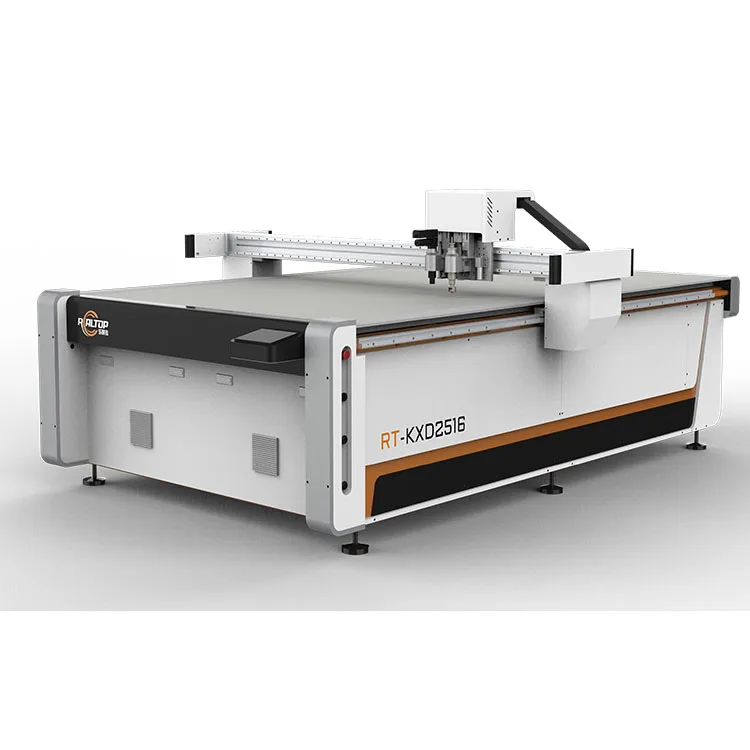
| Model | RT-D2516/RT-S2516 |
| Working Area | 1600 × 2500 mm |
| Machine Size | 3450 × 2300 × 1250 mm |
| Rated Power | 9 kW |
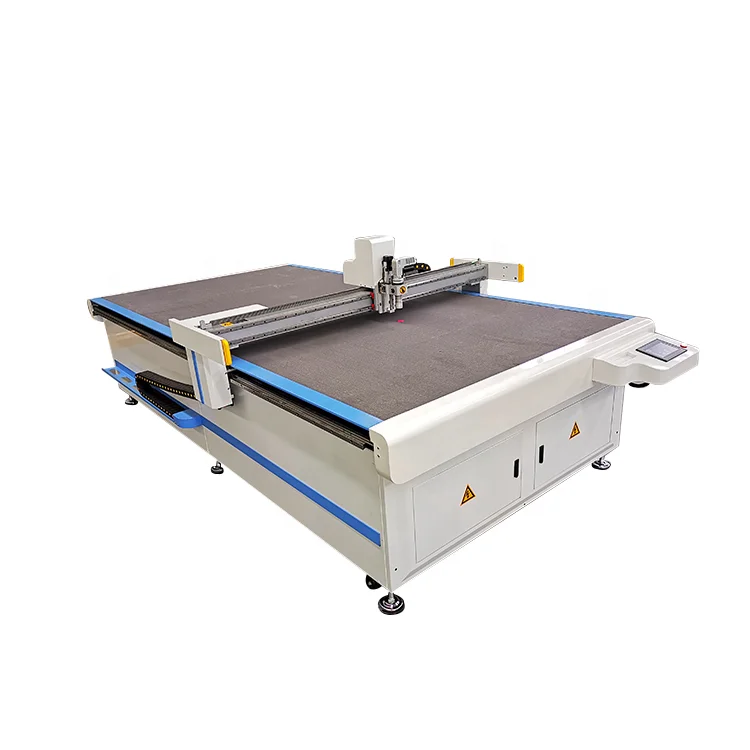
| Table Type | Aluminum alloy honeycomb vacuum platform |
| Tool Head | Swiss imported oscillating knife (full/half cut), creasing wheel |
| Translational Velocity | 800–1200 mm/s |
| Cutting Speed | 200–800 mm/s (varies by material and flute type) |
| Repeated Accuracy | ≤0.1 mm |
| Transmission System | Digital servo motor, linear guide, synchronous belt, ball screw |
| Guide Rail | Taiwan Hiwin linear guide |
| Drive Motor | Taiwan Delta servo motors and drivers |
| Instruction System | HP-GL compatible format |
| Voltage | 380V ± 10% |
| Vacuum Pump | 7.5 kW |
| Conveyor Belt | Germany imported |
| Frame | Welded thick square seamless steel, high-temperature stress relief |
| Safety Device | Infrared sensors, emergency stop |
| Software | Professional carton nesting software (supports multiple file formats) |
| Language Options | English, Russian, Italian, Chinese (customizable) |
Application Suitability
| Application | Material or Output |
|---|---|
| Corrugated carton sample making | Single-face, double-wall and micro-flute corrugated board |
| Short-run packaging production | E-flute, B-flute and BC-flute cartons up to applicable thickness |
| Sticker and label contour cutting | Self-adhesive vinyl, paper stickers, printed labels |
| Display and signage cutting | Cardboard POS displays, paper-based advertising materials |
| Gift box prototyping | Greyboard, art board, coated and uncoated paperboard |
What "200–800 mm/s" Actually Means for Your Flute
Cutting speed on corrugated board depends entirely on the flute profile, wall count and board density — never on the number alone.
I have watched packaging sample shops quote a machine based on the top speed printed on a brochure, then discover on day one that their BC-flute double-wall board forces the head down to the slow end of the range. The RT-D2516/RT-S2516 CNC corrugated carton cutting plotter specifications list 200–800 mm/s, but that spread covers everything from thin sticker vinyl to thick corrugated. Without confirming your actual flute type and GSM, that figure tells you nothing about real throughput. [NEED_CITE: corrugated flute classification and crush resistance standards]
Oscillating Knife and Creasing Wheel Selection by Board Grade
The oscillating knife on the RT-D2516/RT-S2516 handles full-cut and half-cut operations, but the difference between a clean fold line and a cracked one comes down to the creasing wheel matched to your board weight. Running a 400 GSM greyboard requires a wider, shallower creasing profile than a 200 GSM art card. This CNC corrugated carton cutting plotter pairs the Swiss imported knife with application-specific creasing tools so that the fold line compresses fibres rather than tearing them, which matters when the finished carton goes through automated packing lines downstream.
Vacuum Zoning and Registration Drift on Small Die-Cut Parts
A full-sheet vacuum zone holds large carton blanks flat without trouble. The problem shows up when you nest small die-cut parts — sticker contours, gift box components, display fittings — and the vacuum pulls unevenly across unused table area. The aluminum honeycomb platform on the RT-D2516/RT-S2516 supports zoned adsorption that follows the active cutting area. This keeps small pieces pinned at full traverse speed, preventing lift and the registration drift that scrapes printed contours. [NEED_CITE: vacuum table zoning principles for flatbed digital cutting]
How the Drive Train Affects Contour Accuracy on Printed Stickers
Repeated accuracy of ≤0.1 mm comes from the combination of Taiwan Hiwin linear guides and Delta servo motors driving the gantry. On printed sticker contour work, this matters because the cutting path follows the printed registration mark across the entire 1600 × 2500 mm bed. Any backlash in the synchronous belt or play in the ball screw shows up as a visible offset between print and cut, especially at the corners of small labels where the head reverses direction rapidly. The welded steel frame with high-temperature stress relief prevents bed twist from degrading that tolerance over long sample runs.
The Cost of Skipping a Sample Cut on Your Own Board
Specifying a carton cutting machine by working area alone is the most common mistake I see in packaging procurement. The buyer assumes any flatbed of that size handles their substrate, then finds the knife cannot penetrate their particular BC-flute density at production speed. Ragged edges, incomplete cuts and crushed flute structure all appear after the machine is bolted to the floor. With the RT-D2516/RT-S2516, the sample cut report runs your exact board grade and flute profile before any commitment is made, so the tool head, knife stroke and vacuum hold-down are confirmed against your real material. [NEED_CITE: material testing protocols for flatbed cutting equipment]
Why This CNC Corrugated Carton Cutting Plotter Stands Up to Short-Run Demands
The in-house design team configures the knife head, creasing wheel and vacuum zoning around your substrate rather than shipping a default setup. Taiwan Hiwin guides and Delta servos deliver the repeatability that printed contour work requires across the full bed. The professional carton nesting software handles HP-GL and common packaging file formats directly, removing the conversion step that slows sample turnaround. Voltage, plug type and control language are confirmed in writing before production starts. Every machine ships with a factory test record run on the buyer’s material specification.
Documentation & Verification
- Machine specification sheet listing configured tool heads and vacuum zone map
- Electrical schematic with voltage and plug type confirmed for your facility
- Sample cutting report on your corrugated grade and flute before dispatch
- Software licence with file format compatibility note for your nesting workflow
- CE declaration where applicable for your import market requirements
- Spare parts list covering knife blades, creasing wheels and vacuum seals
Installation, Commissioning & Support
- 9 kW rated power plus 7.5 kW vacuum pump requires dedicated 380V three-phase circuit
- Machine footprint of 3450 × 2300 mm needs clear access on three sides for loading
- Welded steel frame arrives assembled; gantry and head calibrated on site
- First-run parameter setup includes vacuum zoning adjustment for your smallest die-cut parts
- Operator training covers creasing wheel changeover by flute type and board weight
- Tool head spare kit includes oscillating knife blades and creasing wheels matched to your substrate
What to Prepare Before Requesting a Quote
Send your corrugated board grade, flute type and typical sheet dimensions so the tool head and vacuum zoning can be configured before quotation. Confirm your local voltage and frequency, the plug type required at your facility, and the control language your operators need. If you run printed sticker contour work, share a sample file so we can verify software compatibility and CCD recognition against your registration mark format before the order is placed.
Frequently Asked Questions
Q: How do I verify real cutting speed on my corrugated board?
A: The 200–800 mm/s range depends on your specific flute profile and board density. Request a sample cutting report run on your exact material — the report documents actual speed, knife stroke and edge quality, giving you a realistic throughput baseline rather than a brochure figure.
Q: Will small die-cut parts stay flat at full traverse speed?
A: The aluminum honeycomb vacuum table supports zoned adsorption that follows the active cutting area. Small sticker contours and box components stay pinned because suction concentrates under the working zone rather than bleeding across unused table surface.
Q: Can the CCD camera track printed marks on corrugated at production speed?
A: CCD contour recognition is available for printed sticker and label work. Confirm your registration mark format and print contrast during the sample cutting stage so the camera tracking parameters are tuned to your substrate before shipment.
Q: How do I choose between knife and creasing wheel for different flutes?
A: E-flute and micro-flute typically use the oscillating knife for clean cuts, while B-flute and BC-flute need a matched creasing wheel to compress fibres without crushing the structure. The tool head configuration is specified per your board grade and confirmed in the sample report.
Q: What software file formats does the nesting software support?
A: The professional carton nesting software accepts HP-GL and common packaging design formats. Share your current workflow files before ordering so compatibility is verified and any format conversion requirements are identified in advance.


商品评价
Clear filtersThere are no reviews yet.