







Fast Shipping
Carrier information

20k products
Payment methods

24/7 Support
Unlimited help desk

2-day Delivery
Track or off orders
Tool Head Matched to Board Grade — Swiss oscillating knife configured for corrugated flute depth, avoiding the crushed-edge failures common when generic cutters meet heavy packaging stock.
Technical Specifications
| Parameter | Value |
|---|---|
| Model | RT-D2516 / RT-S2516 |
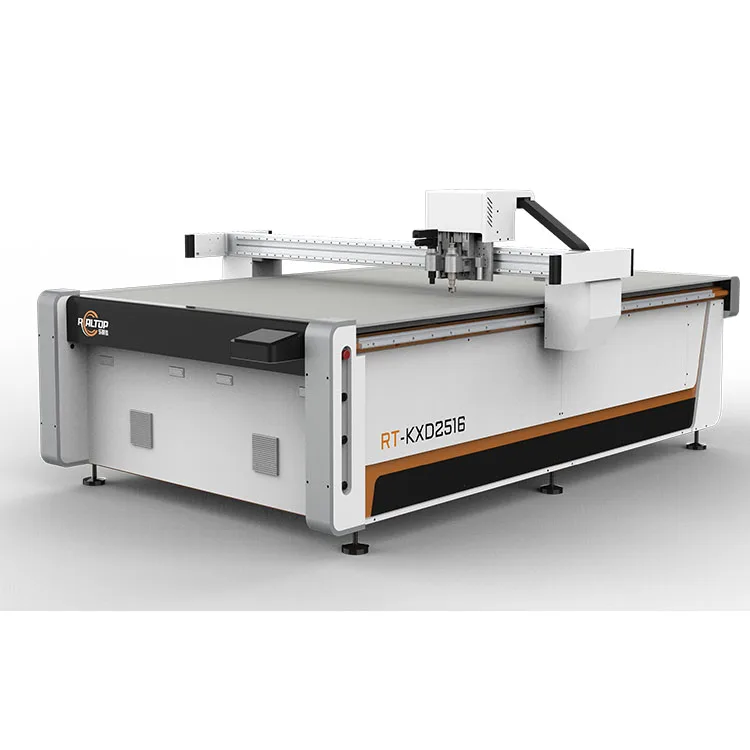
| Product Type | CNC Vibrating Knife Carton Cutting Machine |
| Working Area | 1600 × 2500 mm |
| Machine Dimensions | 3450 × 2300 × 1250 mm |
| Rated Power | 9 kW |
| Vacuum Pump Power | 7.5 kW |
| Table Type | Flat working table with aluminum alloy honeycomb platform |
| Tool Head | Swiss imported knife with vibration full cutting, half cutting, and cursor location |
| Safety Device | Infrared sensors |
| Translational Velocity | 800 – 1200 mm/s |
| Cutting Speed | 200 – 800 mm/s (according to different cutting materials) |
| Repeated Accuracy | ≤ 0.1 mm |
| Transmission System | Digital servo motor, linear guide, synchronous belt, ball screw, rack transmission |
| Servo Motor | Delta servo motor |
| Linear Rail | Taiwan Hiwin imported straight-line square guide |
| Conveyor Belt | Germany imported conveyor belt |
| Felt Belt | Wear-resistant anti-pull composite fiber (tension strength increase 35% — manufacturer claim) |
| Vacuum Platform | Aluminum alloy honeycomb structure with automatic zone adsorption |
| Instruction System | HP-GL compatible format |
| Voltage | 380V ± 10% |
| Software | Professional carton cutting software (supports multiple file formats, language customization) |
| Frame | Welded thick square seamless steel structure with high-temperature treatment |
| Standards | CE referenced |
Application Suitability
| Application | Material or Output |
|---|---|
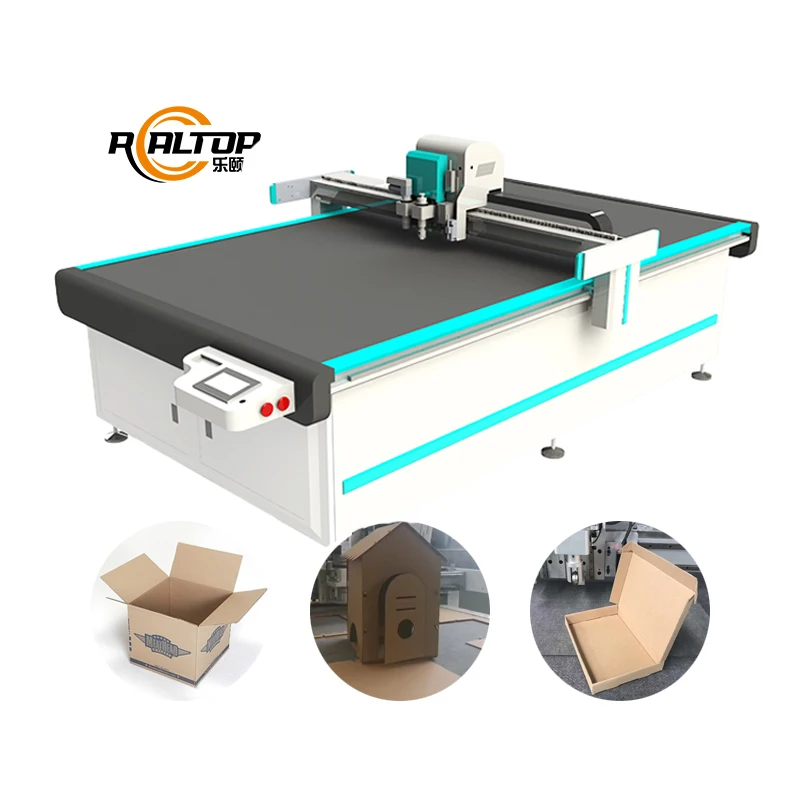
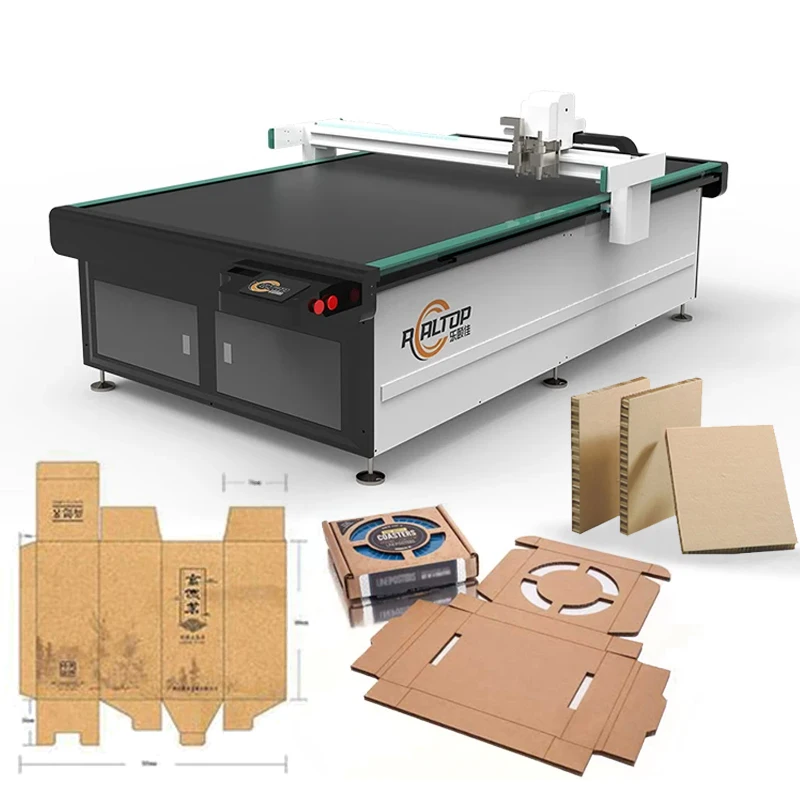
| Corrugated carton creasing and cutting | Single-wall and double-wall corrugated board, short-run prototypes |
| Paper box sample making | Card stock, folding carton board, gray board |
| Packaging carton manufacturing | Large-format paper and board stock for crease-and-cut workflows |
| Sticker and label cutting | Pre-printed vinyl, adhesive-backed paper, pattern sticker sheets |
| Billboard and business card production | Thin PVC sheets, card stock, composite paper materials |
| Flexible non-metal cutting | Leather, sponge composite leather, soft glass, silicon, rubber |
Why the Voltage Question Should Come Before the Price on a CNC Oscillating Knife Cutting Table
Every destination market runs on a different grid, and a 380V ±10% machine arriving at a 220V facility is a three-week paperweight.
I learned this the hard way with a carton cutting system shipped to the Middle East. The voltage standard was never confirmed before loading. When the buyer plugged it in, nothing happened — the transformer mismatch killed the entire startup schedule. Their packaging line sat idle while a step-down transformer was sourced locally. That kind of delay costs more than any discount on the machine itself. [NEED_CITE: voltage and frequency standards by export market]
This is why electrical confirmation belongs at the quotation stage, not the container-loading stage. When evaluating CNC oscillating knife cutting table specifications, voltage compatibility, plug type, and control panel language should be locked in before production begins.
Oscillating Knife versus Drag Knife for Board Weight
The RT-D2516 and RT-S2516 carry a Swiss imported oscillating knife head capable of both full cutting and half cutting in a single setup. For corrugated board, the vibrating action slices cleanly through flutes without crushing the profile — a drag knife would compress the material before penetrating it. When the same job requires creasing lines for fold-up boxes, the half-cut function scores the board to a controlled depth while leaving the facing paper intact. This dual capability means a packaging sample maker can prototype a folded carton on a single CNC oscillating knife cutting table without swapping tools mid-job.
Honeycomb Vacuum Zoning for Small Blanks
Small carton blanks and sticker sheets tend to lift at the edges when a vacuum table treats the entire surface as one zone. The aluminum alloy honeycomb platform on this system uses automatic zone adsorption, meaning only the active cutting area pulls vacuum. This keeps small die-cut shapes flat without wasting suction on empty table space. [NEED_CITE: vacuum hold-down principles for flatbed digital cutters] For sticker producers running nested layouts of varied sizes, zoned vacuum prevents the material shift that ruins contour accuracy on the final pieces.
Decoding the Drive Train for Daily Production Use
The Delta servo motor paired with Taiwan Hiwin linear rails and rack transmission delivers ≤ 0.1 mm repeated accuracy across the full 1600 × 2500 mm working area. In carton sample making, a positional drift of even half a millimeter misaligns crease lines with cut paths, producing boxes that refuse to fold square. Rack transmission resists the belt-stretch drift common on lighter machines after weeks of continuous use. The 9 kW total rated power and 7.5 kW vacuum pump ensure suction remains stable even when cutting dense double-wall board at the upper end of the 200 – 800 mm/s speed range. HP-GL compatibility means files from most packaging CAD systems import directly into the professional carton cutting software without format conversion.
The Cost of a Configuration Mismatch
Ordering a flatbed cutter on working area alone is the most frequent mistake in packaging equipment procurement. A table sized correctly for the sheet but fitted with the wrong knife profile will produce ragged corrugated edges or crushed foam inserts — defects that only appear once production starts. [NEED_CITE: material-specific tooling requirements in digital flatbed cutting] If the vacuum zoning is not specified for the smallest blank in the nesting layout, those parts lift during the final pass, forcing re-cuts and wasted stock. Software incompatibility discovered after delivery means the buyer’s existing CAD workflow cannot feed the machine directly, adding manual programming hours to every job.
Why Packaging Buyers Source This Range
In-house design covers both knife and laser technologies, so the cutting method is matched to the packaging material rather than forced into a single platform. Tool head and table configuration are specified per board grade and flute type before the order is confirmed. Software compatibility is verified against the buyer’s existing file formats and nesting workflow during the pre-order stage. Voltage, plug type, and control language are documented and confirmed for the destination market. Sample cutting on the buyer’s own corrugated or card stock is completed before any commitment is made. [NEED_CITE: CE machinery directive requirements for industrial equipment]
Documentation & Verification
- Machine specification sheet listing confirmed tool head, table zoning, and voltage for your market
- Electrical schematic with 380V ± 10% circuit diagram and plug type matching destination grid
- Tool head and table configuration list specifying Swiss knife parameters for your board grade
- Sample cutting report on your own corrugated or card stock showing edge quality and crease depth
- Software licence and file format compatibility note confirming your CAD workflow imports directly
- Factory test record documenting repeated accuracy across the full working area before dispatch
Installation, Commissioning & Support
- Floor space planning for 3450 × 2300 mm footprint with clearance for conveyor feeding and sheet loading
- Dedicated electrical circuit for 9 kW machine load plus 7.5 kW vacuum pump on 380V ± 10% supply
- Assembled frame with high-temperature-treated welded steel structure requiring on-site leveling only
- First-run parameter setup including Delta servo tuning, vacuum zone mapping, and knife depth calibration
- Operator training on professional carton cutting software, HP-GL file import, and nesting workflow
- Wear parts list covering Swiss knife blades, Germany imported conveyor belt, and composite fiber felt belt
What We Need to Quote Your Configuration
Send the material types you cut most often — corrugated flute grade, card stock weight, sticker substrate — along with the maximum sheet size and typical daily volume. Confirm your facility voltage, frequency, and preferred control panel language. If you have an existing CAD system, share a sample file so we can verify software compatibility and run a cutting test on your actual stock before proposing a configuration.
Frequently Asked Questions
Q: How do I choose between oscillating knife and drag knife for different corrugated board types?
A: Oscillating knives vibrate at high frequency to slice through flutes cleanly without crushing the profile, making them suited for single-wall and double-wall corrugated board. Drag knives work better on thin card stock and sticker materials where a pulled blade produces a clean edge. The Swiss imported head on this system handles both full cutting and half cutting for crease lines, covering most packaging prototype requirements in one setup.
Q: Will the vacuum table hold small carton blanks flat during cutting?
A: The aluminum alloy honeycomb platform uses automatic zone adsorption, activating vacuum only in the active cutting region rather than across the entire table. This prevents small blanks from lifting at the edges during the final cut pass, which is a common problem on machines with single-zone vacuum. The zoning adapts to whatever nesting layout your carton software produces.
Q: Can the software import files from my existing packaging CAD system?
A: The professional carton cutting software supports multiple file formats and is HP-GL compatible, which covers most standard packaging design outputs. Before order confirmation, we verify compatibility against your specific CAD system and nesting workflow. A sample file exchange during the inquiry stage ensures the software chain works end-to-end before the machine ships.
Q: What voltage and language options are available for export markets?
A: The standard configuration runs on 380V ± 10%, but voltage requirements are confirmed for your destination market before production begins. Plug type, frequency, and control panel language are all specified at the quotation stage. This prevents the kind of on-site electrical mismatch that can delay a packaging line startup by weeks.
Q: Do you test the machine on my actual material before I commit?
A: Yes. A sample cutting report is produced on your own corrugated board, card stock, or sticker material, documenting edge quality, crease depth, and dimensional accuracy. This lets you evaluate real results on your production substrate before placing the order, rather than relying on generic demonstration samples that may not reflect your actual cutting requirements.


商品评价
Clear filtersThere are no reviews yet.