


Fast Shipping
Carrier information

20k products
Payment methods

24/7 Support
Unlimited help desk

2-day Delivery
Track or off orders
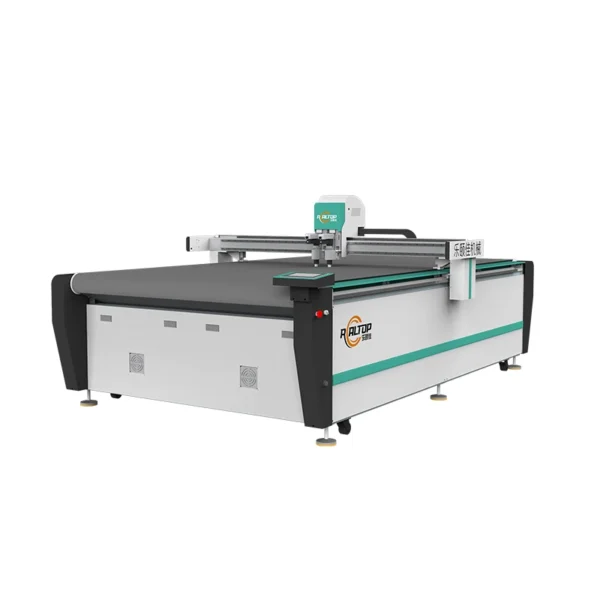
Configurable Tool Head Platform — Each REALTOP RT-D2516/RT-S2516 leaves the factory with the knife, vacuum zoning and vision system matched to the buyer’s actual fabric weight and ply count, not a default catalogue build.
Technical Specifications
| Parameter | Value |
|---|---|
| Product Type | CNC Oscillating Knife Cutting Machine |
| Model | RT-D2516 / RT-S2516 |
| Working Area | 1600 × 2500 mm |
| Machine Size | 3450 × 2300 × 1250 mm |
| Rated Power | 9 kW |
| Voltage | 380 V ±10 % |
| Translational Velocity | 800 – 2000 mm/s |
| Cutting Speed | 200 – 800 mm/s (basis not stated in source — confirm material / thickness) |
| Cutting Thickness | ≤ 100 mm (varies with material density and tool head) |
| Repeated Accuracy | ≤ 0.1 mm |
| Fixed Model | Flat working table / Auto feeding table |
| Multifunctional Head | Swiss imported knife (vibration full cut, vibration half cut, cursor location) |
| Tool Head Options | Oscillating knife, pneumatic knife, high-power vibrating knife, circular knife, V-cutting knife, drag knife, creasing wheel, dotted line knife, punching, brush |
| Visual Positioning | Small CCD camera mark point positioning, panoramic camera recognition, projection positioning |
| Safety Device | Infrared sensors (anti-collision, emergency stop, intelligent sensor stop) |
| Transmission System | Digital servo motor, linear guide, synchronous belt, ball screw |
| Instruction System | HP-GL compatible format |
| Vacuum Table | Magnesium-aluminum alloy, fluorocarbon PVDF powder spraying, anodic oxidation, hard oxidation |
| Vacuum Pump | 7.5 kW, integrated aviation aluminum shell, built-in silencer sponge (noise reduction 35 %) |
| Servo Motor Options | Delta or Panasonic (IP67, waterproof) |
| Control Panel | Touch screen, multiple languages supported |
| Software | Auto typesetting, supports PLT, DXF, AI and other file formats |
| Machine Frame | Welded thick-walled seamless steel structure, high-temperature tempering, CNC machining center finished |
Application Suitability
| Application | Material or Output |
|---|---|
| Garment and footwear cutting | Multi-layer woven, knit, denim, leather and shoe upper materials |
| Soft home furnishing production | Upholstery fabric, curtain cloth, non-woven and sponge padding |
| Automotive interior trimming | Synthetic leather, PU, EVA, XPE foam, composite gasket sheets |
| Carpet and floor mat fabrication | Woven carpet, rubber underlay, PVC and foam board |
| Luggage and bag manufacturing | Heavy canvas, nylon, PU leather, reinforcement panels |
| Packaging sample making | Corrugated cardboard, plastic box stock, sticker film |
Why the Tool Head Decision Matters More Than Table Size
A cutting table sized only by working area will underperform the day a thicker composite or looser knit shows up on the belt.
Many buyers focus on the 1600 × 2500 mm bed and assume any fabric within that footprint will cut cleanly. In reality, a high-loft non-woven or a dense automotive sound-deadening mat demands a completely different oscillating frequency and blade geometry than a light garment lining. When the wrong CNC Oscillating Knife Cutting Machine specifications are locked in before material trials begin, the first sign of trouble is ragged edges on the ply nearest the vacuum surface, forcing operators to slow the head down and lose the throughput they budgeted for. [NEED_CITE: oscillating knife cutting principles for multi-layer textile]
Matching Knife Type to Fabric Construction
The RT-D2516 and RT-S2516 platforms carry up to ten interchangeable tool heads, and selecting among them is the first real engineering decision. A high-power vibrating knife slices through dense foam and rubber gasket stock where a standard oscillating blade would deflect, while a circular knife handles long straight runs on woven garment cloth without the micro-serration left by a reciprocating edge. Creasing wheels and drag knives extend the same chassis into corrugated packaging samples, so a single CNC Oscillating Knife Cutting Machine specifications sheet covers textile, foam and board without adding a second machine.
Vacuum Zoning That Holds Small Pattern Pieces
Small garment panels and shoe upper components tend to lift at the trailing edge once the blade exits the cut, especially on slippery synthetic linings. The magnesium-aluminum alloy table uses a fluorocarbon PVDF coating to reduce static adhesion, while independent vacuum zones let the operator isolate suction only where material is present. A 7.5 kW pump with an integrated silencer sponge keeps ambient noise manageable in continuous shifts. This zoning approach is what keeps the ≤ 0.1 mm repeated accuracy meaningful when nesting dozens of small pieces across the 1600 × 2500 mm bed. [NEED_CITE: vacuum hold-down requirements for small textile parts]
What the Drive Train Tolerance Means for Pattern Matching
A digital servo motor paired with linear guides and ball screws delivers the ≤ 0.1 mm repeatability required for plaid and stripe matching in garment cutting. When the CCD mark-point camera or panoramic recognition system locates printed registration marks, any backlash in the transmission would shift the contour and waste an entire ply. The welded thick-walled steel frame, stress-relieved by high-temperature tempering and finished on a CNC machining center, prevents the frame itself from becoming the source of drift over long production runs.
The Cost of Skipping a Sample Cut Before Commitment
A buyer who approves a machine on working area and price alone often discovers the real limitation on the first day of production. A dense automotive foam that appeared manageable at 20 mm may require the high-power vibrating knife and a slower feed rate, cutting effective throughput below the line-speed assumption. Similarly, a printed stretch knit that tracked perfectly on the supplier’s sample may slip under vacuum if the PVDF-coated table was not specified with fine-zone segmentation. These mismatches surface as edge fuzzing, ply shift or contour drift, each one demanding unplanned downtime. [NEED_CITE: textile cutting edge quality variables]
Why Buyers Source This Platform From the Jinan Workshop
In-house design covers both the knife cutting head and the vacuum table casting, so tool head selection and table zoning are coordinated rather than sourced from separate vendors. Each machine ships with a sample cutting report run on the buyer’s own fabric roll, confirming edge quality and effective cutting thickness before the crate is sealed. Voltage, plug type and control panel language are locked in at order confirmation, avoiding the rewiring delays that strand machines at foreign ports. The software environment is verified against the buyer’s existing PLT, DXF or AI nesting files so the first production day is not spent troubleshooting format imports.
Documentation & Verification
- Machine specification sheet confirming tool head list and vacuum zone layout
- Electrical schematic with voltage and frequency matched to destination grid
- Sample cutting report on buyer’s fabric including edge and thickness photos
- Tool head and table configuration list tied to buyer’s material schedule
- Software license and file format compatibility note for nesting workflow
- Factory test record covering repeatability and CCD mark tracking
Installation, Commissioning & Support
- 380 V ±10 % dedicated circuit with isolated ground for 9 kW total load
- Level foundation pad sized to 3450 × 2300 mm footprint plus operator clearance
- Vacuum pump silencer sponge inspected and 7.5 kW pump rotation verified on site
- Servo drive parameter tuning against buyer’s actual fabric ply stack
- CCD camera calibration using buyer’s printed registration marks
- Spare oscillating blades, drag knife tips and creasing wheels included at delivery
Sending a Useful Inquiry
To receive a configuration that matches your cutting floor rather than a generic quotation, include the heaviest fabric or composite you plan to run along with its thickness and the maximum number of plies you intend to stack. Note your local voltage and frequency so the servo drives and vacuum pump are wound correctly. If your patterns come from a specific nesting software, share a sample file so format compatibility is confirmed before the control panel is programmed.
Frequently Asked Questions
Q: Which tool head should I choose for multi-layer garment fabric versus automotive foam?
A: Multi-layer woven or knit garment cloth typically runs best with the standard oscillating knife or circular knife for long straight segments, while automotive foam and dense rubber gasket material benefit from the high-power vibrating knife or pneumatic knife to prevent blade deflection. The RT-D2516 and RT-S2516 platforms allow tool head swaps on the same multifunctional head, so you can cover both families without purchasing a second machine.
Q: Can the CCD system track printed marks at full production speed on stretch fabric?
A: The small CCD mark-point camera and optional panoramic camera locate printed registration marks before the knife engages, and the servo-driven linear guide maintains ≤ 0.1 mm repeatability during contour traversal. On highly elastic stretch knits, vacuum zone pressure and fabric pre-tension must be tuned during the sample cutting stage so that the mark position does not shift between the camera pass and the actual cut.
Q: How is the vacuum table zoned for small pattern pieces that tend to lift?
A: The magnesium-aluminum alloy table is segmented into independently controlled zones so suction concentrates only under the material currently being cut. The 7.5 kW pump maintains differential pressure even when only a fraction of the 1600 × 2500 mm bed is covered, and the PVDF fluorocarbon coating reduces static cling that would otherwise allow light lining fabrics to drift after the blade exits.
Q: What electrical and language details must be confirmed before the machine ships?
A: Voltage and frequency must match the destination grid — the standard 380 V ±10 % configuration can be adapted where local supply differs. Plug type, servo drive winding and vacuum pump motor rating are set during production. The touch-screen control panel supports English, Russian, Italian, Chinese and custom languages, which are loaded and tested at the factory so operators can begin training on day one.
Q: Will my existing nesting software files run on the machine without conversion?
A: The control software supports PLT, DXF, AI and other common vector formats through HP-GL compatible instructions. Before order confirmation, a sample file from your nesting workflow is opened on the factory system to verify layer recognition, tool path assignment and cut sequence. Any required mapping is documented in the software compatibility note shipped with the machine.


商品评价
Clear filtersThere are no reviews yet.