









Fast Shipping
Carrier information

20k products
Payment methods

24/7 Support
Unlimited help desk

2-day Delivery
Track or off orders
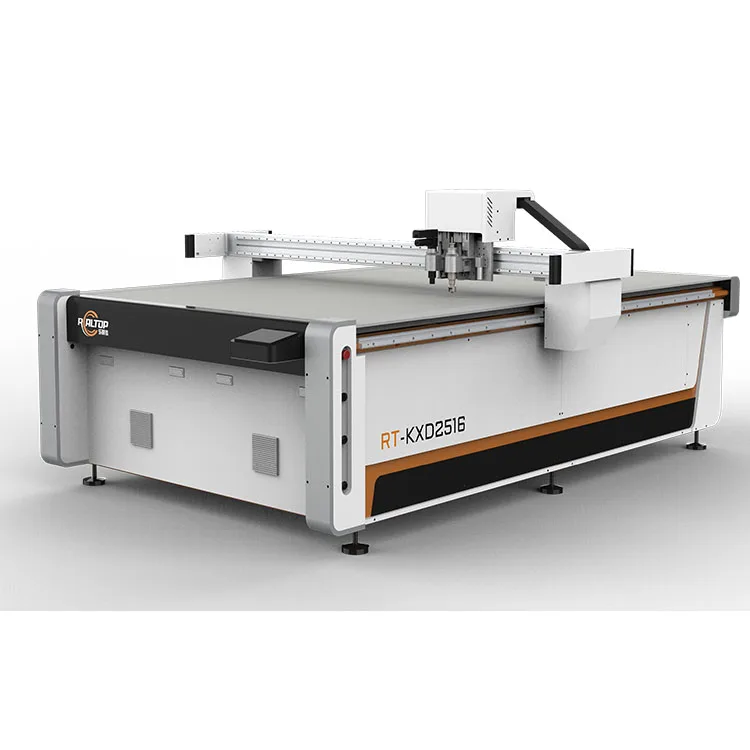
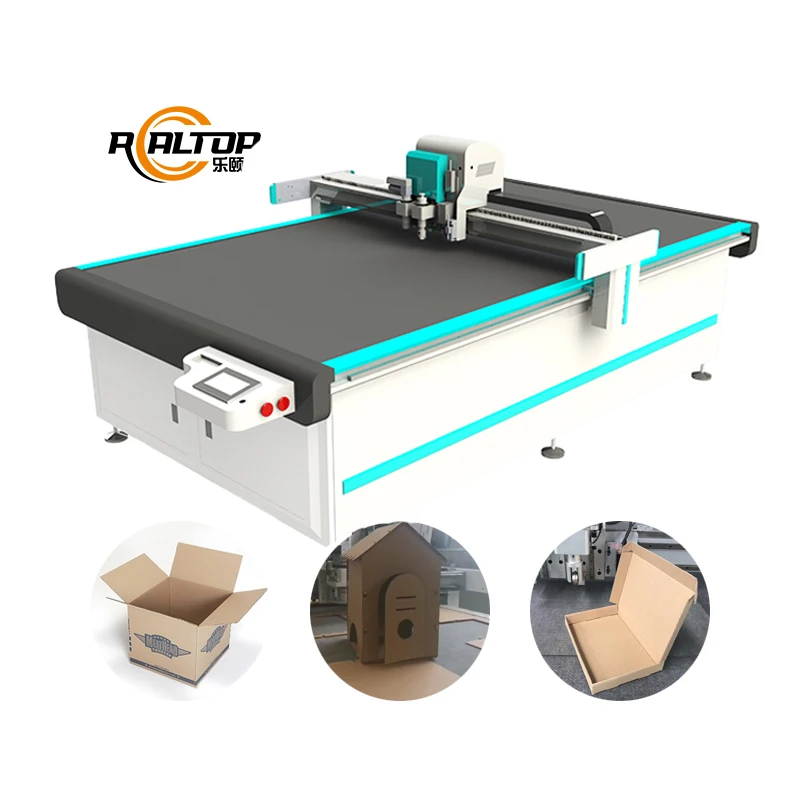
Swiss oscillating knife integration — the RT-D2516/RT-S2516 uses a dedicated vibration tool head specified per corrugated flute profile rather than a generic drag knife setup.
Technical Specifications
| Parameter | Value |
|---|---|
| Model | RT-D2516 / RT-S2516 |
| Working Area | 1600 × 2500 mm |
| Machine Size (L × W × H) | 3450 × 2300 × 1250 mm |
| Rated Power | 9 kW |
| Voltage | 380V ± 10% (50/60 Hz to be confirmed with buyer) |
| Control System | CNC, HP-GL compatible |
| Tool Head | Swiss imported oscillating knife (full cut, half cut, cursor location) |
| Translational Velocity | 800 – 1200 mm/s |
| Cutting Speed | 200 – 800 mm/s (basis to be confirmed by material type, flute and thickness) |
| Repeatability | ≤ 0.1 mm |
| Transmission | Taiwan Hiwin linear guide, Taiwan Delta servo motors and drivers, synchronous belt, ball screw |
| Vacuum Table | Aluminum alloy honeycomb structure with 7.5 kW vacuum pump |
| Conveyor Belt | Germany imported composite fiber felt (tension strength increased by 35% per supplier claim — verify against test report) |
| Safety Device | Infrared sensors, emergency stop |
| Software | Free carton nesting software, multi-format file import |
| Assembly State | Flat working table, auto feeding available |
| Language Options | Customizable (English, Russian, Italian, Chinese available) |
Application Suitability
| Application | Material or Output |
|---|---|
| Corrugated carton sample making | A, B, E, and BE flute profiles in single and double wall |
| Packaging small-batch production | Cardboard, corrugated board, and composite paper panels |
| Sticker and label contour cutting | Self-adhesive vinyl, coated paper, and synthetic label stock |
| Paper box prototyping | Grey board, folding carton board, and kraft composite sheets |
| Gift and express box production | Thin to medium flute corrugated with printed registration marks |
Why a 1600 × 2500 mm Bed Alone Does Not Guarantee Clean Cuts
The oscillating knife must match the flute type, not just the sheet size.
I have watched packaging shops take delivery of a cutter spec’d entirely on working area, only to find the default drag knife crushes E-flute edges and leaves ragged tear lines on double-wall stock. A CNC oscillating knife carton cutting plotter specification sheet that omits flute profile and board thickness leaves the most consequential variable unaddressed. The knife oscillation frequency, stroke length, and downforce all shift when moving from B-flute to triple-layer corrugated, and swapping tool heads after commissioning costs both downtime and tooling budget [NEED_CITE:].
Tool Head Selection Across Flute Profiles
The Swiss imported oscillating knife head on this plotter handles full cutting, half cutting, and cursor location within one tool station. For E-flute micro-corrugated board, the high-frequency short-stroke oscillation produces a shearing action that separates fibers cleanly without compressing the flute tips. Switching to B-flute or BE double wall requires a longer stroke and higher downforce so the blade reaches through the full caliper. Buyers running both thin folding carton and thick corrugated on the same shift benefit from confirming the oscillation amplitude range before the machine leaves the factory.
Vacuum Zoning for Small Carton Blanks
A 7.5 kW vacuum pump pulls air through an aluminum honeycomb table, but suction alone does not solve the problem of small blanks lifting at cut completion. When the knife exits the material at the end of a contour, residual vacuum differential can yank a lightweight sticker or a narrow carton flap upward. Zoning the table into independent sectors lets the operator isolate suction to the area still being cut. Ask the builder how many vacuum zones are wired and whether each can be switched from the control panel or only through manual valve adjustment [NEED_CITE:].
Reading the Motion and Drive Numbers
The Taiwan Hiwin linear rails paired with Delta digital servos deliver a ≤ 0.1 mm repeatability figure, which matters most when creasing and cutting must register to the same printed outline across dozens of blanks. Translational speed of up to 1200 mm/s governs non-cutting travel between contours, while the 200 – 800 mm/s cutting speed window depends entirely on board density and flute geometry. A dense grey board at 2 mm caliper forces the lower end of that range; an E-flute carton blank at 1.5 mm allows the upper end. The 9 kW rated power covers the servo drives, vacuum pump, and oscillating motor combined, so confirm with your electrician that the site supply can sustain continuous draw, not just peak start-up load.
When the Wrong Configuration Reaches the Shop Floor
An underpowered vacuum pump paired with a large-format table means the outer zones lose suction whenever a heavy cut vents air through the kerf. Small carton blanks shift mid-contour, and the nesting software compensates by slowing the feed, which the operator reads as an unexplained drop in output. Similarly, if the CCD camera is promised for contour recognition but the camera model cannot resolve low-contrast registration marks at production speed, every printed carton run devolves into manual alignment [NEED_CITE:].
Why This Build Fits Packaging Workflows
In-house design covers both knife and laser cutting, so the factory selects the process that suits the stock rather than forcing one technology onto every material. Tool head and table configuration are specified per board caliper and daily volume, not pulled from a standard SKU list. CCD camera positioning is offered for printed contour work when the buyer provides print samples before order. Software file format compatibility — HP-GL, DXF, PLT — is confirmed against the buyer’s existing nesting workflow. Sample cutting on the buyer’s own corrugated material is completed before commitment, producing a report that records flute type, knife pressure, and edge condition.
Documentation & Verification
- Machine specification sheet listing tool head model and oscillation stroke range
- Electrical schematic with voltage and frequency confirmation for destination market
- Tool head and vacuum zone configuration list matched to buyer’s flute profiles
- Sample cutting report on buyer-supplied corrugated board with edge photos
- Factory test record documenting repeatability and contour registration results
- Software license and file format compatibility note signed before shipment
Installation, Commissioning & Support
- 380V ± 10% three-phase supply with dedicated 9 kW circuit confirmed before dispatch
- Flat concrete floor required; machine footprint 3450 × 2300 mm plus operator clearance
- Flat-pack shipment with reassembly of honeycomb table and gantry on site
- First-run calibration of servo drives, vacuum zones, and knife stroke by factory engineer
- Operator training covering nesting software, tool head changes, and vacuum zone switching
- Spare oscillating blades, drive belts, and vacuum seals included in initial parts kit
What to Include in Your First Inquiry
Send the specific corrugated flute profiles, board caliper range, and maximum sheet size you run, along with your daily blank volume and whether your workflow already uses nesting software. Confirm your local voltage and frequency, preferred control language, and whether printed contour recognition is required for your carton designs.
Frequently Asked Questions
Q: What board thickness and flute type is the 200 – 800 mm/s cutting speed based on?
A: That range is a general window. Actual speed depends on flute profile, board density, and caliper. We run a sample cut on your own corrugated stock and record the achievable speed with the selected oscillating knife stroke before quoting a production figure.
Q: How do I choose between full cut, half cut, and creasing wheel on this plotter?
A: Full cut separates the blank from the sheet, half cut scores fold lines on thin carton board, and a creasing wheel compresses flute without breaking the liner on corrugated stock. We recommend the tool combination after reviewing your box structural design.
Q: How many vacuum zones does the table have, and why does it matter?
A: The aluminum honeycomb table is divided into independently switchable zones. Multiple zones prevent small carton blanks from lifting when adjacent areas are vented during cutting, which is critical for sticker and label runs.
Q: Can the software import my existing DXF or AI box templates?
A: The carton nesting software supports multi-format import including HP-GL, DXF, and PLT. We verify file compatibility with your current design software during the pre-order sample phase and document the result in a compatibility note.
Q: What voltage and language options are confirmed before shipment?
A: The standard supply is 380V ± 10%, but we confirm your site frequency and plug type before production. Control language is customizable — English, Russian, Italian, and Chinese are available, with other languages arranged on request.


商品评价
Clear filtersThere are no reviews yet.