
Blog
How Do Manufacturers Reduce Operating Noise of Knife Cutting Machines?

How Do Manufacturers Reduce Operating Noise of Knife Cutting Machines?
I still remember walking into a customer's workshop where their quality control manager was shouting instructions to operators over the constant hum and clatter of their knife cutting machines. They called us not because the equipment was broken, but because noise had become a compliance risk and was disrupting their quality inspections. That visit taught me something crucial: noise is not a single problem you fix by swapping one part or adding a cover. It is a system problem that requires coordination across mechanical design, cutting operations, and sound transmission paths.
Manufacturers reduce knife cutting machine noise through three simultaneous interventions: precision mechanical design to control noise generation at the source, cutting process optimization to minimize operational noise during material processing, and transmission path management to block sound propagation. Effective noise reduction requires addressing all three levels rather than applying isolated fixes like soundproof covers or motor upgrades alone.
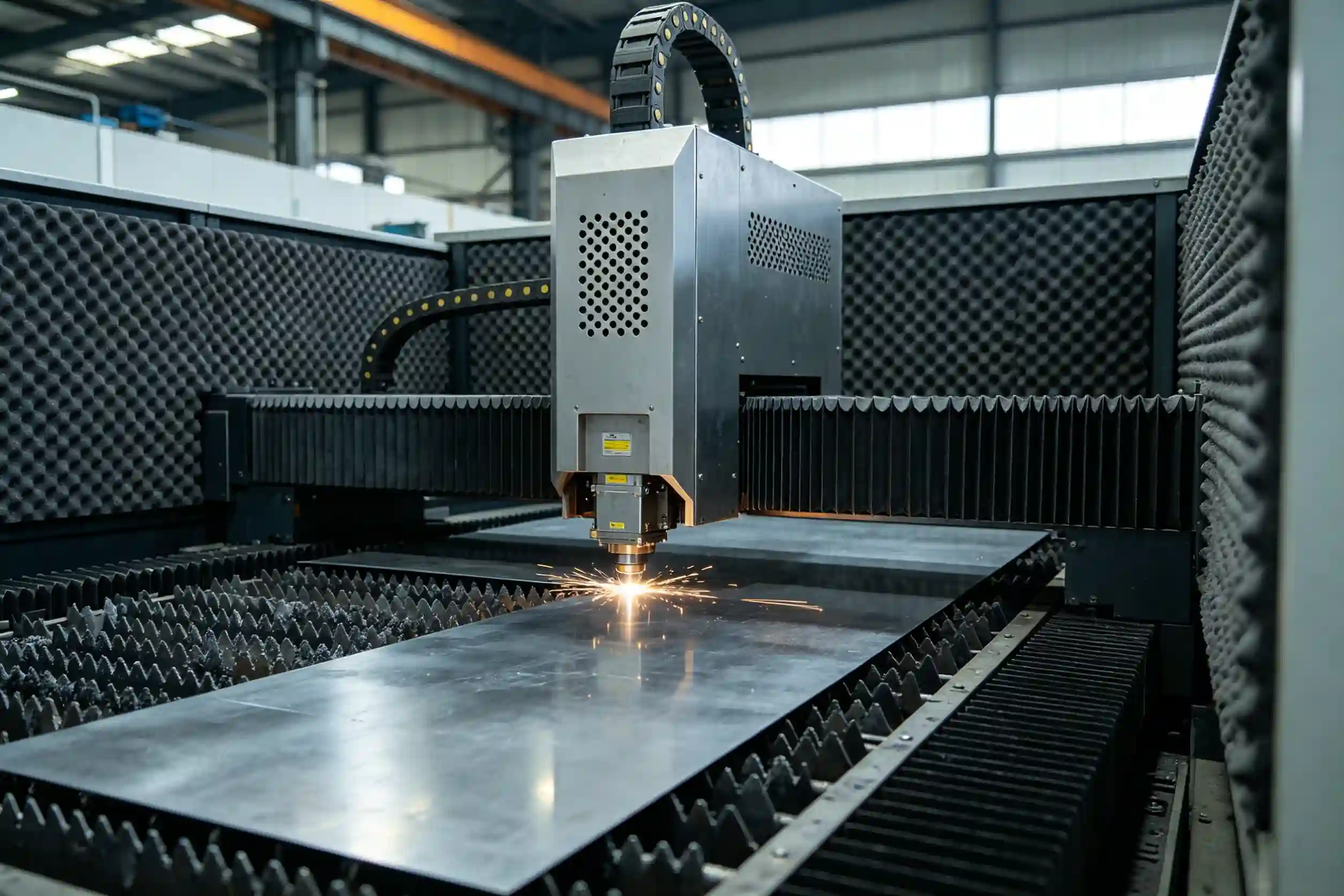
Most customers approach us with the same assumption: they think noise comes from motor power and can be fixed by adding a soundproof enclosure. That assumption costs them time and budget because it ignores the real sources of operational noise and the way different noise types interact in a production environment.
Why Does Cutting Machine Noise Matter to Production Operations?
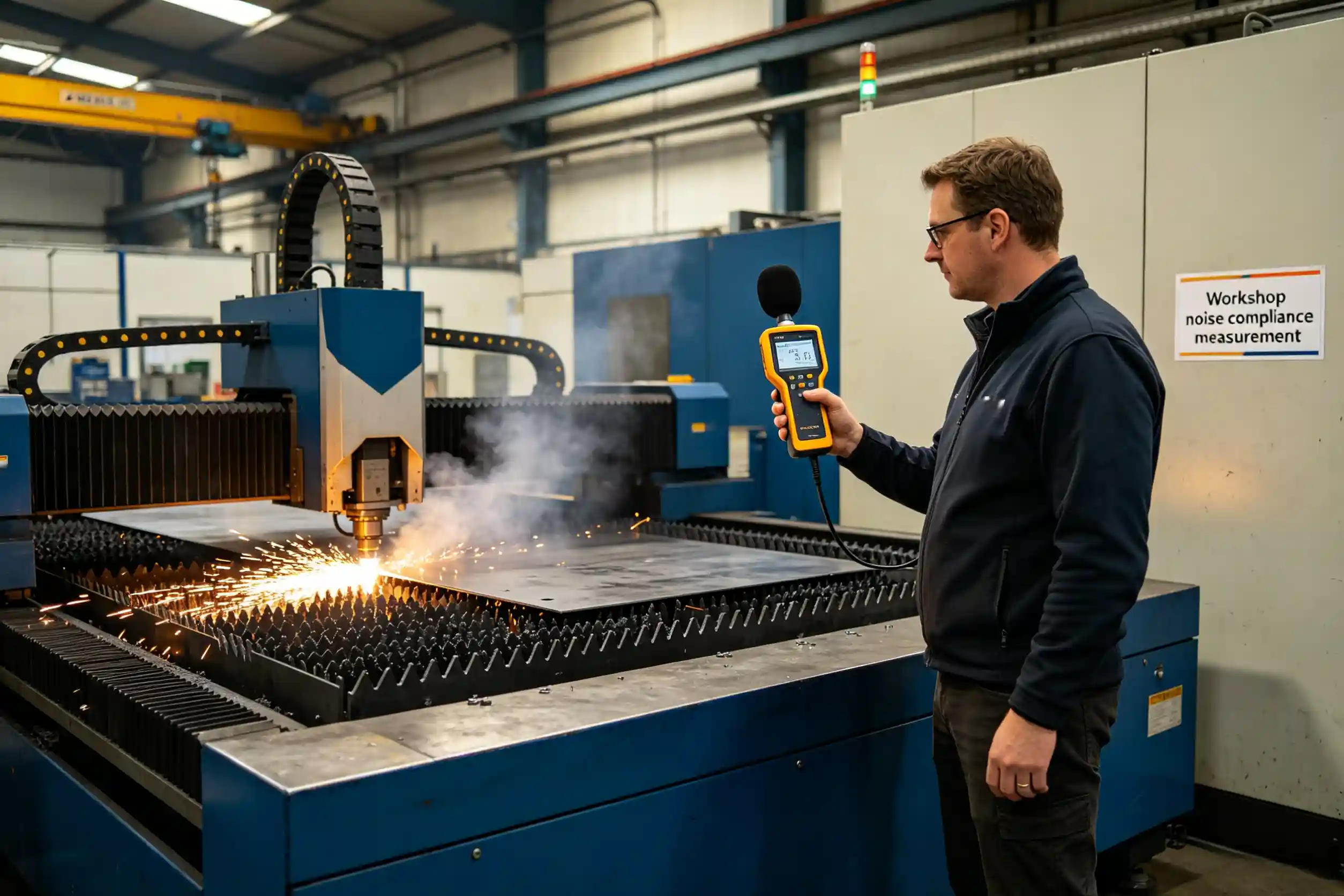
When customers first contact us about noise, they are not asking because the machine sounds louder than before. They are asking because noise has created a measurable business problem: either they face regulatory compliance requirements that demand noise levels below specific thresholds, or their workshop noise interferes with communication during quality control inspections.
Knife cutting machine noise matters to production operations because excessive noise creates compliance risk under workplace safety regulations and disrupts communication between quality control staff and machine operators during inspection processes. Unlike equipment failure symptoms, noise does not indicate malfunction but represents an operational management challenge that affects regulatory standing and production workflow efficiency.
What Are the Real Decision Variables Behind Noise Reduction?
Customers who contact us about noise are not troubleshooting a broken machine. They are managing risk. I have worked with manufacturers who needed to pass workplace safety audits and others who needed to reduce noise because supervisors could not hear quality issues being reported from the cutting area. The decision to invest in noise reduction is about choosing between compliance penalties, production communication gaps, or equipment modification costs.
The most common mistake I see is treating noise as a single-variable problem. A customer once told me they installed a soundproof cover and the noise barely changed. When we inspected their setup, the cover only blocked sound transmission but did nothing to address the vibration and impact noise generated during cutting. The cover made the workspace darker and harder to monitor without solving the underlying noise generation.
Another customer assumed that upgrading to a more powerful motor would increase noise, so they refused to improve their vacuum system. In reality, their old vacuum fan was generating more noise than necessary because it was running at inefficient speeds to compensate for poor airflow design. Noise is not simply proportional to power. It depends on how components interact during operation.
Where Does Knife Cutting Machine Noise Actually Come From?
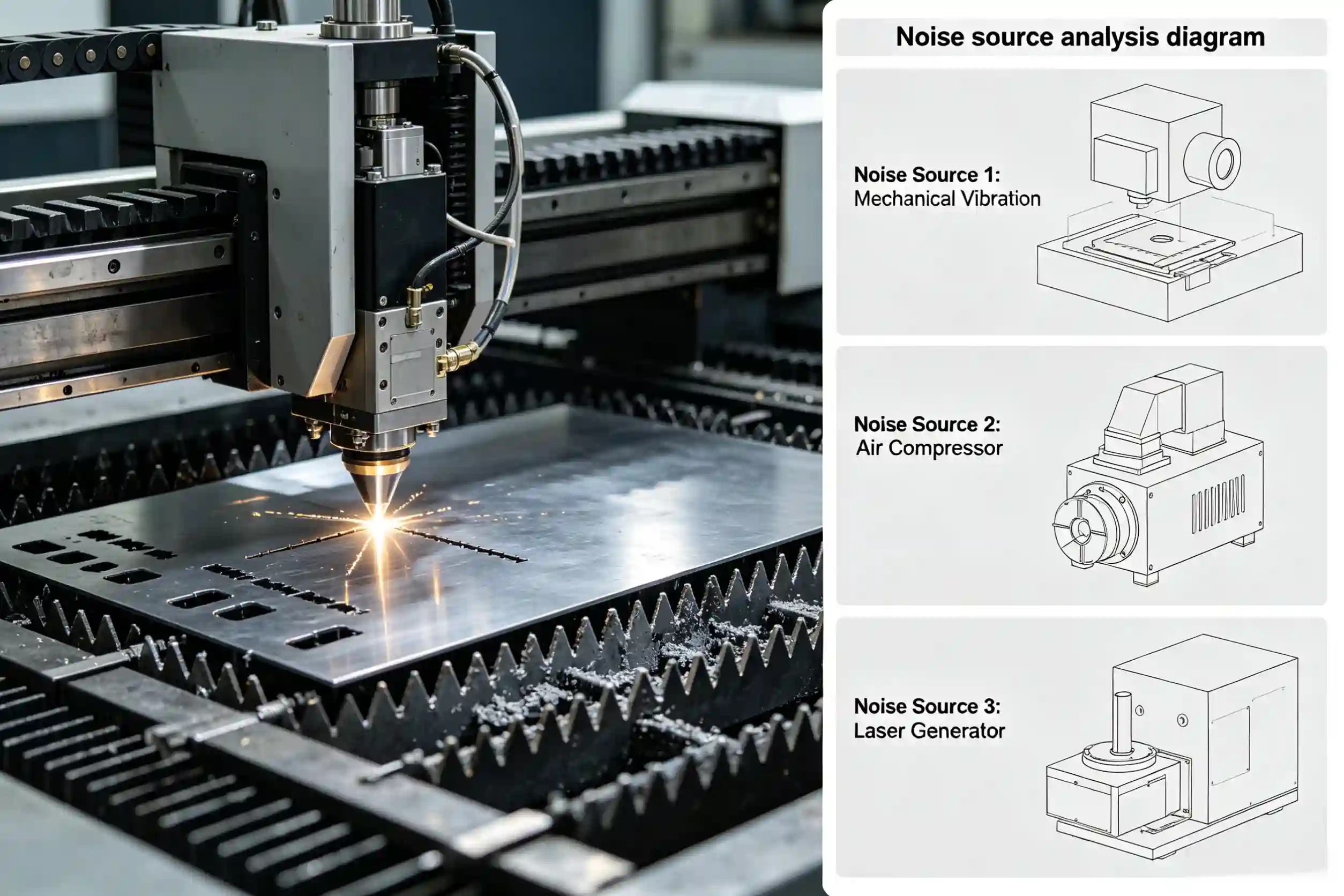
Most people assume knife cutting machines are noisy because of the motor. That assumption is only partially correct. During our retrofit projects, we identified three distinct noise sources, and each requires a different engineering approach.
Knife cutting machine noise originates from three distinct sources: cutting process noise generated by blade-material contact and high-frequency vibration[^1], transmission system noise produced by guide rails, sliders, gears, and belts during machine movement, and power system noise created by motors and vacuum fans during operation. Each source requires targeted engineering intervention rather than generic noise suppression methods.
How Does Cutting Process Generate Operational Noise?
Cutting noise happens when the blade contacts the material and vibrates at high frequency. Different materials produce different noise profiles[^2]. When we tested leather cutting versus composite material cutting, the leather generated lower-frequency impact noise while the composite produced sharper, higher-frequency vibration noise. The blade itself acts as a sound-transmitting surface, amplifying vibration through the tool holder and machine frame.
I worked on a project where the customer was cutting gasket materials with aggressive blade angles. The cutting noise was so sharp that operators reported ear fatigue after a few hours. We adjusted the blade geometry and reduced the cutting speed slightly. The noise dropped noticeably, and the customer reported that operators could now hear verbal instructions without shouting. The key insight was that cutting noise is not just about blade sharpness. It is about how the blade interacts with material properties and how vibration propagates through the cutting system.
What Role Does Transmission System Play in Noise Generation?
Transmission noise comes from the guide rails, sliders, and belt systems that move the cutting head across the working area. During machine movement, friction and impact between metal components generate vibration that radiates as sound[^3]. Low-precision guide rails amplify this noise because they allow micro-movements and play between the slider and rail surface[^4].
We tested a noise reduction retrofit where we replaced standard guide rails with precision-ground rails and upgraded to silent sliders with vibration-damping inserts. The customer measured a noticeable reduction in the rhythmic clatter that had been present during high-speed cutting passes. The improvement was not dramatic, but it was consistent across all cutting operations. The lesson was that transmission noise is cumulative. Small improvements in multiple components add up to measurable operational noise reduction.
Why Do Power Systems Contribute Persistent Background Noise?
Motor and vacuum fan noise are the constant background hum that customers notice first. Motors generate electromagnetic noise and mechanical vibration[^5], while vacuum fans produce aerodynamic noise from air turbulence[^6]. The vacuum system is often the loudest component because it runs continuously and moves large volumes of air at high speeds.
One customer complained that their vacuum fan was unbearably loud, even though it was rated as a standard industrial unit. When we inspected their setup, we found that the fan was oversized for their material thickness and was running at maximum speed to compensate for poor air duct design. We redesigned the duct layout to improve airflow efficiency and replaced the fan with a variable-speed unit. The customer reported that the background noise dropped enough that they could hold normal conversations near the machine without raising their voices. The key insight was that power system noise is not just about component selection. It is about matching system design to operational requirements.
What Engineering Methods Actually Reduce Cutting Machine Noise?
The most important lesson from our noise reduction projects is that isolated fixes fail. Adding a soundproof cover without addressing noise generation is like putting a bandage on a wound without cleaning it first. The cover might reduce sound transmission, but the noise source continues to create vibration and impact that propagate through the machine frame and floor.
Effective noise reduction in knife cutting machines requires simultaneous intervention across three engineering domains: precision mechanical components that control noise at the source, optimized cutting parameters that minimize operational noise generation, and transmission path management that blocks sound propagation. No single method works across all material types and cutting applications.
How Do Precision Transmission Components Control Noise at the Source?
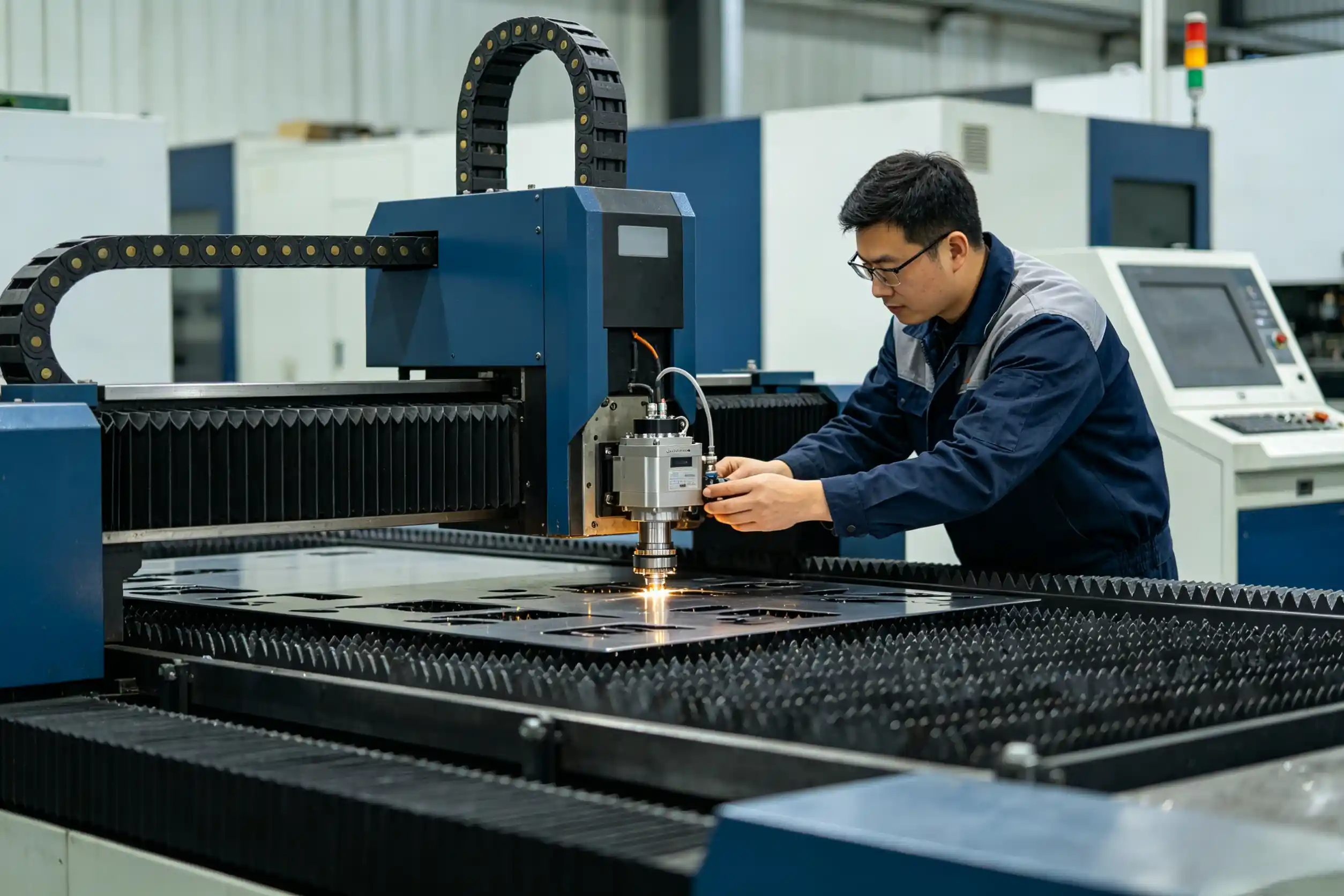
Precision transmission components reduce noise by minimizing friction, vibration, and play between moving parts[^7]. High-precision guide rails maintain tight tolerances that eliminate micro-movements during acceleration and deceleration. Silent sliders incorporate vibration-damping materials that absorb impact rather than transmitting it to the machine frame[^8]. High-precision bearings reduce rotational friction and eliminate the grinding noise that comes from worn or low-quality bearings.
We worked with a customer who was cutting automotive interior materials and needed to reduce noise to meet workshop safety standards. We upgraded their transmission system with precision-ground guide rails, silent sliders, and high-precision bearings. The customer reported that the rhythmic clatter during cutting passes was noticeably reduced, and the machine felt smoother during operation. The improvement was not dramatic enough to eliminate all noise, but it was significant enough to bring their workshop into compliance with safety regulations.
The key insight was that precision components do not eliminate noise. They reduce the mechanical inefficiencies that amplify noise. A machine with loose tolerances generates more vibration and impact noise because components are constantly colliding and shifting during operation. Tightening those tolerances reduces the opportunity for noise-generating movements.
What Cutting Parameters Influence Operational Noise Levels?
Cutting parameters directly affect noise generation during material processing. Blade geometry, cutting speed, and tool path strategy all influence how much vibration and impact noise is created. Aggressive blade angles generate more cutting force and higher-frequency vibration[^9]. High cutting speeds increase the rate of blade-material contact and amplify impact noise. Complex tool paths with frequent direction changes create more acceleration and deceleration noise.
I worked on a project where the customer was cutting leather for automotive seats. Their operators were using maximum cutting speed to improve throughput, but the noise was so loud that quality control staff could not hear defect reports from operators. We tested different blade geometries and reduced the cutting speed by 15 percent. The noise dropped enough that normal conversations were possible near the machine, and the customer reported that the slight reduction in cutting speed had minimal impact on overall production time because operators were more efficient when they could communicate clearly.
The key insight was that cutting noise is not just a byproduct of the cutting process. It is a variable that can be optimized like any other production parameter. Customers who push cutting speed to the maximum without considering noise impact often create operational inefficiencies that offset the speed gains.
How Can Manufacturers Optimize Motor and Vacuum Fan Design?
Motor and vacuum fan noise can be reduced through component selection and system design optimization. Variable-speed motors allow operators to adjust motor speed to match cutting requirements, reducing unnecessary noise during light-duty operations[^10]. Silent fan designs incorporate aerodynamic blade profiles and sound-absorbing housing materials. Optimized air duct layouts reduce turbulence and improve airflow efficiency[^11], allowing fans to operate at lower speeds.
One customer had installed a high-power vacuum fan that was generating excessive background noise. When we analyzed their setup, we found that the air duct had multiple sharp bends that created turbulence and reduced airflow efficiency. We redesigned the duct layout with gradual bends and larger diameter tubing. The fan could now operate at lower speeds while maintaining the same material hold-down performance. The customer reported that the background hum was noticeably quieter, and the reduction in fan speed also lowered their energy consumption.
The key insight was that power system noise is often a symptom of inefficient system design. Customers who focus only on selecting "quiet" components without optimizing system layout will not achieve meaningful noise reduction.
| Engineering Domain | Noise Control Method | Operational Impact | Implementation Complexity |
|---|---|---|---|
| Transmission System | Precision guide rails, silent sliders, high-precision bearings | Reduces vibration and impact noise during machine movement | Medium - requires component replacement and alignment calibration |
| Cutting Process | Blade geometry optimization, cutting speed reduction, tool path tuning | Minimizes blade-material contact noise and high-frequency vibration | Low to Medium - requires testing and parameter adjustment |
| Power Systems | Variable-speed motors, silent fan design, optimized air duct layout | Reduces electromagnetic noise and aerodynamic turbulence | Medium to High - may require system redesign and component upgrades |
| Sound Transmission | Vibration-damping materials, acoustic enclosures, isolated mounting | Blocks noise propagation to surrounding workspace | Medium - most effective when combined with source control |
How Should Customers Evaluate Vendor Noise Control Approaches?
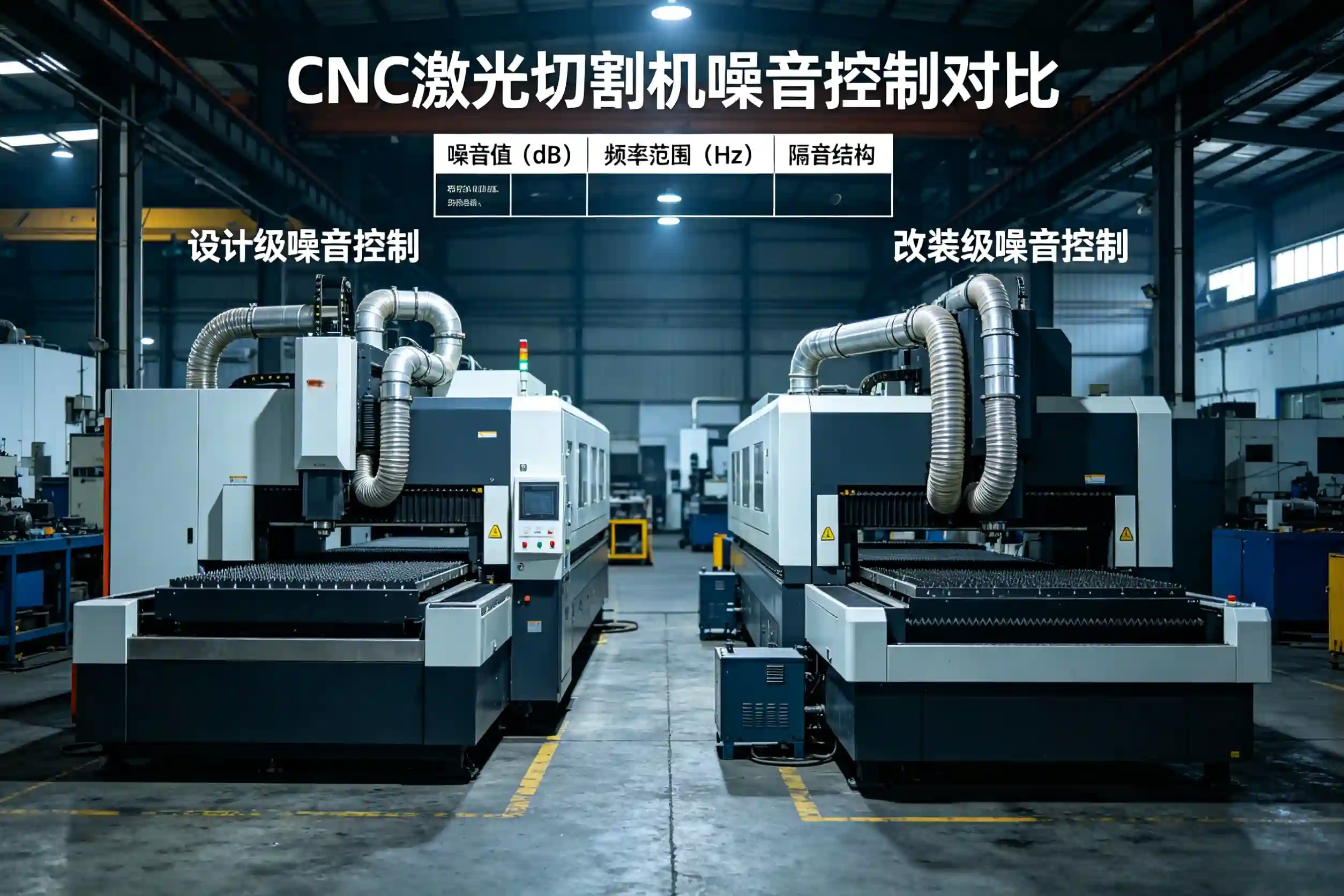
The most important question customers should ask is whether a vendor's noise control is built into the design or added as an afterthought. Machines designed with noise reduction in mind use precision components, optimized cutting parameters, and efficient power systems from the start. Machines with add-on noise control rely on soundproof covers and retrofit modifications that address symptoms rather than root causes.
Customers should evaluate vendor noise control by examining whether noise reduction is integrated into mechanical design or applied as retrofit modifications. Design-level noise control uses precision transmission components, optimized cutting processes, and efficient power systems, while retrofit-level noise control relies on soundproof covers and component upgrades that address sound transmission without controlling noise generation.
What Questions Reveal a Vendor's Noise Reduction Expertise?
Ask the vendor to explain where noise comes from in their machine design. Vendors who understand noise as a system problem will describe cutting process noise, transmission system noise, and power system noise. Vendors who treat noise as a single-variable problem will focus only on motor power or soundproof covers.
Ask the vendor to describe how they test noise reduction methods. Vendors with field experience will describe customer projects where they tested specific modifications and measured operational outcomes. Vendors without field experience will cite generic specifications or lab measurements without operational context.
Ask the vendor how noise reduction affects other performance variables. Vendors who understand trade-offs will explain how reducing cutting speed lowers noise but may affect throughput, or how optimizing air duct layout improves both noise and energy efficiency. Vendors who oversimplify will claim that noise reduction has no operational impact.
How Can Customers Verify Real-World Noise Reduction Results?
Request references from customers who have implemented noise reduction modifications. Speak directly with those customers and ask whether the noise reduction met compliance requirements or improved workshop communication. Ask whether the modifications affected cutting quality, maintenance requirements, or operational costs.
Request on-site demonstrations where you can measure noise during actual cutting operations using your materials. Generic demonstrations with ideal materials may not reflect the noise characteristics of your specific application. Bring a basic sound level meter and measure noise during different cutting operations to understand how noise varies with material type and cutting parameters.
Review the vendor's maintenance documentation to understand whether noise reduction components require special maintenance or create new maintenance burdens. Precision components may require more frequent lubrication or alignment checks. Variable-speed motors may require software updates or control system maintenance. Understanding these requirements helps you evaluate the total cost of noise reduction over the equipment lifecycle.
Conclusion
Reducing knife cutting machine noise is not about adding soundproof covers or upgrading a single component. It requires simultaneous intervention across mechanical design, cutting operations, and transmission paths. Effective noise reduction starts with understanding where noise comes from and choosing vendors who treat noise as a system problem rather than a cosmetic issue.
[^1]: "[PDF] Blade-Wake Interaction Noise for Hovering sUAS Rotors, Part I", https://ntrs.nasa.gov/api/citations/20230008089/downloads/Thurman_BWI_PT1_FINAL.pdf. Research on cutting mechanics demonstrates that tool-workpiece contact generates vibration through periodic force variations and material separation dynamics, with frequency characteristics influenced by cutting parameters and material properties. Evidence role: mechanism; source type: paper. Supports: the physical mechanism of vibration generation during cutting tool-material contact. [^2]: "Research Progress of Noise in High-Speed Cutting Machining - PMC", https://pmc.ncbi.nlm.nih.gov/articles/PMC9146239/. Studies of machining acoustics indicate that workpiece material properties, including hardness, density, and damping characteristics, affect the frequency spectrum and amplitude of cutting-generated noise. Evidence role: general_support; source type: paper. Supports: the influence of material properties on cutting process acoustics. Scope note: Research focuses primarily on metal cutting; applicability to leather, composites, and other materials used in knife cutting machines may vary [^3]: "Research on the Friction Noise Generation Mechanism and ... - PMC", https://pmc.ncbi.nlm.nih.gov/articles/PMC10458101/. Acoustic theory establishes that mechanical vibration in solid structures radiates sound when vibrating surfaces couple with surrounding air, with radiation efficiency dependent on frequency, surface area, and boundary conditions. Evidence role: mechanism; source type: encyclopedia. Supports: the physical process by which mechanical vibration converts to acoustic energy. [^4]: "Vibration and Noise Analysis and Experimental Study of Rail ... - PMC", https://pmc.ncbi.nlm.nih.gov/articles/PMC10223835/. Engineering studies of linear motion systems show that clearance between sliding components creates impact and stick-slip phenomena that generate vibration, with noise levels correlating to the magnitude of clearance and operating speed. Evidence role: mechanism; source type: paper. Supports: how mechanical clearances in linear motion systems contribute to vibration and noise. [^5]: "Electromagnetically induced acoustic noise - Wikipedia", https://en.wikipedia.org/wiki/Electromagnetically_induced_acoustic_noise. Motor acoustics research identifies electromagnetic forces acting on stator and rotor components as sources of tonal noise, while mechanical sources include bearing vibration, cooling fan noise, and aerodynamic effects. Evidence role: mechanism; source type: paper. Supports: the electromagnetic and mechanical sources of motor-generated noise. [^6]: "[PDF] Fan Noise Predictions of the NASA Source Diagnostic Test using ...", https://ntrs.nasa.gov/api/citations/20240005861/downloads/Fernandes%20CEAS%20AIAA%20Aeroacoustics%202024.pdf. Aeroacoustic research demonstrates that fan noise originates from turbulent boundary layers on blade surfaces, blade-wake interactions, and flow separation, with broadband and tonal components dependent on blade geometry and operating conditions. Evidence role: mechanism; source type: paper. Supports: the aerodynamic mechanisms by which fans generate noise through turbulent flow. [^7]: "[PDF] Topic 16 Rolling element linear motion bearings - MIT", https://web.mit.edu/2.70/Lecture%20Materials/Documents/Week%2004/PMD%20Topic%2016%20Rolling%20linear.pdf. Studies of precision mechanical systems indicate that tighter tolerances and reduced clearances decrease impact forces and stick-slip behavior, resulting in lower vibration amplitudes and reduced structure-borne noise transmission. Evidence role: general_support; source type: paper. Supports: the relationship between mechanical precision and noise reduction in motion systems. Scope note: Noise reduction magnitude depends on specific component design, operating conditions, and system integration [^8]: "Experimental study on parameter identification and isolator ...", https://ui.adsabs.harvard.edu/abs/2025IJMMD.tmp...60H/abstract. Research on vibration damping demonstrates that viscoelastic materials convert mechanical energy to heat through internal friction, reducing vibration amplitude and structure-borne sound transmission across a frequency range determined by material properties. Evidence role: mechanism; source type: paper. Supports: how damping materials reduce vibration transmission through energy dissipation. [^9]: "Methodology for Evaluating the Cutting Force of Planar Technical ...", https://pmc.ncbi.nlm.nih.gov/articles/PMC8704524/. Cutting mechanics research shows that tool geometry parameters, including rake angle and clearance angle, influence chip formation forces and cutting stability, with certain geometries promoting chatter vibration at characteristic frequencies. Evidence role: mechanism; source type: paper. Supports: how cutting tool geometry affects force generation and vibration during material processing. Scope note: Research primarily addresses metal cutting; direct applicability to knife cutting of flexible materials may differ [^10]: "IMPACT OF ELECTRICAL NOISE ON THE TORSIONAL ...", https://oaktrust.library.tamu.edu/handle/1969.1/172578. Studies of motor drive systems indicate that variable-speed operation can reduce noise by operating at lower speeds when full power is not required, though variable-frequency drives may introduce additional electromagnetic noise at certain operating points. Evidence role: general_support; source type: paper. Supports: the acoustic benefits of variable-speed motor operation. Scope note: Net noise reduction depends on drive technology, motor design, and specific operating conditions [^11]: "[PDF] Performance Study of a Ducted Fan System", https://ntrs.nasa.gov/api/citations/20020052231/downloads/20020052231.pdf. Fluid dynamics principles establish that duct design features such as bend radius, cross-sectional transitions, and surface roughness affect flow separation and turbulence intensity, with optimized geometries reducing pressure losses and improving flow uniformity. Evidence role: mechanism; source type: education. Supports: how duct geometry influences flow turbulence and system efficiency.


