
Blog
How Do Manufacturers Customize Cutting Solutions for Carbon Fiber Composites Without Causing Material Damage?

How Do Manufacturers Customize Cutting Solutions for Carbon Fiber Composites Without Causing Material Damage?
Most buyers assume carbon fiber cuts like standard fabric—until they see edge delamination in their first batch. I learned this after watching an automotive parts supplier reject three machines because their engineering team never specified their quality tolerance before purchase.
Customizing a carbon fiber cutting solution requires matching the cutting method (laser, waterjet, or CNC knife) to your material structure, production volume, and defect acceptance level—not just finding the fastest machine. Buyers who clarify these three variables before contacting suppliers avoid costly equipment mismatches and production delays.
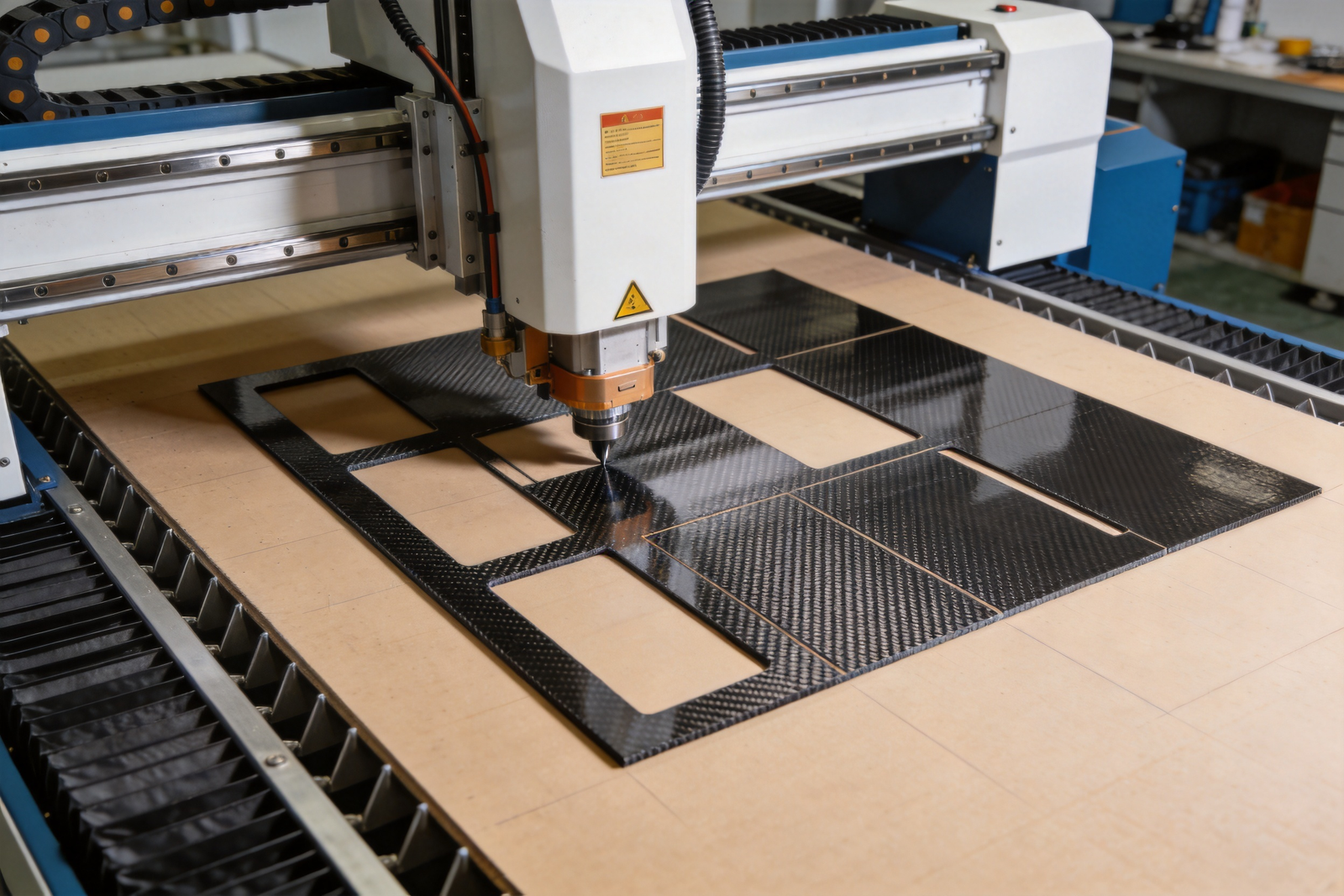
I handle equipment customization projects for clients who process carbon fiber in aerospace and automotive sectors. Most of them start with the wrong question. This article walks through how we reframe their requirements and why standard cutting machines fail for carbon fiber composites.
Why Do Standard Cloth Cutting Machines Fail on Carbon Fiber Composites?
Buyers often call us asking if our fabric cutting machines work on carbon fiber prepreg. They see "flexible material" in our product descriptions and assume the equipment transfers directly. This mistake costs them weeks of troubleshooting.
Standard cloth cutting machines fail on carbon fiber because they are designed for textile fibers with uniform tensile strength—not for layered composites with resin matrices that crack under incorrect blade pressure or heat buildup from tool friction[^1].
What Makes Carbon Fiber Different from Regular Fabric?
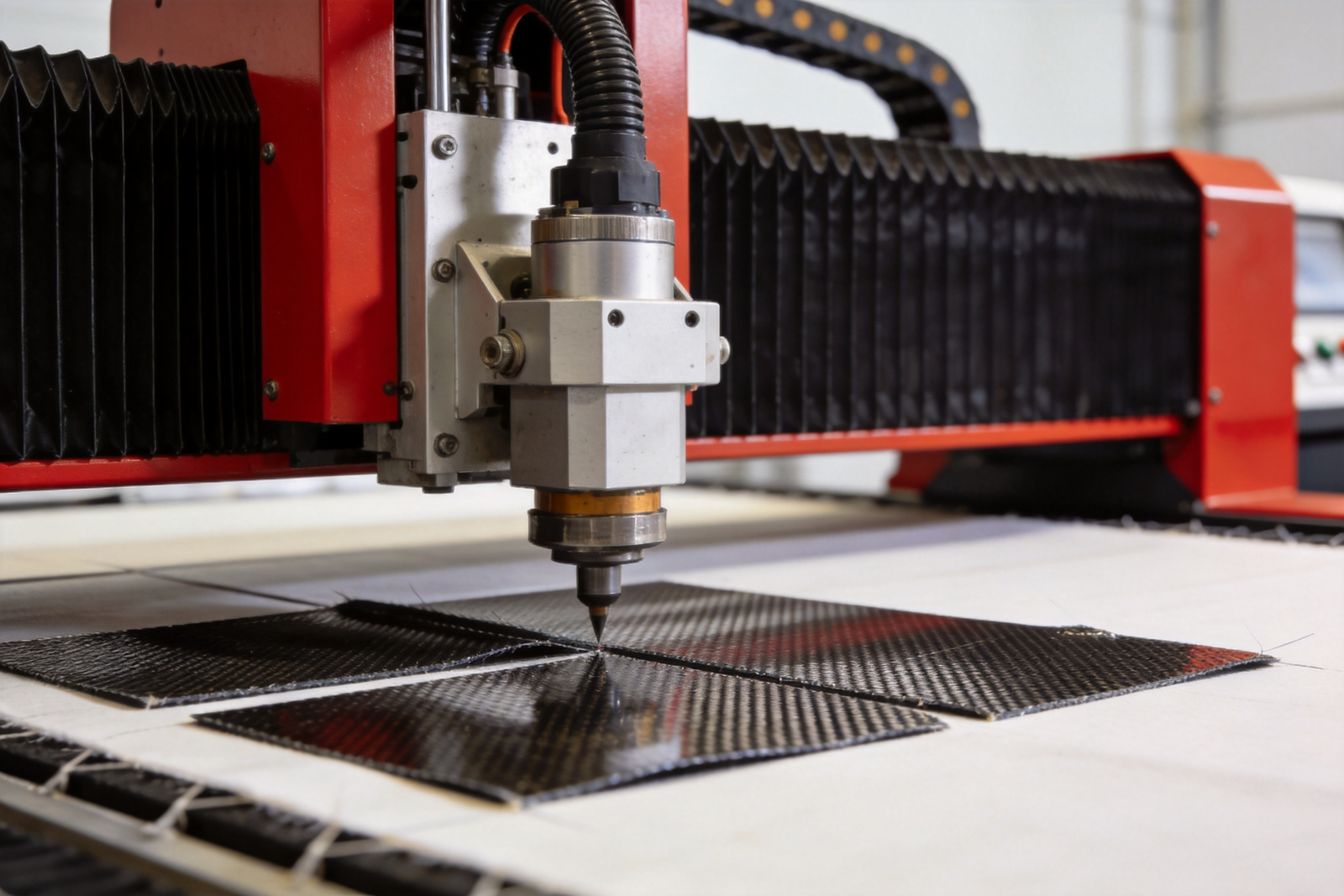
Carbon fiber composites are not woven textiles. They combine directional fibers (unidirectional or woven) with thermosetting or thermoplastic resins. When a blade cuts through the material, it separates fibers and fractures the resin matrix. If the cutting force is too high, the resin cracks beyond the cut line—this is called delamination. If the blade generates heat, the resin softens or burns, weakening the bond between fiber layers.
Standard cloth cutting machines use oscillating blades optimized for textile drag cutting. These blades move at fixed frequencies and pressures designed for fabrics that deform under tension. Carbon fiber does not deform—it fractures. When the blade pressure exceeds the resin's shear strength, the bottom layers separate from the top layers. The client only discovers this after laminating the parts and running stress tests.
We worked with an automotive interior supplier who used a standard fabric cutter on carbon fiber trim panels. Their first production run passed visual inspection, but ultrasonic testing revealed subsurface delamination in 30% of parts[^2]. They had to scrap the batch and restart with a customized CNC knife cutter that controlled blade depth and feed rate based on laminate thickness. The new machine added three weeks to their project timeline.
| Cutting Variable | Standard Fabric Cutter | Carbon Fiber Requirement |
|---|---|---|
| Blade Pressure | Fixed (designed for textile drag) | Variable (adjusted for resin shear strength) |
| Heat Generation | Not controlled (friction is acceptable) | Minimized (heat damages resin matrix) |
| Layer Support | No vacuum hold (fabric drapes) | Full vacuum (prevents bottom layer movement) |
| Dust Extraction | Optional (textile lint is low-risk) | Required (carbon dust is conductive and toxic[^3]) |
The supplier's engineering team did not specify these variables when selecting equipment. They treated carbon fiber like a premium fabric instead of a structural composite. This is the most common mistake I see in equipment inquiries.
What Are the Real Decision Variables for Selecting a Carbon Fiber Cutting Method?
Clients ask us which machine cuts carbon fiber fastest. Speed is irrelevant if the cut edges fail quality inspection. We redirect the conversation to three variables: material structure, production volume, and defect tolerance.
The correct cutting method depends on whether you are processing unidirectional prepreg, woven laminates, or cured parts—and whether you prioritize edge precision, batch throughput, or cost per part. Aerospace clients choose different solutions than automotive suppliers because their quality requirements differ.
How Do Material Structure and Thickness Affect Cutting Method Choice?
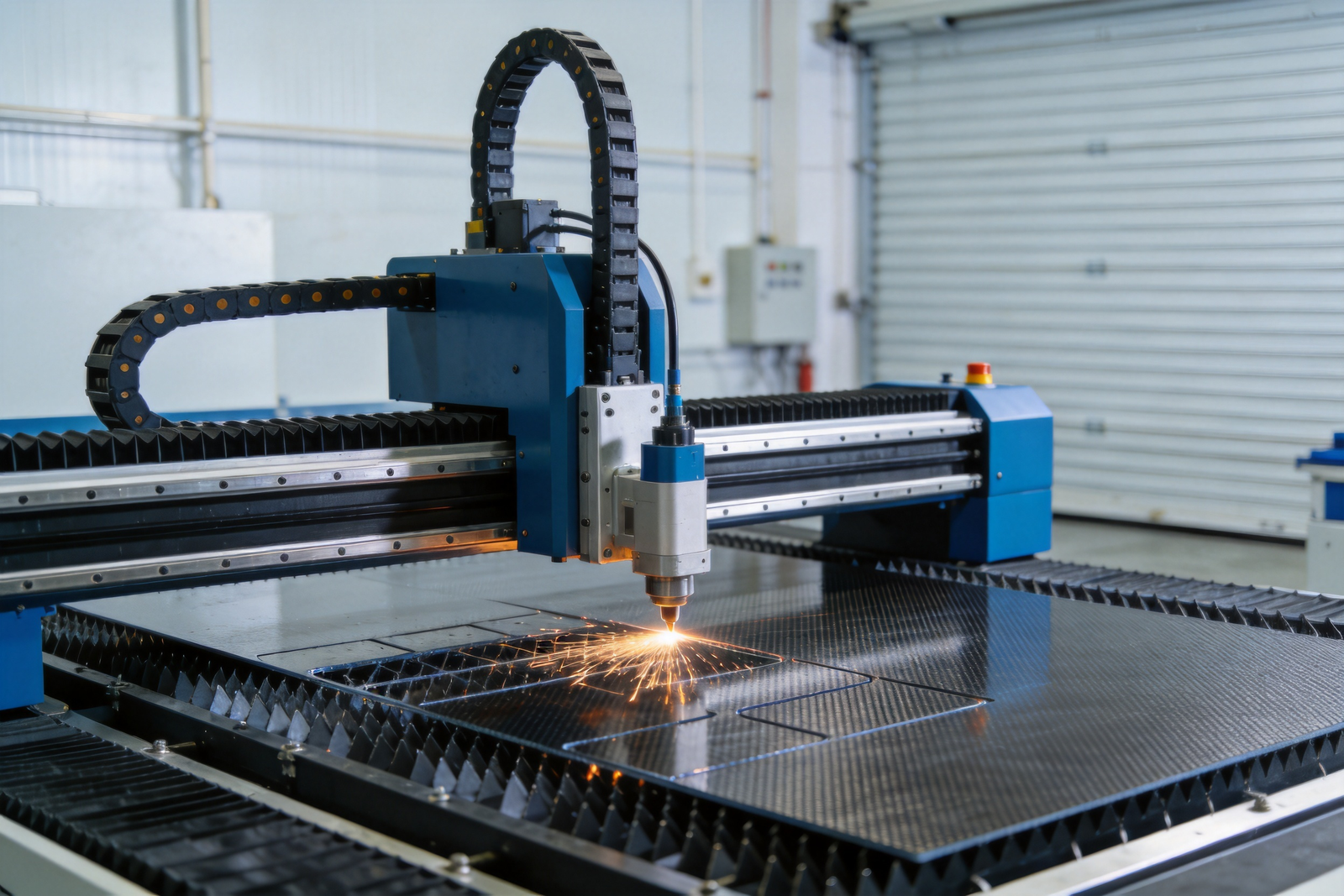
Unidirectional (UD) carbon fiber prepreg has fibers aligned in one direction, held together by uncured resin. When you cut UD material, the fibers on the bottom layer can pull away from the cut line if the blade does not sever them cleanly. This requires a sharp blade with precise depth control. CNC knife cutting works well for UD prepreg up to 5mm thick because the blade can penetrate the full thickness without excessive force.
Woven carbon fiber has fibers interlaced at 90-degree angles. The weave structure distributes cutting forces more evenly, reducing delamination risk compared to UD material. However, woven laminates are often thicker (5mm to 20mm) and require more cutting force. CNC knife blades can dull quickly on thick woven composites. Clients processing woven laminates above 10mm thickness often choose waterjet cutting because the abrasive stream does not generate tool wear or heat-affected zones.
Cured carbon fiber parts have fully hardened resin matrices. The material is rigid and brittle. Cutting cured parts generates higher forces than cutting prepreg. Laser cutting is common for cured parts because the focused beam vaporizes resin and severs fibers without mechanical contact. However, lasers create heat-affected zones (HAZ) where the resin around the cut edge degrades. For aerospace applications with strict material property requirements, laser-cut edges may need secondary machining to remove the HAZ.
We supplied a CNC knife cutter to an aerospace supplier who processes UD prepreg for wing components. Their material specification prohibited heat exposure above 60°C during cutting. Laser cutting was ruled out immediately. Waterjet cutting was eliminated because moisture absorption in uncured resin could affect lamination quality. CNC knife cutting met their requirements, but we had to customize blade geometry and vacuum hold-down pressure to prevent fiber pullout on the bottom layer. The final machine cuts at 600mm/s with edge delamination under 0.1mm—well within their tolerance.
| Material Type | Thickness Range | Recommended Cutting Method | Key Limitation |
|---|---|---|---|
| UD Prepreg | 0.5mm - 5mm | CNC Knife | Blade dulling on thick laminates |
| Woven Prepreg | 2mm - 10mm | CNC Knife or Waterjet | Knife requires frequent blade changes above 8mm |
| Thick Woven Laminates | 10mm - 20mm | Waterjet | Moisture contamination risk in uncured resin |
| Cured Parts | 3mm - 15mm | Laser or Waterjet | Laser creates HAZ; waterjet is slower |
Clients who contact us without specifying material type and thickness receive a decision tree, not a product recommendation. We ask them to send material samples so we can run cutting tests and measure edge quality before proposing equipment. This avoids the "buy first, troubleshoot later" cycle that delays production.
How Do Aerospace and Automotive Quality Requirements Differ?
Aerospace clients prioritize edge precision over cutting speed. Their parts undergo nondestructive testing (ultrasonic or X-ray inspection) to detect subsurface defects[^4]. A carbon fiber component with 0.2mm delamination at the cut edge will fail inspection even if it looks clean visually. For these clients, we customize CNC knife cutters with closed-loop blade pressure control and multi-pass cutting strategies that minimize subsurface damage. Cutting speed drops to 300mm/s, but edge quality meets aerospace inspection standards.
Automotive suppliers balance cost and throughput. Their carbon fiber parts are often semi-structural (interior trim, underbody panels) rather than primary load-bearing components. They accept higher delamination tolerances (0.5mm) in exchange for faster cutting speeds and lower equipment cost. For automotive clients, we configure CNC knife cutters with single-pass cutting and standard blade geometry. Cutting speed increases to 800mm/s, reducing cost per part.
I worked with an automotive parts manufacturer who initially requested an aerospace-grade CNC knife cutter. After reviewing their quality specifications, we found they only needed visual edge inspection—no ultrasonic testing. We reconfigured the machine with a simplified blade control system and eliminated the multi-pass cutting feature. This reduced the equipment cost by 30% and doubled their throughput. They did not need aerospace-level precision, but their procurement team assumed "higher quality equals better" without understanding the cost trade-off.
The difference between aerospace and automotive requirements also affects dust extraction and material handling. Aerospace clients require Class H dust extractors that capture carbon particles below 0.3 microns[^5] because loose carbon dust can contaminate clean room environments. Automotive clients use standard industrial dust collectors. Aerospace clients need automated material loading systems to prevent contamination from manual handling. Automotive clients accept manual loading if it reduces equipment cost.
| Client Type | Edge Quality Requirement | Typical Cutting Speed | Cost Sensitivity | Inspection Method |
|---|---|---|---|---|
| Aerospace | Delamination < 0.1mm | 300mm/s - 500mm/s | Low (quality prioritized) | Ultrasonic or X-ray |
| Automotive | Delamination < 0.5mm | 600mm/s - 1000mm/s | High (cost per part matters) | Visual or basic measurement |
Clients who do not separate aerospace and automotive decision criteria end up with over-specified or under-performing equipment. We ask them which inspection method they use before discussing machine features. This question clarifies their real quality requirements.
Why Does Laser Cutting Create Problems for Structural Carbon Fiber Parts?
Buyers see laser cutting as a high-tech solution for carbon fiber. It is fast, non-contact, and produces narrow kerf widths. Aerospace clients often ask if laser cutting can replace CNC knife cutting for prepreg parts. The answer depends on whether they accept heat-affected zones in their material specification.
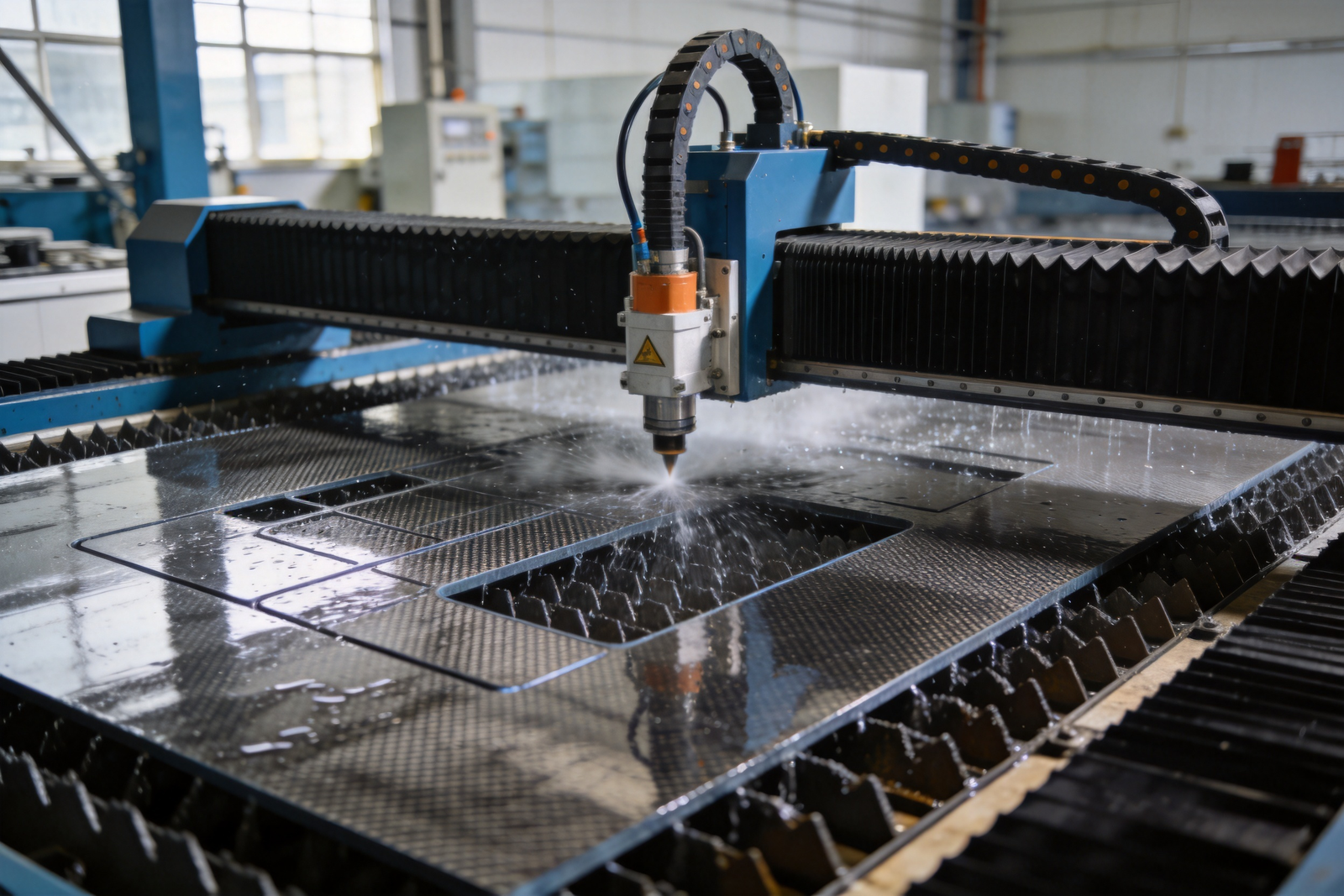
Laser cutting vaporizes resin and severs carbon fibers using focused thermal energy, creating a heat-affected zone (HAZ) around the cut edge where resin properties degrade—this zone can extend 0.5mm to 2mm into the material depending on laser power and cutting speed. For structural parts that require full material strength at cut edges, HAZ is unacceptable.
What Happens in the Heat-Affected Zone?
When a laser beam cuts carbon fiber, the resin matrix absorbs infrared energy and heats rapidly. Thermosetting resins (like epoxy) begin to decompose above 300°C[^6]. The laser focal point reaches temperatures above 1000°C, vaporizing resin instantly. However, heat conducts into the surrounding material. The resin within 0.5mm to 2mm of the cut edge undergoes thermal degradation. Its glass transition temperature drops, reducing stiffness[^7]. The bond between resin and fiber weakens, making the edge more susceptible to delamination under mechanical stress.
Carbon fibers themselves do not melt—they sublime at temperatures above 3000°C[^8]. However, the resin matrix that holds fibers together degrades long before the fibers are affected. In the HAZ, the composite loses its structural integrity. If the part is a primary load-bearing component, the weakened edge zone creates a failure initiation point.
We worked with an aerospace parts manufacturer who tested laser cutting on carbon fiber wing ribs. Their material specification required tensile strength retention above 95% at all cut edges. Mechanical testing showed tensile strength dropped to 80% within 1mm of the laser-cut edge due to resin degradation in the HAZ[^9]. They switched to CNC knife cutting, which produced no measurable HAZ and met their strength retention requirement.
When Is Laser Cutting Acceptable for Carbon Fiber?
Laser cutting works for non-structural or secondary parts where edge strength is not critical. Automotive interior trim panels, decorative covers, and electromagnetic shielding components can tolerate HAZ because they do not carry mechanical loads. For these applications, laser cutting offers higher throughput than CNC knife cutting and lower consumable cost than waterjet cutting.
Laser cutting is also acceptable when the cut edge will be covered or bonded. If the carbon fiber part is laminated with additional layers after cutting, the HAZ is embedded within the laminate structure and does not affect overall part strength. Some aerospace suppliers use laser cutting for prepreg plies that will be stacked and cured together, accepting HAZ in individual plies because the final laminate meets strength requirements.
We supplied a laser cutter to an automotive supplier who produces carbon fiber dashboard trim. Their parts are bonded to plastic substrates and do not undergo structural loading. Laser cutting speed reached 1200mm/s with acceptable edge quality for their application. They did not need to control HAZ because edge strength was irrelevant. This is a clear case where laser cutting was the right choice.
| Cutting Method | HAZ Presence | Edge Strength Retention | Best Application |
|---|---|---|---|
| Laser | Yes (0.5mm - 2mm) | 70% - 85% in HAZ | Non-structural parts, covered edges |
| Waterjet | No (cold cutting) | 95%+ (moisture risk only) | Thick laminates, structural parts |
| CNC Knife | No (mechanical cutting) | 90% - 98% (depends on blade sharpness) | Prepreg, thin laminates, aerospace parts |
Clients who ask "can laser cut carbon fiber" without specifying structural requirements receive a conditional answer. We ask whether the part is load-bearing and whether their material specification allows thermal damage. If they cannot answer these questions, we recommend cutting trials before equipment selection.
How Does Waterjet Cutting Handle Thick Carbon Fiber Laminates Without Delamination?
Waterjet cutting is a cold cutting process. It uses a high-pressure water stream mixed with abrasive particles to erode material[^10]. Because there is no heat generation and no mechanical contact force, waterjet cutting does not create heat-affected zones or delamination caused by excessive blade pressure. Clients processing thick woven laminates above 10mm often ask if waterjet cutting is the best choice.
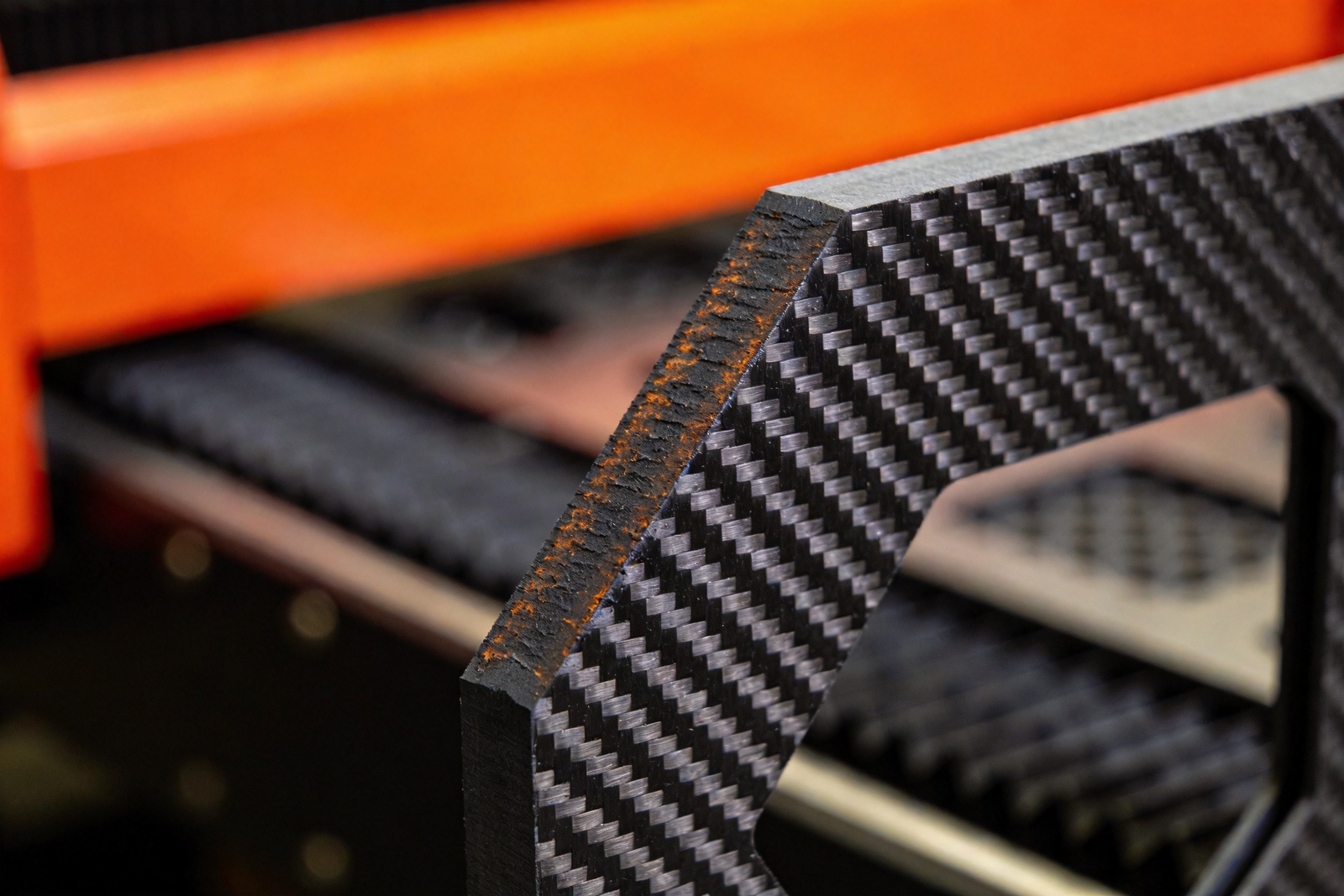
Waterjet cutting eliminates delamination in thick carbon fiber laminates by using a high-pressure abrasive stream that erodes resin and severs fibers without applying concentrated mechanical force—making it suitable for laminates where CNC knife blades would dull quickly or require excessive cutting force. However, moisture absorption in uncured resin composites creates contamination risks that require post-cutting drying.
Why Does Waterjet Cutting Avoid Delamination?
Delamination occurs when cutting force separates the bottom layers of a composite from the top layers. CNC knife cutting applies downward blade pressure concentrated along the cut line. If the resin matrix cannot withstand this pressure, the bottom layer debonds. Waterjet cutting distributes cutting energy across a narrow stream of abrasive particles. Each particle removes a microscopic amount of material. The cumulative effect severs the laminate without applying concentrated force that could separate layers.
Waterjet cutting also does not generate tool wear. CNC knife blades dull after cutting thick or abrasive composites, reducing edge quality over time. A dull blade requires higher cutting force, increasing delamination risk. Waterjet cutting maintains consistent edge quality because the abrasive stream does not degrade. Clients processing large batches of thick laminates avoid the blade replacement cycle that interrupts CNC knife cutting production.
We supplied a waterjet cutter to an industrial equipment manufacturer who produces carbon fiber structural panels for heavy machinery. Their laminates ranged from 12mm to 18mm thick—too thick for efficient CNC knife cutting. Waterjet cutting produced clean edges with no measurable delamination across the full thickness range. The client reported zero blade-related downtime because waterjet cutting eliminated blade wear.
What Are the Moisture Contamination Risks in Uncured Composites?
Waterjet cutting uses water as the cutting medium. If the carbon fiber material is uncured prepreg, water can penetrate the resin matrix and remain trapped between fiber layers. Moisture contamination affects resin cure chemistry and can create voids in the final laminated part. Aerospace clients with strict moisture control requirements often reject waterjet cutting for prepreg materials.
Cured carbon fiber laminates do not absorb water into the resin matrix because the resin has fully crosslinked. However, water can remain on the surface or in voids created during cutting. Clients who use waterjet cutting for cured parts must dry the cut edges before assembly or bonding to prevent moisture-related defects.
We worked with an aerospace supplier who initially considered waterjet cutting for UD prepreg parts. Their material specification required moisture content below 0.1% before lamination[^11]. Waterjet cutting introduced moisture levels above 0.5%, requiring vacuum drying for 24 hours after cutting[^12]. The drying step added cost and time, making CNC knife cutting more efficient for their application. They only use waterjet cutting for cured parts where moisture absorption is not a concern.
| Waterjet Cutting Advantage | Waterjet Cutting Limitation | Mitigation Strategy |
|---|---|---|
| No heat-affected zone (cold cutting) |
[^1]: "Characterization of progressive damage behaviour and failure ...", https://pmc.ncbi.nlm.nih.gov/articles/PMC12012072/. Research on composite material cutting mechanics demonstrates that resin matrices in carbon fiber laminates are susceptible to crack propagation when subjected to concentrated mechanical forces or thermal degradation from frictional heating during machining operations. Evidence role: mechanism; source type: paper. Supports: the mechanical failure mechanisms of resin matrices in carbon fiber composites under cutting forces. Scope note: Studies typically focus on specific resin systems and cutting parameters rather than universal failure thresholds [^2]: "Recent Trends in Non-Destructive Testing Approaches for ... - PMC", https://pmc.ncbi.nlm.nih.gov/articles/PMC12250815/. Ultrasonic nondestructive testing methods are established techniques for detecting internal delamination and disbonds in layered composite structures, with sensitivity to defects based on acoustic impedance mismatches between separated layers. Evidence role: mechanism; source type: paper. Supports: the use of ultrasonic testing for detecting subsurface delamination in carbon fiber composites. Scope note: Detection sensitivity depends on delamination size, depth, and specific ultrasonic testing parameters employed [^3]: "Carbon fibre composites - Safety - Monash University", https://www.monash.edu/hsw/safety/chemical/carbon-fibre-composites-ohs-information-sheet. Occupational safety literature identifies carbon fiber dust as presenting both electrical conductivity concerns for sensitive equipment and potential respiratory irritation risks, though carbon fibers themselves are not classified as highly toxic substances. Evidence role: general_support; source type: government. Supports: the conductive and health hazard properties of carbon fiber dust. Scope note: Toxicity characterization focuses primarily on mechanical irritation rather than chemical toxicity [^4]: "What are the Different Inspection Methods of Non-destructive ...", https://www.addcomposites.com/post/non-destructive-testing-for-composites-different-inspection-methods. Aerospace industry standards for composite component inspection routinely employ multiple nondestructive testing methods including ultrasonic testing and X-ray radiography to detect internal defects such as delaminations, voids, and porosity that may compromise structural integrity. Evidence role: expert_consensus; source type: institution. Supports: the application of nondestructive testing methods for aerospace composite component inspection. [^5]: "What is a HEPA filter? | US EPA", https://www.epa.gov/indoor-air-quality-iaq/what-hepa-filter. Class H dust extractors, as defined in European dust class standards (corresponding to HEPA filtration), are designed to capture at least 99.995% of particles down to 0.3 microns, making them suitable for hazardous dust applications including carbon fiber particulates. Evidence role: definition; source type: government. Supports: the filtration capabilities of Class H dust extraction systems. [^6]: "[PDF] MODELING OF THERMO-MECHANICAL DEGRADATION OF ...", https://repository.arizona.edu/bitstream/handle/10150/668426/azu_etd_20257_sip1_m.pdf?sequence=1. Thermal analysis studies of epoxy resins commonly used in carbon fiber composites show that thermal degradation typically initiates in the range of 300-400°C, with specific decomposition temperatures varying based on resin formulation and curing conditions. Evidence role: statistic; source type: paper. Supports: the thermal decomposition onset temperature for epoxy and other thermosetting resins. Scope note: Decomposition onset temperatures are resin-specific and depend on heating rate and atmospheric conditions during testing [^7]: "[PDF] The Significance of Glass Transition Temperature of Molding ...", https://nepp.nasa.gov/docuploads/C2AC9972-786D-45F8-A06DB653A0D0AD73/The%20significance%20of%20Tg%203.pdf. Thermal degradation of epoxy and other thermosetting resins results in chain scission and crosslink density reduction, which manifests as decreased glass transition temperature and reduced modulus, affecting the load-bearing capacity of the polymer matrix. Evidence role: mechanism; source type: paper. Supports: the effect of thermal degradation on glass transition temperature and stiffness in thermosetting resins. Scope note: The magnitude of property changes depends on degradation extent and specific resin chemistry [^8]: "Carbon Fiber Oxidation in 4D - PMC - NIH", https://pmc.ncbi.nlm.nih.gov/articles/PMC12548517/. Carbon fibers exhibit exceptional thermal stability, with degradation in inert atmospheres occurring through sublimation at temperatures exceeding 3000°C, though oxidation in air begins at much lower temperatures (above 400-600°C depending on fiber type). Evidence role: general_support; source type: encyclopedia. Supports: the high-temperature behavior of carbon fibers. Scope note: Practical degradation in manufacturing environments occurs via oxidation rather than sublimation [^9]: "Experimental Analysis of Heat-Affected Zone (HAZ) in Laser Cutting ...", https://pmc.ncbi.nlm.nih.gov/articles/PMC7956482/. Studies on laser cutting of carbon fiber composites report measurable reductions in mechanical properties within the heat-affected zone, with strength reductions ranging from 15-30% depending on laser parameters and material systems, attributed to thermal degradation of the resin matrix. Evidence role: statistic; source type: paper. Supports: mechanical property degradation in heat-affected zones of laser-cut carbon fiber composites. Scope note: Specific strength retention values vary significantly with laser type, cutting speed, material thickness, and resin system [^10]: "(PDF) Characterization of Abrasion and Erosion Mechanisms during ...", https://www.academia.edu/107473873/Characterization_of_Abrasion_and_Erosion_Mechanisms_during_Abrasive_Waterjet_Machining_of_Hard_Metals. Abrasive waterjet cutting is a material removal process that uses a high-velocity stream of water (typically 200-400 MPa) mixed with abrasive particles (commonly garnet) to erode material through repeated micro-cutting and erosion mechanisms. Evidence role: definition; source type: encyclopedia. Supports: the material removal mechanism in abrasive waterjet cutting. [^11]: "[PDF] Based Prepreg FiberCote Graphite Fabric E765/T300 6K 5HS", https://agate.niar.wichita.edu/Materials/WP3.3-033051-110%20Rev.%202.pdf. Aerospace composite manufacturing standards typically specify strict moisture content limits for prepreg materials prior to lamination and cure, with requirements often in the range of 0.1-0.5% by weight to prevent void formation and ensure proper resin cure. Evidence role: general_support; source type: institution. Supports: moisture content control requirements in aerospace composite manufacturing. Scope note: Specific moisture limits vary by material system, manufacturer specifications, and application requirements [^12]: "Experimental Study on Carbon Fiber-Reinforced Polymer Groove ...", https://pmc.ncbi.nlm.nih.gov/articles/PMC10537397/. Research on waterjet cutting of uncured composite prepregs identifies moisture absorption as a process concern, with studies documenting the need for post-cutting drying procedures to reduce moisture content to acceptable levels for subsequent lamination and cure processes. Evidence role: case_reference; source type: paper. Supports: moisture absorption concerns when waterjet cutting uncured composite prepreg materials. Scope note: Moisture absorption rates and drying requirements depend on resin type, material thickness, and cutting parameters


