







Fast Shipping
Carrier information

20k products
Payment methods

24/7 Support
Unlimited help desk

2-day Delivery
Track or off orders
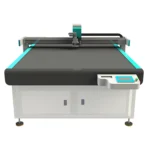
Tool Head and Table Configuration Specified Per Material — The RT-D2516/RT-S2516 is configured with Swiss imported vibration knife heads selected for corrugated board, gray board and composite stock thickness rather than a generic cutting setup, ensuring edge quality matches the production requirement from the first sheet.
Technical Specifications
| Parameter | Value |
|---|---|
| Model | RT-D2516/RT-S2516 |
| Product Type | CNC Vibration Knife Carton Cutting Machine |
| Working Area | 1600 × 2500 mm |
| Overall Dimensions | 3450 × 2300 × 1250 mm |
| Rated Power | 9 kW |
| Voltage | 380V ±10% |
| Translational Velocity | 800–2000 mm/s |
| Cutting Speed | 200–800 mm/s (basis not stated in source — confirm material / thickness) |
| Repeated Accuracy | ≤0.1 mm |
| Multifunctional Head | Swiss imported knife with vibration full cutting, vibration half cutting, and cursor location |
| Safety Device | Infrared sensors |
| Table Type | Aluminum alloy honeycomb structure vacuum adsorption platform |
| Vacuum Pump | 7.5 kW |
| Transmission System | Digital servo motor, linear guide, synchronous belt, imported ball screw |
| Servo Motor | Taiwan Delta servo motors and drivers |
| Linear Guide | Taiwan Hiwin rail |
| Instruction System | HP-GL compatible format |
| Software | Professional carton nesting software included |
| Language Options | English, Russian, Italian, Chinese, and customizable |
| Other Configuration | Germany imported conveyor belt, auto feeding |
| Standard | CE |
Application Suitability
| Application | Material or Output |
|---|---|
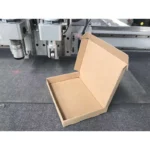
| Packaging carton sample making | Corrugated board, gray board, card stock for short-run prototypes and die-free samples |
| Express and snack food packaging | Foldable carton board and composite packaging material for box structure cutting |
| High-end gift box production | Thick gray board and laminated board for rigid box creasing and cutting |
| Advertising and signage display | PVC foam board, vinyl, and board stock for point-of-sale and billboard cutting |
| Gasket and flexible material fabrication | Rubber, sponge composite leather, silicon, and soft glass for industrial sealing |
Why the Wrong Knife Head Ruins Your First Batch of Samples
Material-matched tool head selection eliminates ragged edges and crushed board before the first production run.
I once set up a V-knife cutter for a packaging client who ran standard corrugated on paper, only to find their actual stock was high-density gray board. The blade wore out at nearly three times the expected rate, and the first samples came off the table with torn edges. That kind of mismatch is not a machine fault — it is a specification fault. When buyers evaluate a CNC oscillating knife cutting table, specifications should always start with the material sample in hand, not the brochure headline [NEED_CITE: material density and blade wear correlation in carton sample cutting].
Vibration Knife Mechanics on Board and Flexible Stock
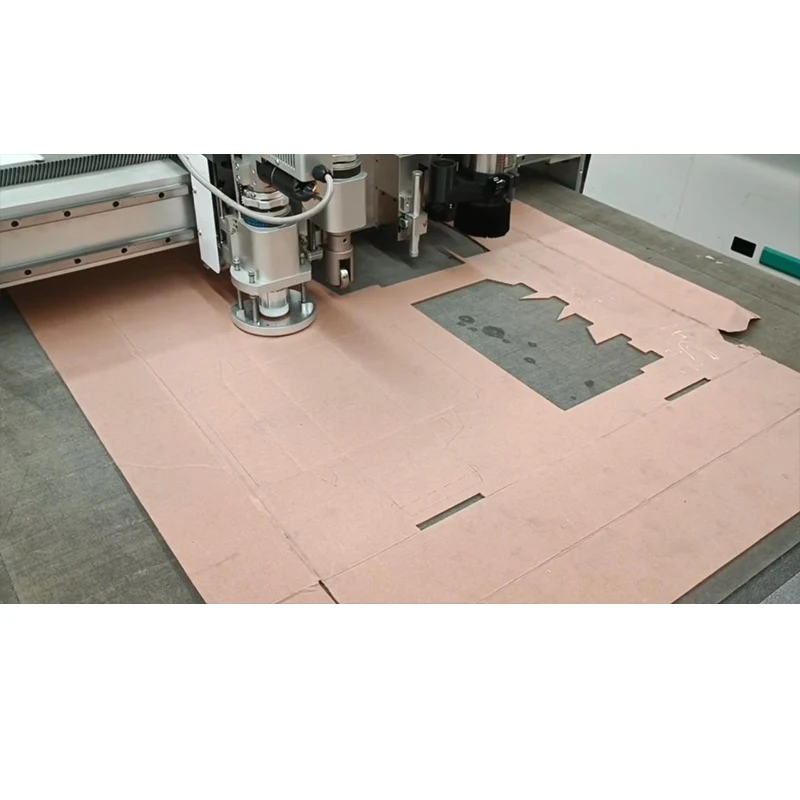
The Swiss imported vibration knife head on the RT-D2516/RT-S2516 performs full cutting, half cutting, and cursor location within a single tool station. For corrugated board sample making, this means a crease line and a through-cut can follow one another without a tool change, preserving registration across the sheet. The vibration frequency keeps the blade moving through dense gray board without the drag marks that a static drag knife leaves on laminated surfaces.
Vacuum Hold-Down Across the Full Working Area
The aluminum alloy honeycomb vacuum platform paired with a 7.5 kW vacuum pump addresses a common failure point in carton sample cutting: small offcut pieces lifting mid-pass and catching the knife. Uniform adsorption across the 1600 × 2500 mm working area means nesting layouts with mixed large panels and small structural tabs stay flat. This CNC oscillating knife cutting table configuration is essential when cutting thin vinyl or flexible gasket material where even minor lift produces dimensional drift [NEED_CITE: vacuum zoning requirements for small-part digital cutting].
Reading the Specifications That*rvo motors and Hiwin linear guides deliver ≤0.1 mm repeatability, which matters when a carton sample must fold and lock after cutting. A tolerance stack-up beyond that threshold causes tab-and-slot misalignment on rigid box prototypes. The HP-GL compatible instruction system with professional carton nesting software means files from common packaging CAD packages import without conversion errors — a detail frequently overlooked until a buyer’s existing design workflow fails at the machine. The 9 kW rated power and 380V ±10% supply requirement also dictate that the buyer’s electrical panel must be confirmed before the machine leaves the factory, not after arrival.
The Real Cost of Skipping the Material Test
A blade chosen for 2 mm corrugated will shred on 4 mm gray board, and the resulting edge quality cannot be fixed by slowing the feed rate alone. I have seen buyers accept a machine on working area alone, then discover their material thickness sits outside the cutting envelope. Small carton parts lift off poorly zoned vacuum tables, producing scrap that accumulates through the shift. Software that cannot read the buyer’s native file format forces a manual redraw of every dieline, which negates the purpose of buying a digital sample cutter [NEED_CITE: file format compatibility in packaging CAD workflows].
Why This Build Approach Reduces Field Surprises
The RT-D2516/RT-S2516 is specified with both knife and laser cutting technologies available across the manufacturer’s range, so the cutting method is matched to the material rather than forced into one head type. Every tool head and table configuration is written against the buyer’s stated material before the order is confirmed. CCD camera positioning is available for printed contour work where registration to a pre-printed sheet is required. Software compatibility and file format support are verified before production starts. Voltage, plug type, and control language are customized to the destination market. Material sample cutting on the buyer’s own stock is performed before commitment.
Documentation & Verification
- Machine specification sheet listing knife head type matched to each stated board material and thickness
- Electrical schematic confirming 380V ±10% supply, plug type and phase before shipment
- Tool head and vacuum table configuration record per buyer material and production volume
- Sample cutting report on buyer-supplied corrugated or gray board stock before order confirmation
- Software licence document with file format compatibility note for buyer’s existing CAD system
- Factory test record showing cutting accuracy and edge quality on agreed material sample
Installation, Commissioning & Support
- Floor space must accommodate 3450 × 2300 mm footprint plus operator clearance around the 1600 × 2500 mm working area
- Dedicated 380V ±10% circuit rated for 9 kW machine load plus 7.5 kW vacuum pump on separate breaker
- Machine ships as a single flat-table unit; vacuum pump and conveyor feeding system connect on site
- First-run parameter setting includes vacuum zoning adjustment and knife oscillation frequency per board grade
- Operator training covers tool head swap procedure, nesting software import and crease depth calibration
- Spare Swiss vibration knife blades and Hiwin rail lubrication schedule provided at handover
What to Prepare Before Requesting a Quotation
Share the specific board grade and thickness you cut most often, along with a sample dieline file in your native CAD format. Confirm your facility voltage and frequency, the control language your operators need, and whether your production runs include small nested parts that require targeted vacuum zoning. If you work with printed stock, indicate whether contour recognition to registration marks is part of your workflow.
Frequently Asked Questions
Q: How is the correct tool head selected for different board thicknesses?
A: The knife type and oscillation frequency are matched to the buyer’s stated material — corrugated, gray board, or flexible composite — before the order is placed. A sample cutting run on the buyer’s own stock confirms edge quality and cutting depth. The configuration record documents which head is assigned to which material, so there is no guesswork on the shop floor.
Q: What software file formats does the system import?
A: The HP-GL compatible instruction system with professional carton nesting software supports common packaging CAD exports. Before order confirmation, a file format compatibility note is issued verifying that the buyer’s existing design files import without manual redraw. This step prevents workflow surprises after the machine is installed.
Q: Can voltage, plug type and control language be customized before shipment?
A: Yes. The 380V ±10 system is confirmed against the buyer’s facility electrical specification, and plug type is matched to the destination market. Control language is selectable from English, Russian, Italian, Chinese or customized. An electrical schematic documenting all three items is issued before the machine ships.
Q: What sample cutting validation is provided before commitment?
A: The buyer sends actual production material — corrugated board, gray board, or flexible stock — and a representative dieline file. The machine cuts the sample under production conditions, and a sample cutting report documenting edge quality, cutting speed and dimensional accuracy is returned with the physical samples for buyer approval before the order is finalized.
Q: How does the vacuum table handle small carton parts without lift?
A: The aluminum alloy honeycomb vacuum platform provides uniform adsorption across the full 1600 × 2500 mm working area, and zoning is configured based on the buyer’s typical nesting layout. Small structural tabs and offcuts stay flat during cutting, which is critical when running short-run carton samples with mixed part sizes on a single sheet.


商品评价
Clear filtersThere are no reviews yet.