




Fast Shipping
Carrier information

20k products
Payment methods

24/7 Support
Unlimited help desk

2-day Delivery
Track or off orders
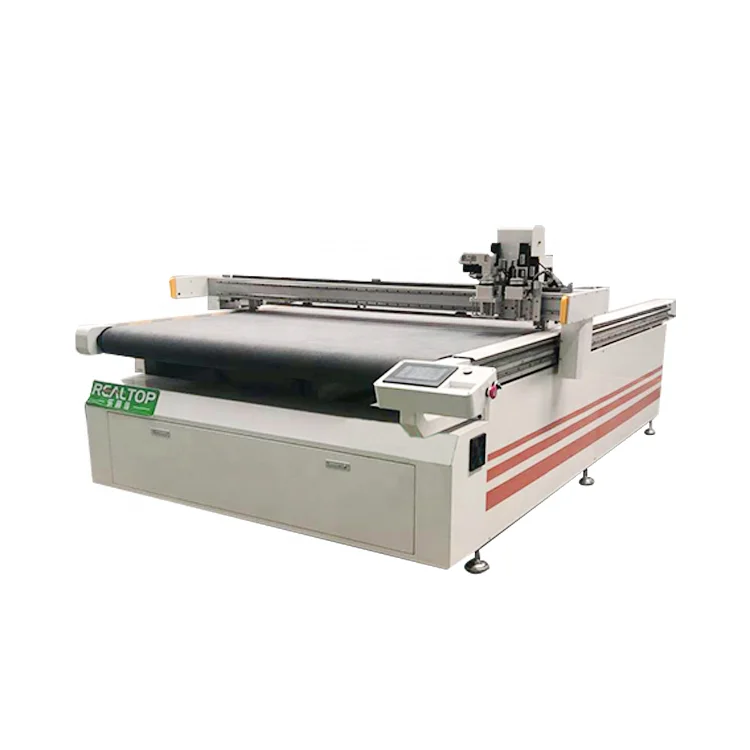
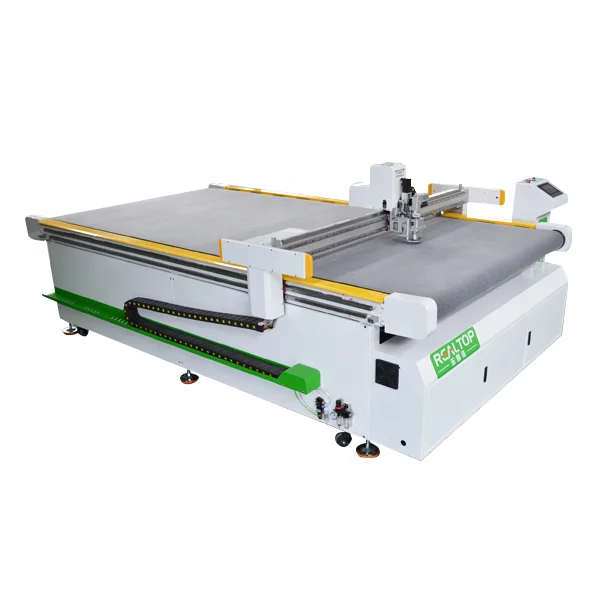
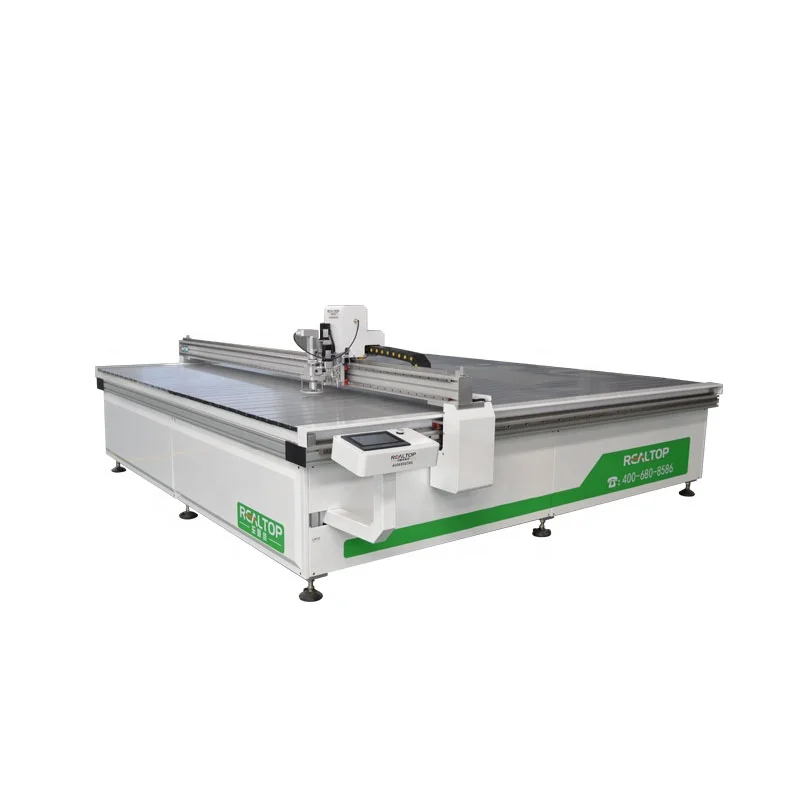
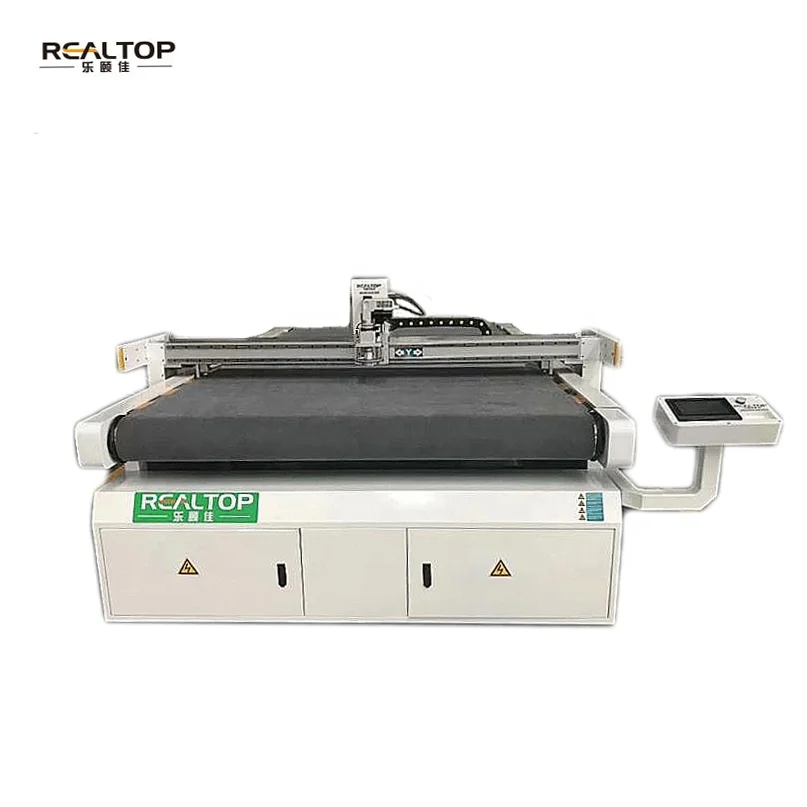
Tool Head Matching — Oscillating knife, drag knife, and creasing wheel configured per material density and thickness rather than forcing one blade through every composite layup.
Technical Specifications
| Parameter | Value |
|---|---|
| Model | RT-D2516/RT-S2516 |
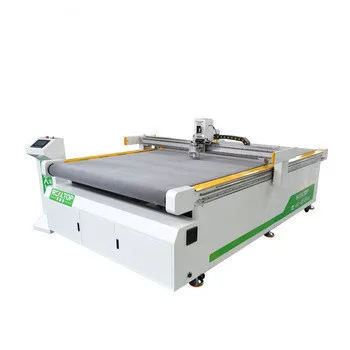
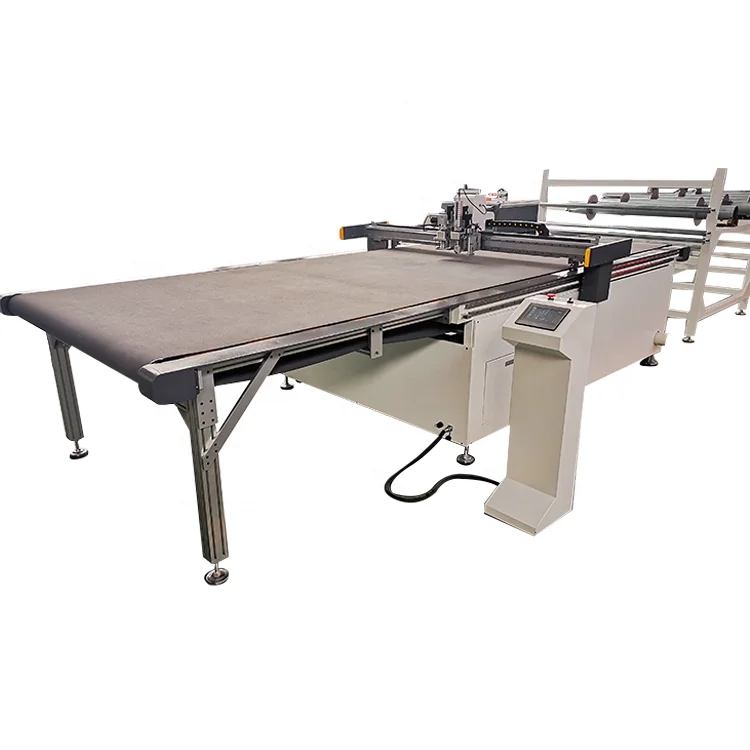
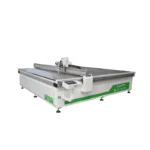
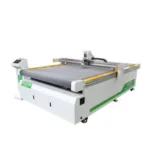
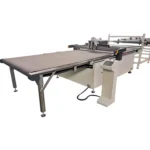
| Product Type | CNC Oscillating Knife Cutting Machine |
| Working Area | 1600 × 2500 mm |
| Machine Size (L × W × H) | 3450 × 2300 × 1250 mm |
| Rated Power | 9 kW |
| Table Type | Flat working table with conveyor belt and vacuum |
| Multifunctional Head | Swiss imported knife with vibration full cutting, vibration half cutting, and cursor location |
| Translational Velocity | 800 – 1200 mm/s |
| Cutting Thickness | 200 – 800 mm/s (basis not stated in source) |
| Repeated Accuracy | ≤ 0.1 mm |
| Transmission System | Digital servo motor, linear guide, synchronous belt, imported ball screw |
| Servo Motor | Japanese Yaskawa |
| Linear Rail | Taiwan Hiwin |
| Vacuum Pump | 7.5 kW |
| Instruction System | HP-GL compatible format |
| Voltage | 380V ± 10% |
| Safety Device | Infrared sensors |
| Assembly State | Auto feeding system included |
| Standards | CE (verify applicability to this model) |
Application Suitability
| Application | Material or Output |
|---|---|
| Gasket and seal fabrication | PTFE, ETFE, silicone rubber, non-woven fiber sheets |
| Automotive interior trimming | Multi-layer sponge composite leather, sound-deadening EVA and XPE foam |
| Structural core machining | Carbon fiber and glass fiber composite panels, paper honeycomb inserts |
| Footwear and bag material cutting | PU, EVA foam blocks, flexible leather, garment cloth |
| Packaging sample making | Corrugated paper, foam board, corrugated cardboard inserts |
| Insulation panel processing | PE and PP foam sheets, soft glass, composite insulation rolls |
What "Cutting Thickness" Actually Means on a Knife Table
A published thickness number without a stated material density is a guess, not a guarantee.
I once watched a workshop cut 20 mm EVA foam all morning without issue, then switch to a denser XPE block the same afternoon — the blade deflected, the edge crushed, and the operator spent two hours adjusting down-force by hand. The cutting thickness figure on any CNC oscillating knife cutting machine specifications sheet only becomes meaningful when tied to a specific foam density, composite layup, and tool head configuration [NEED_CITE: material density and blade deflection in oscillating knife cutting]. Before a thickness claim reaches the buyer it should already be validated on that buyer’s own stock.
Oscillation Frequency Meets Composite Layer Structure
Multi-layer composites — a foam core sandwiched between two fabric skins — react differently to each tool head setting. The Swiss imported oscillating knife on the RT-D2516/RT-S2516 supports both full-cut and half-cut vibration modes, letting the operator slice through the entire stack in one pass or score only the top skin for a fold line. Matching the oscillation mode to the layer count is what separates a clean contour edge from a delaminated mess.
Vacuum Hold-Down on Porous and Low-Mass Stock
A 7.5 kW vacuum pump paired with the conveyor-integrated flat table addresses the most common complaint on foam cutting lines: material lift at the blade exit point. Porous sponge and honeycomb panels leak vacuum quickly, so the table zoning must keep suction concentrated under the cut path. This CNC oscillating knife cutting machine’s conveyor-vacuum combination allows continuous feed while maintaining hold-down pressure across the 1600 × 2500 mm working area [NEED_CITE: vacuum zoning strategies for porous composite panels].
Translating Servo Specs into Edge Quality
The Yaskawa digital servo motors and Hiwin linear rails deliver ≤ 0.1 mm repeatability, but the practical meaning of that tolerance shows up on the finished part. On a gasket with a 3 mm bolt-hole pattern, a 0.1 mm deviation keeps every hole concentric; on a contoured automotive interior panel, it keeps the stitched seam allowance consistent around curves. Imported ball screws and synchronous belts complete the drive chain, reducing backlash that would otherwise appear as chatter marks on hard composite surfaces.
The Cost of Skipping the Material Trial
Buying a knife cutting table on working area alone is the most expensive shortcut in composite fabrication. When the tool head is mismatched to the stock — a drag knife on closed-cell EVA, for example — the edge compresses rather than cuts, and downstream lamination or bonding fails at the seam. I have seen entire production batches scrapped because the vacuum table zoning was not configured for small gasket parts; the pieces lifted during the final pass and the contour drifted [NEED_CITE: vacuum hold-down requirements for small-part nesting]. Every configuration decision — blade angle, oscillation amplitude, vacuum zone layout — needs to be locked against a sample cut on the actual material before the order is confirmed.
Why Sourcing This Table Starts at the Factory Floor
REALTOP designs and builds both knife and laser cutting platforms in-house, so the RT-D2516/RT-S2516 is specified around the composite or foam stock the buyer actually runs rather than forced into a single-method compromise. The tool head and vacuum table configuration are listed line-by-line in the order documentation, not left to the assembler’s judgment on the shop floor. Software compatibility with the buyer’s existing nesting workflow and HP-GL file import is confirmed before production begins, avoiding the week-long integration delay that surfaces only after the crate arrives.
Documentation & Verification
- Machine specification sheet listing RT-D2516/RT-S2516 tool head and vacuum pump configuration
- Electrical schematic confirming 380V ± 10% wiring for destination market frequency
- Sample cutting report on buyer’s own composite or foam stock with edge photographs
- Factory test record showing ≤ 0.1 mm repeatability across full working area travel
- Software licence and HP-GL file format compatibility note for nesting workflow
- Spare parts list covering Swiss knife blades, vacuum seals, and conveyor belt sections
Installation, Commissioning & Support
- Floor space of 3450 × 2300 mm plus operator clearance; level concrete slab required for 0.1 mm accuracy
- Dedicated 380V ± 10% circuit rated for 9 kW plus 7.5 kW vacuum pump on separate breaker
- Auto feeding system and conveyor table pre-assembled; vacuum pump connected on-site during commissioning
- First-run parameter tuning on buyer’s material to set oscillation amplitude, feed rate, and vacuum zone mapping
- Operator training covering HP-GL file import, tool head changeover, and CCD cursor location function
- Initial spare blade and vacuum seal kit shipped with machine to prevent unplanned downtime in the first weeks
Preparing Your Inquiry
To match the right knife head and vacuum zoning to your line, tell us the composite or foam type, nominal thickness, sheet or roll dimensions, and daily part volume. Confirm the local voltage, frequency, and preferred control language so the electrical schematic is drawn correctly before the build starts. If your existing nesting software outputs HP-GL or another vector format, send a sample file so compatibility is verified against the instruction system before the order is locked.
Frequently Asked Questions
Q: How is cutting thickness verified for my specific foam density and composite layup?
A: We run a sample cut on your exact stock — measuring edge quality, delamination, and dimensional accuracy — before confirming the tool head and oscillation settings. The sample cutting report ships with the machine so the production parameters are already documented on day one.
Q: Which tool head configuration prevents crushed edges on multi-layer sponge and EVA?
A: The Swiss imported oscillating knife offers full-cut and half-cut vibration modes. For closed-cell EVA and sponge composites, the oscillation amplitude and blade angle are tuned to slice through each layer without compressing the core, keeping edge profiles sharp enough for downstream bonding.
Q: Is CCD camera contour recognition available for printed composite panels at production speed?
A: CCD camera positioning with cursor location is configurable on this platform. We test tracking accuracy on your printed registration marks at full translational velocity before shipment so contour cuts stay within tolerance during continuous production runs.
Q: What vacuum table zoning options handle small gasket parts without lift during cutting?
A: The flat conveyor-vacuum table can be divided into independently controlled zones. For nested small gasket layouts, only the zones under active cut paths are energized, concentrating hold-down force where it is needed and preventing edge lift on lightweight composite stock.
Q: How do I confirm voltage, plug type, and control language before shipment?
A: The electrical schematic is reviewed and signed off during the order stage, listing supply voltage, frequency, plug standard, and control panel language for the destination market. Any deviation from the default 380V ± 10% configuration is addressed before the machine enters final assembly.


商品评价
Clear filtersThere are no reviews yet.