






Fast Shipping
Carrier information

20k products
Payment methods

24/7 Support
Unlimited help desk

2-day Delivery
Track or off orders
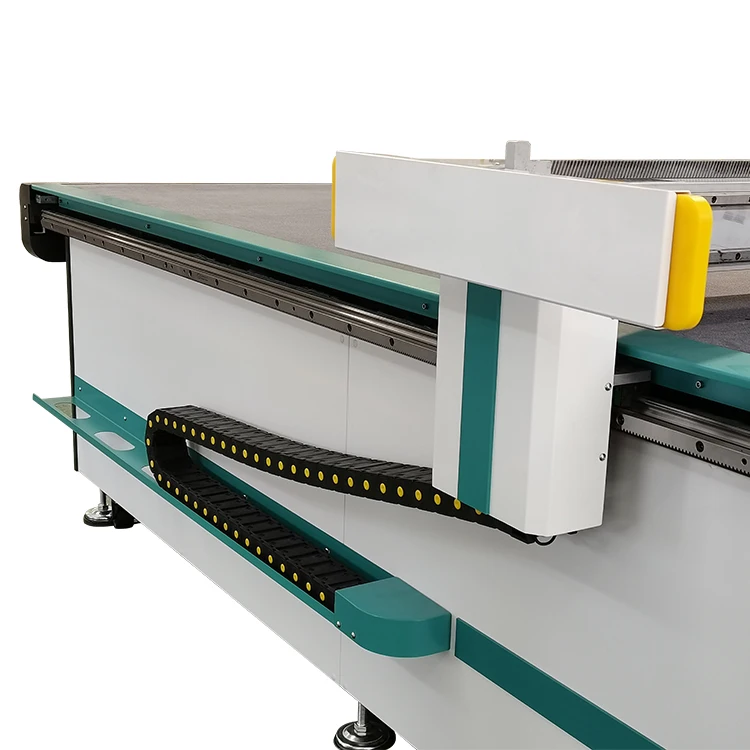
Vacuum Zoning Matched to Sheet Size — Tool head and table configuration on the RT-D2516/RT-S2516 specified per flute profile and blank dimensions, preventing small carton lift during high-speed oscillating cuts.
Technical Specifications
| Parameter | Value |
|---|---|
| Model | RT-D2516/RT-S2516 |
| Product Type | CNC Oscillating Knife Cutting Machine for Packaging |
| Working Area | 1600 × 2500 mm |
| Machine Size | 3450 × 2300 × 1250 mm |
| Rated Power | 9 kW |
| Vacuum Pump | 7.5 kW |
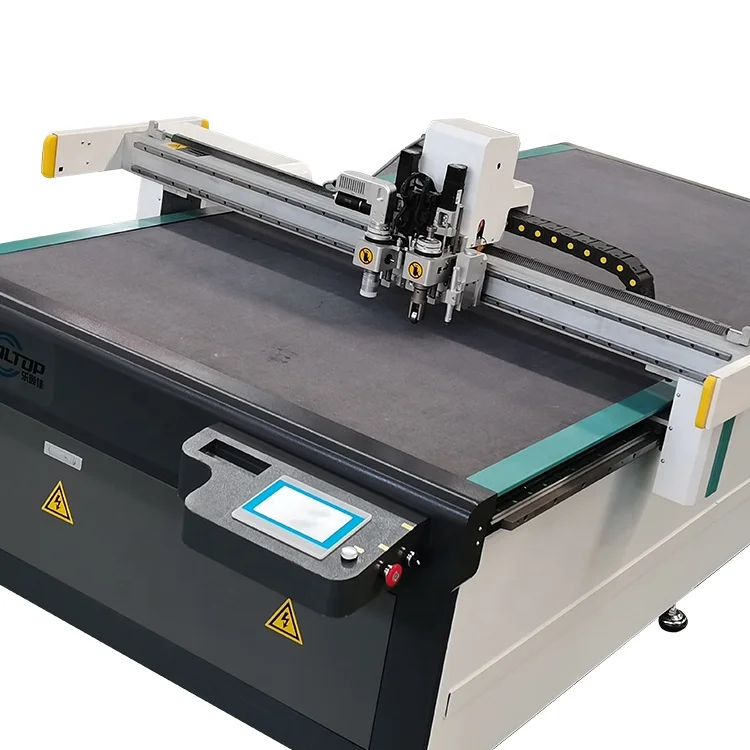
| Table Type | Flat working table with vacuum and auto feeding |
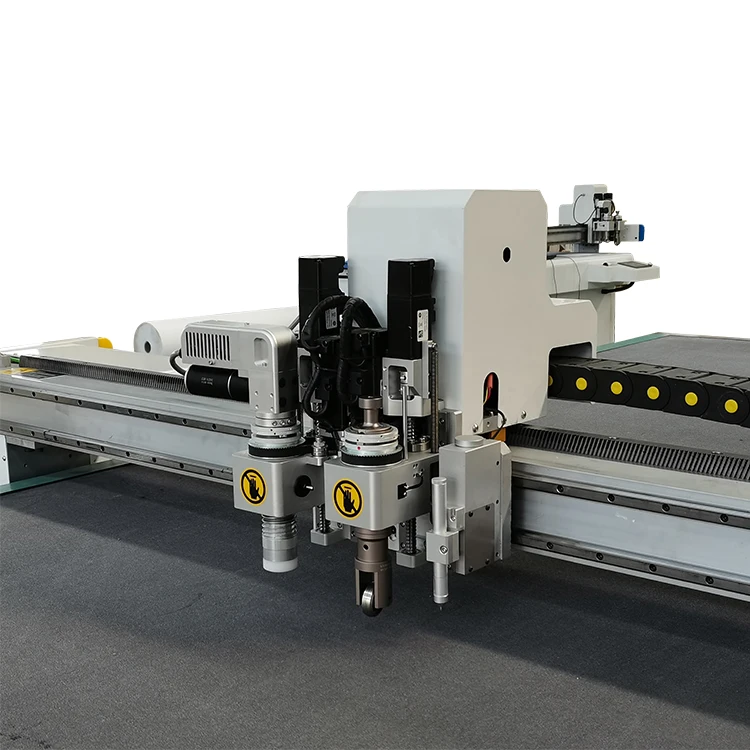
| Tool Head | Swiss imported oscillating knife with vibration full cutting, half cutting and cursor location |
| Translational Velocity | 800–1200 mm/s |
| Cutting Speed | 200–800 mm/s (basis not stated in source — confirm material / thickness) |
| Repeated Accuracy | ≤0.1 mm |
| Servo Motor | Japanese Yaskawa |
| Linear Rail | Taiwan Hiwin |
| Conveyor Belt | Germany imported |
| Transmission System | Digital servo motor, linear guide, synchronous belt, imported ball screw |
| Instruction System | HP-GL compatible format |
| Voltage | 380V ± 10% |
| Safety Device | Infrared sensors |
| Warranty | 12 months for whole machine |
| Standards | CE referenced |
Application Suitability
| Application | Material or Output |
|---|---|
| Carton and packaging sample making | Corrugated board, grey board, paper honeycomb |
| Short-run folding carton production | Single and multi-ply cardboard up to working area limit |
| Display and signage blanking | Foam board, PVC sheet, composite display panels |
| Gasket and automotive interior cutting | Flexible rubber, non-woven fabric, semi-rigid composites |
| Footwear and leather goods blanking | PU, EVA, synthetic and genuine leather sheets |
What "Working Area Alone" Leaves Out When Choosing a CNC Oscillating Knife Cutting Machine Specifications Guide
A 1600×2500 mm bed does not guarantee clean corrugated cuts if the vacuum zoning and tool head are not matched to the flute and blank size.
Buyers routinely shortlist flatbed cutters by table dimensions and price, then discover the machine cannot hold small carton blanks flat during oscillating knife passes. When a nested packaging sample lifts mid-cut, the blade drags through the flute at an angle, leaving crushed edges and dimensional drift that ruins the entire sheet. I have watched sample rooms waste entire corrugated batches because the vacuum zones were factory-set for large sign panels rather than the 80×120 mm die-cut blanks the buyer actually runs [NEED_CITE: vacuum zoning effects on small part retention during oscillating knife cutting].
Oscillating Knife Tooling for Corrugated Flute Profiles
The Swiss imported oscillating knife head on the RT-D2516/RT-S2516 delivers full-cut, half-cut and cursor location modes. Full-cut mode shears through B, C and E flute at high frequency, while half-cut scores crease lines for folding carton workflows without penetrating the lower liner. Cursor location aligns the tool to pre-printed registration marks, critical when sample makers need to verify that the CNC oscillating knife cutting machine specifications match the die-line tolerance on screen before committing to a short run.
Auto-Feeding Conveyor for Continuous Sheet Throughput
The flat working table pairs a 7.5 kW vacuum pump with a Germany-imported conveyor belt for automated sheet advancement. In sample and short-run carton environments, operators load sheets at one end while cut blanks exit at the other, reducing manual repositioning between jobs. The auto-feeding system keeps the cutting speed between 200 and 800 mm/s consistent across the full 1600×2500 mm working area, so nested packaging samples maintain positional accuracy from the first blank to the last [NEED_CITE: auto-feeding conveyor impact on positional accuracy in flatbed digital cutters].
How Servo Drive and Linear Rail Translate to Carton Accuracy
The Japanese Yaskawa digital servo motors paired with Taiwan Hiwin linear rails hold repeated accuracy at ≤0.1 mm across the entire bed. For packaging sample makers, this tolerance matters most on interlocking tab-and-slot closures, where even a 0.3 mm drift across a long crease line causes the assembled carton to twist. The imported ball screw and synchronous belt transmission eliminates backlash accumulation that cheaper rack-and-pinion setups produce after extended cutting cycles, keeping dimensional accuracy stable whether the machine runs one sample or fifty sheets in sequence.
The Hidden Cost of Misconfigured Vacuum Zoning
When vacuum zones are factory-set for large format work and a buyer cuts small carton blanks, the suction distributes over unoccupied zones instead of concentrating under the part. The corrugated sheet lifts at the trailing edge during high-frequency oscillation, the blade catches the flute wall, and the resulting ragged edge forces the sample maker to recut the entire nest. This failure repeats on every sheet until someone re-maps the zoning to the actual blank dimensions, by which time production schedules have already slipped [NEED_CITE: vacuum zone configuration for small format carton blanking on CNC flatbed cutters].
Why Packaging Shops Source the RT-D2516/RT-S2516 Here
In-house design covers both knife and laser cutting technologies, so packaging buyers get the cutting method matched to their flute profile rather than forced into one platform. Tool head and table configuration on the RT-D2516/RT-S2516 is specified against the buyer’s actual corrugated board and daily volume, not quoted from a generic catalogue page. CCD camera positioning for printed contour work can be integrated for sample makers running pre-printed sheets. Software compatibility is confirmed against the buyer’s existing DXF or PLT nesting workflow before the order is locked. Voltage, plug type and control language are verified against the destination market to avoid on-site electrical rework. Sample cutting on the buyer’s own corrugated board runs before commitment, so the cut edge and crease quality are evaluated on real material rather than promised on paper.
Documentation & Verification
- Machine specification sheet confirming tool head and vacuum zoning matched to your flute profile
- Electrical schematic with voltage, plug and frequency validated for your local grid
- Sample cutting report on your corrugated board showing edge quality and crease depth
- Tool head and table configuration list itemizing oscillating knife, conveyor and vacuum zones
- HP-GL file format compatibility note and software licence confirmation before dispatch
- Factory test record documenting repeated accuracy across the full 1600×2500 mm bed
Installation, Commissioning & Support
- 380V ± 10% supply with dedicated circuit rated for the 9 kW machine plus 7.5 kW vacuum pump
- Floor space of approximately 3450×2300 mm with clearance for conveyor sheet feeding and blank exit
- Machine arrives assembled; leveling and vacuum zone re-mapping completed during first-day commissioning
- Oscillating knife frequency, half-cut depth and cursor calibration set on your board during installation
- Blade and conveyor belt wear inspection schedule aligned with your daily corrugated cutting volume
- Infrared sensor safety zones tested and documented before operator training begins
Request a Configuration Quote
Send your corrugated board type, flute profile, sheet dimensions and typical nest layout so we can specify vacuum zoning and tool head settings for the RT-D2516/RT-S2516. Include your local voltage, frequency and preferred control language to confirm electrical configuration before quotation. If you run existing CAD software, share a sample DXF or PLT file so we verify HP-GL instruction system compatibility and nesting workflow integration.
Frequently Asked Questions
Q: How do I match oscillating knife frequency and blade type to my corrugated flute?
A: Blade angle and oscillation frequency must match the flute profile. B-flute cuts cleanly at higher frequency with a narrow-angle blade, while C-flute requires a wider blade and lower frequency to avoid crushing the flute wall. We run sample cuts on your actual board to confirm the combination before finalizing the tool head configuration on the RT-D2516/RT-S2516.
Q: What printed mark quality does CCD contour recognition require?
A: The CCD camera needs registration marks with sufficient contrast and consistent size relative to the camera’s field of view. Marks printed on corrugated liners with heavy ink bleed or low contrast may fail to track at full cutting speed. We test with your printed sheet to confirm recognition reliability before integrating CCD positioning into your packaging workflow.
Q: How should vacuum zones be configured for small carton blanks?
A: Small blanks require concentrated suction directly under each nested part rather than uniform suction across the full bed. The 7.5 kW vacuum pump on the RT-D2516/RT-S2516 supports multi-zone control so suction focuses on occupied areas. We map zones to your typical nest layout during commissioning to prevent sheet lift during oscillating knife passes.
Q: What electrical details must be confirmed before shipment?
A: The RT-D2516/RT-S2516 operates at 380V ± 10%, but plug type, frequency and phase configuration vary by market. We confirm your local grid specifications and supply an electrical schematic matching your requirements. Control system language is also verified so operators can navigate menus without translation barriers on arrival.
Q: Which software file formats does the HP-GL instruction system accept?
A: The instruction system processes HP-GL compatible output, which most packaging CAD platforms export as DXF or PLT files. We verify compatibility with your existing nesting software and confirm file import settings before order. If your workflow uses AI or PDF die-lines, we test conversion accuracy on a sample file to ensure dimensional integrity is maintained.


商品评价
Clear filtersThere are no reviews yet.