


Fast Shipping
Carrier information

20k products
Payment methods

24/7 Support
Unlimited help desk

2-day Delivery
Track or off orders
Swiss Oscillating Knife Integration — Full-cut, half-cut, and creasing tool heads are matched to the buyer’s actual board flute profile and sticker stock before the machine leaves the factory.
Technical Specifications
| Parameter | Value |
|---|---|
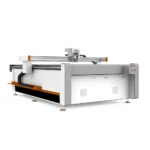
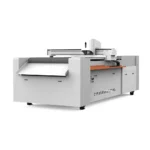
| Product Type | CNC Oscillating Knife Cutting Table |
| Model | RT-D2516/RT-S2516 |
| Working Area | 1600×2500 mm |
| Overall Dimensions | 3450×2300×1250 mm |
| Rated Power | 9 kW |
| Voltage | 380V ±10% |
| Frequency | 50/60 Hz (basis not stated in source) |
| Control System | CNC (HP-GL compatible format) |
| Tool Head Type | Swiss imported oscillating knife (vibration full cutting, half cutting, cursor location) |
| Translational Velocity | 800–2000 mm/s |
| Cutting Speed | 200–800 mm/s (according to different cutting materials) |
| Repeatability | ≤0.1 mm |
| Transmission System | Digital servo motor, linear guide, synchronous belt, ball screw |
| Servo Motor | Taiwan Delta |
| Linear Guide | Taiwan Hiwin rail |
| Vacuum Table | Aluminum alloy honeycomb structure with zoned vacuum adsorption |
| Vacuum Pump | 7.5 kW |
| Conveyor Belt | Germany imported |
| Auto Feeding | Yes |
| Table Type | Flat working table |
| Safety Device | Infrared sensors and emergency stop |
| Language Options | English, Russian, Italian, Chinese; special languages customizable |
| Software | Professional carton nesting software included (free) |
| Cutting Thickness | ≤100 mm (varies with material) |
| Certification | CE |
| Warranty | First year parts free (buyer pays shipping); on-site engineer service available (buyer covers travel and accommodation) |
Application Suitability
| Application | Material or Output |
|---|---|
| Packaging and carton sample making | Corrugated cardboard, greyboard, kraft paper |
| Short-run box production | Single, double, and triple-wall corrugated board |
| Sticker and label contour cutting | Vinyl, PVC, adhesive-backed paper, synthetic label stock |
| Signage and display fabrication | Foam board, honeycomb paper board, corrugated plastic |
| Flexible material cutting | Leather, soft glass, silicone, rubber, sponge, composite textiles |
Why the Voltage Question Must Precede the Price on CNC Oscillating Knife Cutting Table Specifications
An incorrectly specified power supply can halt a production floor for weeks while a transformer is sourced and shipped.
When a buyer focuses only on working area and cutting speed, the electrical compatibility often gets assumed rather than verified. I once watched a packaging line in Germany sit idle for nearly three weeks because the cutting table arrived configured for 380V/50Hz while the facility ran on 480V/60Hz. The production manager had approved the purchase order without a second look at the electrical page. That delay cost more in lost output than the machine itself [NEED_CITE: voltage and frequency standards by export market]. The CNC oscillating knife cutting table specifications must include confirmed voltage, frequency, and plug type matched to the buyer’s actual workshop supply before the machine enters production.
Oscillating Knife Mechanics on Corrugated Flutes
The Swiss imported oscillating knife on this CNC oscillating knife cutting table vibrates at high frequency to slice through corrugated board without crushing the flute structure. Unlike a static drag knife that drags and compresses the material, the oscillating action produces a clean cross-section on both single-wall and double-wall profiles. The half-cut mode scores the board for folding without penetrating the bottom liner, which is essential for carton sample makers who need fold lines that hold shape during assembly.
Vacuum Zoning and Small-Part Stability
The aluminum alloy honeycomb vacuum table uses zoned adsorption to hold material flat across the 1600×2500 mm working area. When cutting small sticker contours or narrow label strips, a single-zone vacuum loses grip because the uncovered table area bleeds suction. Zoned control directs vacuum only to the region under the material, keeping small parts anchored during high-speed traversal [NEED_CITE: vacuum adsorption principles for flatbed cutting tables]. The 7.5 kW vacuum pump provides sufficient negative pressure for porous corrugated board and non-porous vinyl alike.
Drive Accuracy and Contour Tracking
Taiwan Delta servo motors paired with Hiwin linear rails deliver ≤0.1 mm repeatability across the full cutting envelope. For packaging sample makers running intricate carton lock mechanisms or sticker producers following printed contour borders, this positional accuracy determines whether parts assemble correctly downstream. The synchronous belt and ball screw transmission converts servo rotation into linear motion with minimal backlash. At translational velocities up to 2000 mm/s, the drive system must decelerate and reverse direction at corners without overshoot, which is where servo tuning and rail rigidity become critical to edge quality.
The Cost of Skipping a Sample Cut
Selecting tool heads based on catalog descriptions rather than actual material tests leads to problems that only appear on the production floor. A corrugated board with high recycled content behaves differently from virgin kraft liner — the flute crushes more easily, requiring adjusted oscillation amplitude and cutting pressure. Sticker materials with aggressive adhesive can gum up a knife edge, demanding a different blade geometry or coating [NEED_CITE: material-specific tooling selection for digital cutting]. Without a sample cutting report on the buyer’s own stock, these variables remain unknown until the machine is running in the workshop.
Why Source This Equipment Here
The design team configures tool head combinations — oscillating knife, drag knife, creasing wheel — based on the buyer’s specific material stack rather than shipping a default setup. CCD camera positioning is available for printed contour work where registration marks must be read at production speed. Software compatibility is confirmed before order, with the professional carton nesting software accepting DXF, PLT, and AI files directly from common packaging CAD platforms. Voltage, control language, and plug type are verified against the buyer’s site conditions, documented on the electrical schematic before fabrication begins. Every machine ships with a factory test record run on the buyer’s specified material, not a generic demonstration board.
Documentation & Verification
- Machine specification sheet with confirmed tool head and table configuration for your material
- Electrical schematic and voltage confirmation matched to your workshop supply before shipment
- Sample cutting report on your corrugated board, sticker stock, or foam material
- Software licence and file format compatibility note for your existing CAD workflow
- CE declaration and factory test record documenting performance before dispatch
- Spare parts list with recommended consumables for your daily production volume
Installation, Commissioning & Support
- Requires a level concrete floor with minimum 3500×2400 mm clearance for the RT-D2516/RT-S2516 overall dimensions
- Dedicated 380V ±10% three-phase circuit rated for at least 9 kW plus the 7.5 kW vacuum pump
- Machine ships fully assembled; positioning requires standard forklift access to the 3450×2300 mm footprint
- First-run parameter tuning for cutting speed, oscillation frequency, and vacuum zoning on your material
- Operator training covers CNC control interface, tool head changes, and nesting software workflow in your confirmed language
- Wear parts inventory includes oscillating knife blades, vacuum table seals, and conveyor belt sections
What to Provide with Your Inquiry
To configure the RT-D2516/RT-S2516 correctly, share the material types you cut most often along with typical sheet thickness and maximum sheet dimensions. Confirm your workshop voltage and frequency so the electrical system is built to match. Let us know which file formats your design team uses so we verify nesting software compatibility before order placement.
Frequently Asked Questions
Q: How is cutting speed verified on my specific corrugated board thickness and flute type?
A: We run a sample cutting test using your actual board stock, measuring edge quality, flute compression, and cutting time at different speeds. The sample cutting report documents the recommended cutting speed and oscillation settings for each material you plan to process, so you have a verified baseline from day one.
Q: Which tool head combination handles both creasing and full-cutting on packaging carton in one pass?
A: The RT-D2516/RT-S2516 can be configured with an oscillating knife for through-cutting and a creasing wheel for fold lines, mounted on the same tool carriage. This allows creasing and cutting to execute in a single pass without manual repositioning, reducing setup time on carton sample production.
Q: Is the vacuum table zoning sufficient for small sticker and label parts without material lift?
A: The honeycomb vacuum table is divided into independently controlled zones. When cutting small contours, only the zones beneath the active cutting area are engaged, maintaining concentrated suction on the material. This prevents small sticker parts from lifting or shifting during high-speed knife traversal.
Q: What file formats does the nesting software accept, and can it integrate with my existing CAD workflow?
A: The included professional carton nesting software imports DXF, PLT, and AI files, along with HP-GL compatible formats. If your design team works in a specific packaging CAD platform, we verify file import and nesting compatibility during the pre-order confirmation stage to avoid workflow disruption.
Q: How are voltage, plug type, and control language confirmed before shipment?
A: We require your workshop voltage, frequency, and plug standard at the inquiry stage. These are documented on the electrical schematic and voltage confirmation sheet you approve before production. The control interface language is set to your preference from available options or customized for your operator team.


商品评价
Clear filtersThere are no reviews yet.