



Fast Shipping
Carrier information

20k products
Payment methods

24/7 Support
Unlimited help desk

2-day Delivery
Track or off orders
In-House Knife Tooling Matched to Fabric — every oscillating head and vacuum zone is configured against the buyer’s actual textile stack rather than sold on table size alone.
Technical Specifications
| Parameter | Value |
|---|---|
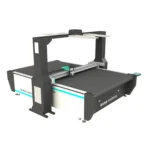
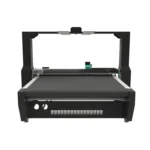
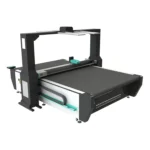
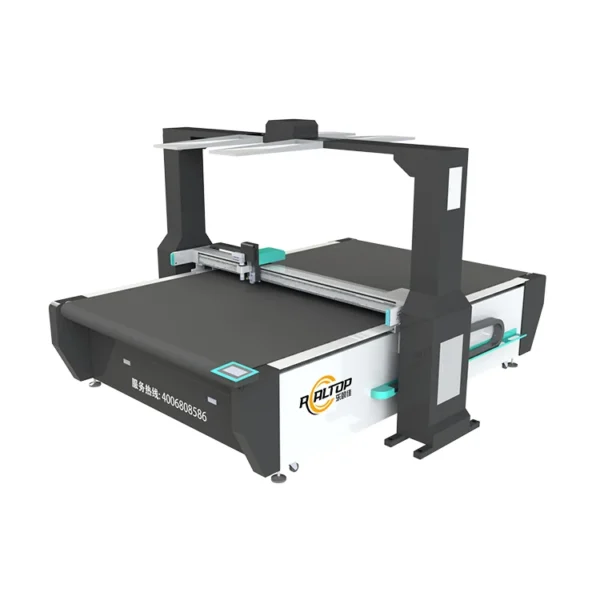
| Product Type | CNC Oscillating Knife Cutting Machine |
| Effective Cutting Area Options | 2500×1600mm / 2500×1800mm / 2500×2000mm / 3000×1600mm / 3000×2000mm |
| Max Idle Speed | 2500 mm/s |
| Actual Cutting Speed | 500–2000 mm/s (depending on material thickness and hardness) |
| Repeated Positioning Accuracy | ±0.1 mm |
| Repeatability | ±0.01 mm |
| Cutting Depth Control Accuracy | 0.03 mm |
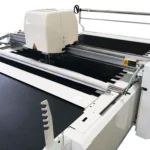
| Cutting Head | Oscillating knife with MAXON vibrating cutter head |
| Blade Options | Tungsten steel 35#, 26#, 16# |
| Servo Motor | Delta (optional Yaskawa, Panasonic) |
| Guide Rail | HIWIN |
| Rack | YYC |
| Control Interface | 7-inch LCD touch screen |
| Feeding Method | Fixed or auto-feeding (optional) |
| Conveyor Belt | 4mm Ammeraal felt |
| Air Pump Power | 9 kW |
| Main Motor Power | 2 kW |
| Voltage | 380V or 220V (optional) |
| Cable | igus high-flex shielded cable |
| Framework | CO2 protection welded bed with secondary vibration aging treatment |
| Total Weight | 1300 kg |
| Software | CUT-REALTOP with intelligent automatic nesting module |
| Safety Equipment | Infrared blocking stop and anti-collision protection |
Application Suitability
| Application | Material or Output |
|---|---|
| Sportswear and activewear production | Sublimation-printed stretch knit, polyester mesh, spandex blends |
| Garment and footwear panel cutting | Woven cotton, denim, synthetic leather, microfiber |
| Multi-layer textile nesting | Bulk knit fabric stacks, fleece, technical textiles |
| Composite and leather goods | PU leather, genuine leather sheets, foam-backed composites |
| Gasket and packaging sample making | Non-woven felt, rubber sheet, corrugated board |
Why Material Thickness Decides the Knife Before the Table Size Does
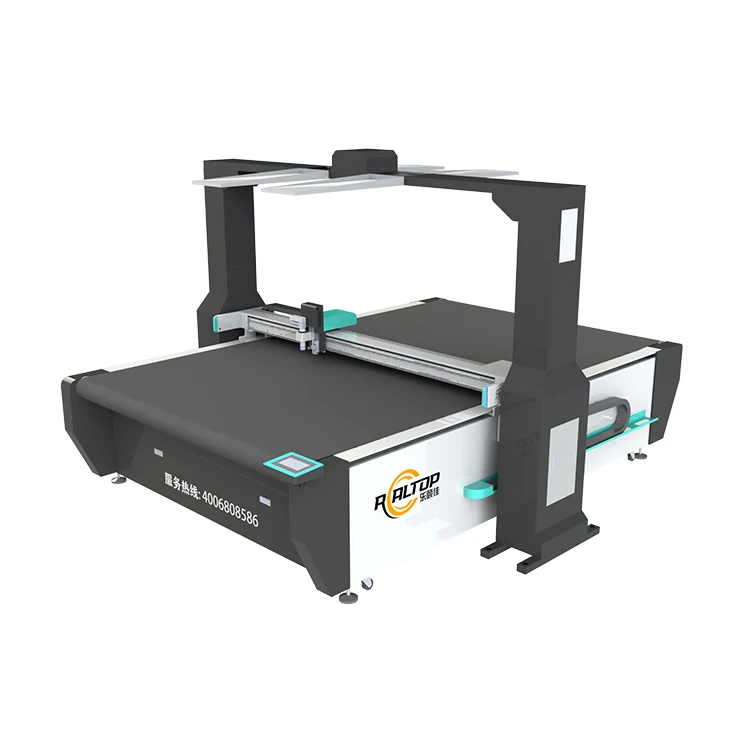
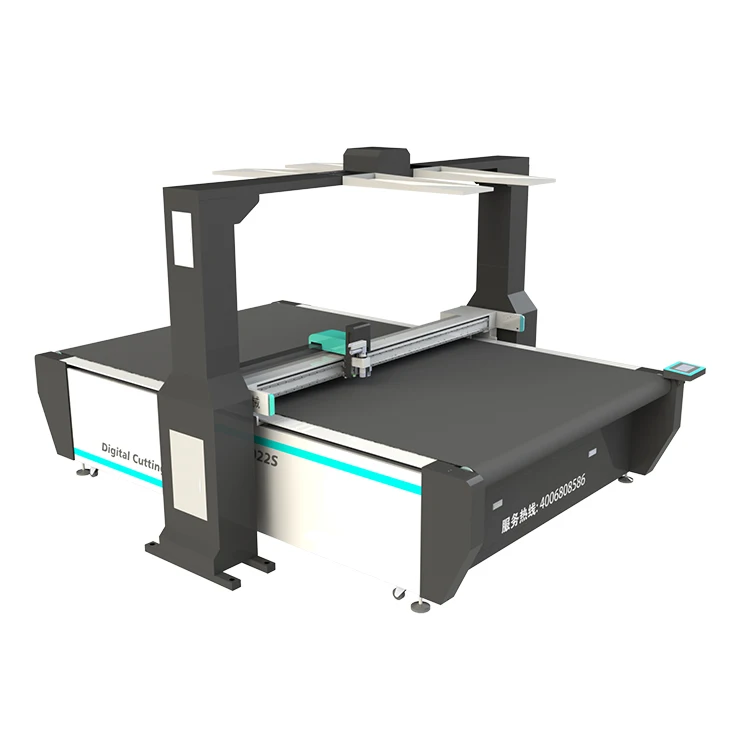
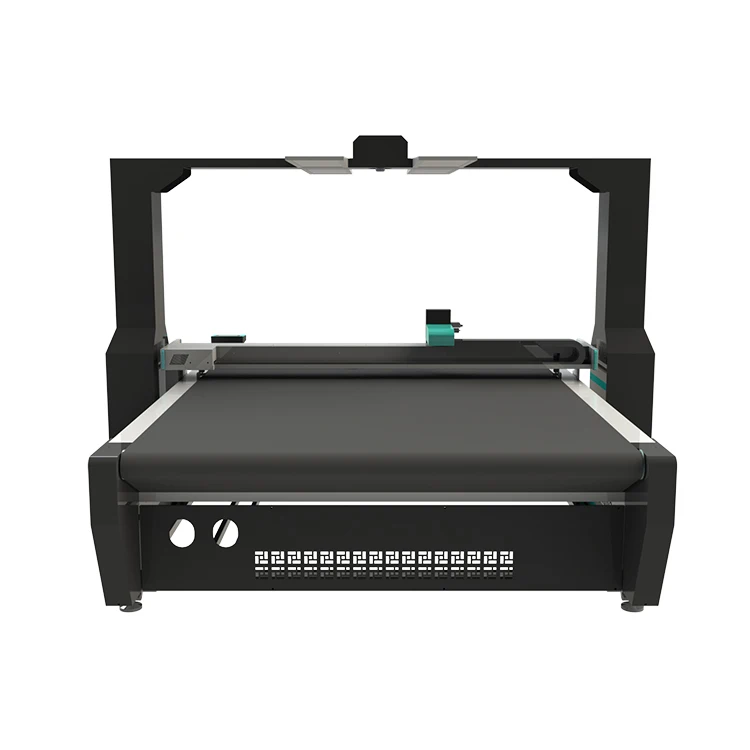
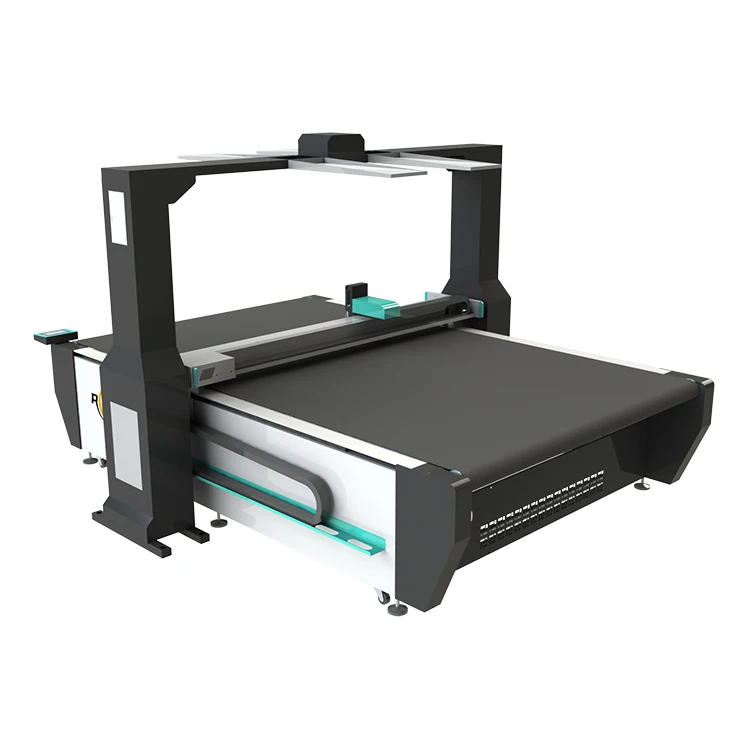
A cutting table chosen purely on working area often fails the moment the blade meets a dense multi-layer lay-up. The correct CNC oscillating knife cutting machine specifications must be built around the fabric stack you actually run, not the maximum sheet dimension you might someday need.
I have watched garment workshops invest in large-format tables only to discover the standard 16# blade could not penetrate their six-layer fleece without delaminating the bottom ply. The cutting speed drops, the edge frays, and operators start forcing the head — which wears the oscillating mechanism prematurely [NEED_CITE: oscillating knife wear patterns under high-density textile loads]. Selecting tool head, blade profile, and vacuum zoning together prevents most of these production-floor surprises.
Blade Selection Across Fabric Densities
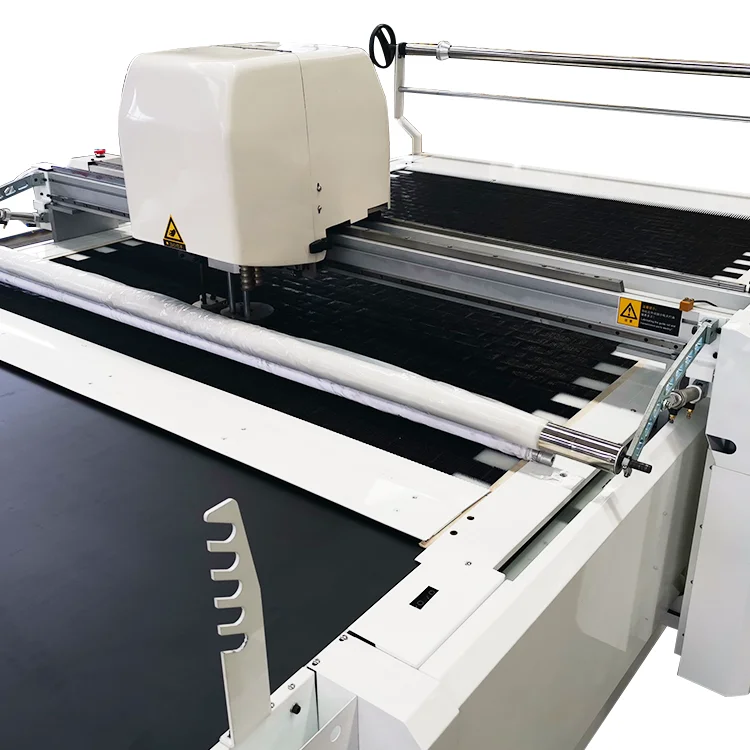
The oscillating head accepts tungsten steel blades in 35#, 26#, and 16# profiles. A sportswear line cutting single-ply sublimation-printed stretch knit needs a fine 16# blade at moderate oscillation frequency to keep the contour tight around armholes and curved seams. Switch that same head to a 35# blade when the order calls for six-layer neoprene, and the stroke length handles the stack depth without dragging the bottom layer out of register.
Vacuum Table Zoning for Small Panel Hold-Down
The 9 kW air pump feeds a conveyor-backed vacuum plenum divided into independently valved zones. When cutting small gusset pieces or collar inserts, only the zones directly under the cutting path stay open. This keeps suction concentrated on a small area, preventing the fabric edges from lifting mid-stroke. Without zoning, lightweight knit panels shift once the blade exits the material boundary, and the nesting yield drops noticeably on a CNC oscillating knife cutting machine running mixed-size garment panels.
Reading the Specs That Actually Matter on the Floor
Repeated positioning accuracy of ±0.1 mm and repeatability of ±0.01 mm sound close, but they measure different things. Positioning accuracy governs where the head arrives relative to the file coordinate; repeatability governs how consistently it returns to that same coordinate across hundreds of cycles. For printed sportswear fabric where a CCD camera — if fitted — tracks registration marks, repeatability is the number that keeps each cut panel identical. The 0.03 mm cutting depth control accuracy matters when kissing the conveyor belt surface to avoid scoring the Ammeraal felt, which extends belt life on continuous auto-feeding runs. Servo drive selection between Delta, Yaskawa, and Panasonic influences deceleration smoothness at corners, directly affecting edge quality on tight athletic-wear contours [NEED_CITE: servo tuning effect on oscillating knife corner quality]. The HIWIN guide rail and YYC rack combination maintains linear motion fidelity across the full 3000 mm travel, so panels cut at the far end of a 3020 table match those cut near the origin.
The Cost of Skipping a Material Trial Run
When a buyer specifies a machine on working area and price without running sample cuts on their own fabric roll, the hidden costs surface during the first production week. Ragged edges on elastane blends mean recutting panels, which pushes daily output below target. Incorrect vacuum zoning lifts small pieces into the blade path, causing head strikes that trip the infrared blocking stop repeatedly. Each stop interrupts the nesting sequence and wastes the remaining material on that lay [NEED_CITE: fabric cutting downtime causes in garment workshops]. These problems trace back to a configuration that was never validated against the buyer’s specific textile weight, stretch percentage, and ply count.
Why Sourcing This Cutter From the Builder Matters
The frame is CO2-welded and then put through secondary vibration aging treatment, which relieves residual stress before the guide rails are mounted — this keeps the 3000 mm travel true over years of continuous oscillation. The MAXON vibrating cutter head is paired with a tool configuration list matched to the buyer’s stated material, so a leather goods producer receives a different setup than a sportswear factory. Software compatibility is confirmed before order: the CUT-REALTOP nesting module and file format conversion tools are tested against the buyer’s existing DXF or PLT workflow. Voltage is locked to the destination market at quotation stage, so a 220V workshop in Southeast Asia does not receive a 380V cabinet. Sample cutting on the buyer’s actual material roll is completed and documented before the machine enters production.
Documentation & Verification
- Factory test record cutting your fabric roll at stated speed and ply count before dispatch
- Electrical schematic confirming 380V or 220V wiring matched to destination market
- Tool head and blade configuration list tied to your material type and thickness
- Software licence and file format compatibility note for your nesting workflow
- CE declaration referencing applicable machinery directive standards
- Packing photographs showing bed, gantry, and control cabinet secured for freight
Installation, Commissioning & Support
- 1300 kg welded bed requires level concrete floor with anchor points across 3000×2000mm footprint
- Dedicated 380V three-phase or 220V circuit with breaker rated above 11 kW total connected load
- Gantry and control cabinet ship separate; on-site assembly covers rail alignment and belt tension
- First-run calibration verifies ±0.01mm repeatability across full travel using dial indicator
- Operator training covers nesting module setup, blade change procedure, and vacuum zone mapping
- Spare tungsten steel blades and igus cable segments included for initial maintenance cycle
Before You Send the Inquiry
Share the fabric type, weight per square meter, and maximum ply count you plan to cut. Confirm your daily panel volume and whether auto-feeding from a roll is needed or if you load fixed sheets. Specify your workshop voltage, frequency, and preferred control language so the electrical cabinet and LCD interface are built to match. If you run sublimation-printed stretch fabric, send a sample roll so we can test CCD mark tracking at production speed and document edge quality before quotation.
Frequently Asked Questions
Q: How do I choose between the 16#, 26#, and 35# tungsten steel blades?
A: The 16# blade suits single-ply or light knit fabrics where fine contour detail is critical, such as sportswear armholes. The 26# handles mid-weight woven textiles and two-to-three-layer lay-ups. The 35# blade is specified for dense stacks like six-layer fleece, neoprene, or leather where stroke depth must penetrate the full thickness without dragging lower plies out of alignment.
Q: What cutting speed is realistic on multi-layer sportswear fabric?
A: Actual cutting speed ranges from 500 to 2000 mm/s depending on material thickness and hardness. A single-ply polyester mesh runs near the upper range, while a four-layer spandex blend requires slower travel to maintain edge fusion. We record speed and edge quality on your own fabric sample before confirming the production rate in the quotation.
Q: How does vacuum zoning affect small garment piece cutting?
A: Independent zone valves concentrate suction only where the blade is actively cutting. Small panels like collar inserts or pocket pieces need localized hold-down; a fully open table spreads suction too thin and lets lightweight knit edges lift. We configure zone layout based on your smallest panel dimension before the table is assembled.
Q: Can the CCD camera track printed marks on stretch fabric at full speed?
A: Printed registration marks on sublimation stretch fabric can shift when the material relaxes after unrolling. The CCD system must be calibrated to your specific print contrast and fabric stretch percentage. We run your printed roll at target production speed and document mark-acquisition success rate before committing to a configuration.


商品评价
Clear filtersThere are no reviews yet.