





Fast Shipping
Carrier information

20k products
Payment methods

24/7 Support
Unlimited help desk

2-day Delivery
Track or off orders
Precision Tool Configuration — every RTT4060 knife setup is validated on your actual cardboard or adhesive stock before the machine leaves the factory, not guessed from a catalog grid.
Technical Specifications
| Parameter | Value |
|---|---|
| Model | RTT4060 |
| Product Type | CNC Digital Cutting Plotter |
| Series | T series |
| Working Area | 400 × 600 mm |
| Tool Head Type | Multifunctional (cutting, creasing, kiss-cutting, dotted-line) |
| Positioning System | CCD auto positioning |
| Control Interface | HD Touch Control Panel with network port |
| Feeding Method | Fully automated feeding, cutting and picking |
| Warranty | 12 months for whole machine |
| Customization | OEM & ODM supported |
Application Suitability
| Application | Material or Output |
|---|---|
| Packaging sample making | Corrugated cardboard, folding carton board, grey board |
| Graphic finishing | Self-adhesive vinyl, PP sheet, PVC sheet, coated paper |
| Short-run box production | A3 format paper boxes, greeting cards, structural prototypes |
| Personalized packaging | Small batch and individualized product processing without die tooling |
Why "Working Area" Is the Wrong First Question for Packaging CNC Cutting Table Buyers
A 400 × 600 mm bed is only useful if the knife, creasing wheel and vacuum zones match the substrate you actually run.
Many buyers specify a digital flatbed cutting plotter for packaging purely by sheet size, then discover the oscillating knife crushes their flute profile or the drag knife leaves ragged edges on self-adhesive vinyl. The cutting method and tool combination must be decided by the material behaviour — thickness, density, adhesive backing — not by the footprint of the machine. When the wrong tool head meets the wrong substrate, you get crushed corrugated cores, delaminated labels and a machine that technically "works" but cannot produce saleable output [NEED_CITE: material-specific tooling selection for oscillating knife systems].
Matching the Knife to the Substrate, Not the Brochure
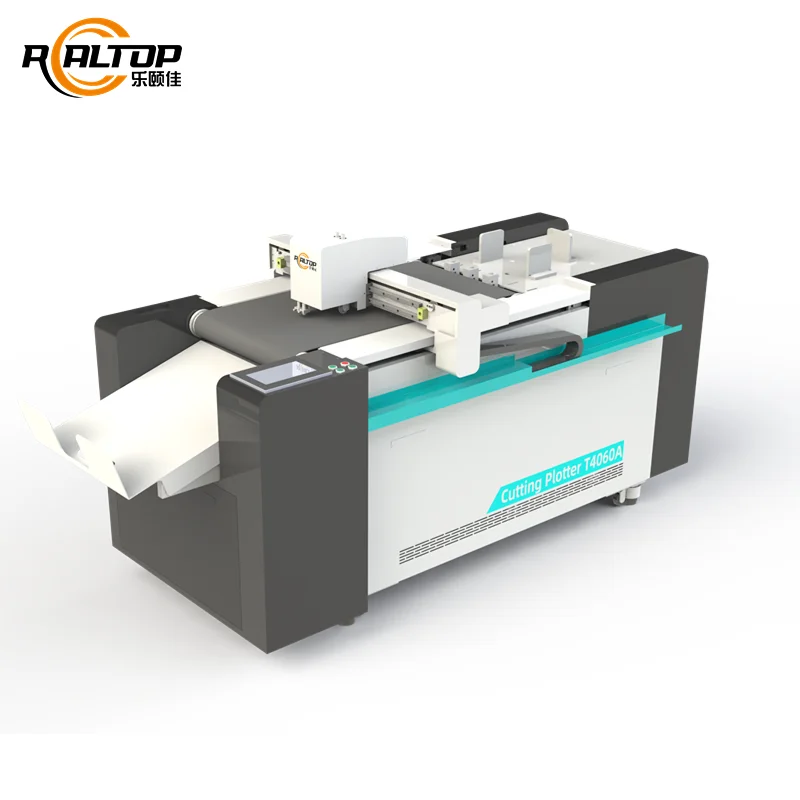
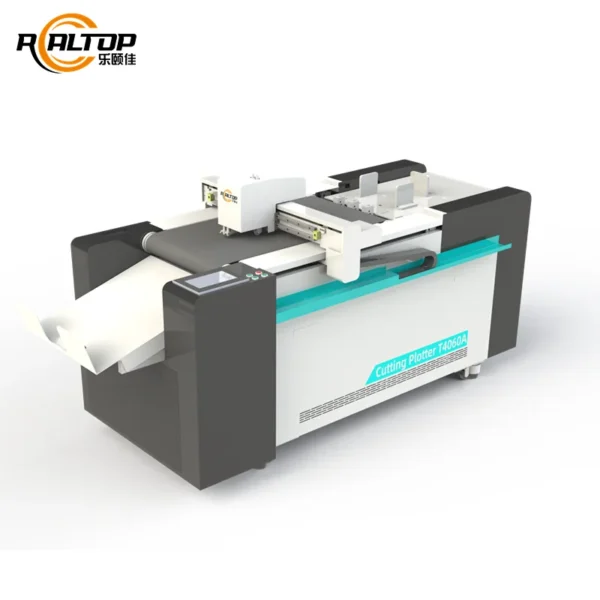
The RTT4060 T-series supports oscillating knife, drag knife, creasing wheel and dotted-line tooling within a single multifunctional head. For corrugated cardboard sample making, the oscillating knife delivers a clean vertical cut through single and double wall flute without compressing the core. For self-adhesive vinyl kiss-cutting, the drag knife follows the CCD-tracked printed contour while controlling depth to leave the backing intact. A CNC oscillating knife cutting table configured this way handles the full packaging substrate range on one bed, eliminating the need for separate plotters for board and film work.
CCD Contour Recognition Under Production Conditions
Static demonstrations of CCD positioning are common; reliable tracking at running speed on varied print qualities is where systems diverge. The RTT4060 reads printed registration marks on pre-printed cardboard and graphic sheets, adjusting the cut path in real time. For short-run packaging where print-to-cut registration defines the saleable product, this capability must be validated on your specific print stock and mark contrast before the order is confirmed [NEED_CITE: CCD positioning accuracy standards in digital finishing].
Reading the Specification Sheet Beyond the Headline Numbers
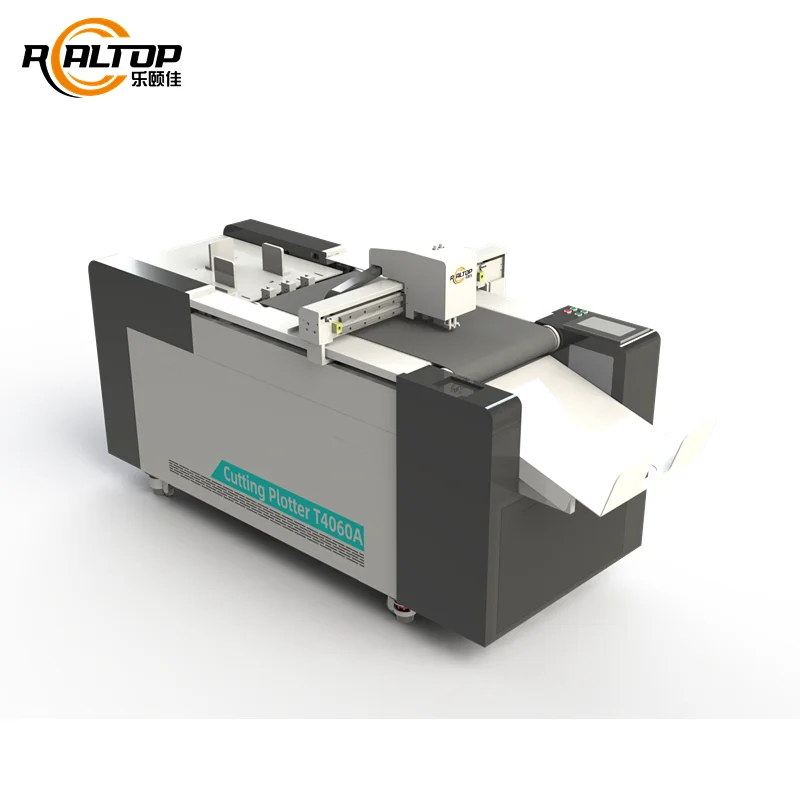
The 400 × 600 mm working area places the RTT4060 in the compact-format category, suited to A3 box and card work where material handling speed matters more than sheet throughput. The fully automated feed-cut-pick cycle removes manual sheet loading from the operator’s task list during short-run production. Network port connectivity allows file transfer directly from your existing design and nesting software rather than relying on USB drives on the shop floor. The HD touch control panel centralises job setup, tool offset entry and vacuum zone selection in one interface, reducing the changeover time between cardboard sample jobs and adhesive kiss-cut runs.
The Cost of Skipping the Sample Cut Step
When tool head selection is based on a sales conversation rather than a physical test, the failures appear after installation: crushed foam gaskets, frayed textile edges, kiss-cuts that score the release liner. These are not warranty claims — they are configuration errors. Buyers who skip sample cutting on their own material frequently discover that the vacuum zoning cannot hold small cut parts flat, or that the oscillating frequency suited to cardboard tears their thinner PP sheet stock [NEED_CITE: vacuum zoning requirements for small-part digital cutting].
Why This Configuration Path Matters
The in-house design and production team covers both knife and laser cutting technologies, so the RTT4060 is specified as a knife machine because your material demands it, not because it is the only method available. Tool head and vacuum table configuration are documented per material type before the order is placed. CCD camera positioning is tested against your printed marks at production speed, not demonstrated on a high-contrast sample. Software compatibility with your existing file format and nesting workflow is confirmed in writing. Voltage, plug type and control panel language are agreed before shipment, eliminating on-site electrical surprises.
Documentation & Verification
- Machine specification sheet confirming RTT4060 tool head and vacuum zone configuration
- Sample cutting report produced on your cardboard grade and adhesive stock
- Electrical schematic with your confirmed voltage and frequency noted
- Software licence and file format compatibility statement for your design workflow
- Tool head and creasing wheel configuration list matched to your material range
- Factory test record documenting cut quality on your supplied substrates before dispatch
Installation, Commissioning & Support
- Dedicated circuit requirement confirmed for the RTT4060 control and vacuum systems before delivery
- Vacuum table zoning configured and tested on your smallest cut part during commissioning
- HD touch control panel language set to your operator preference at first power-on
- CCD camera calibrated against your actual printed registration marks during installation
- Multifunctional tool head offsets set for each of your specified materials during training
- Spare knife blades, creasing wheels and wear parts list provided at handover
What to Include in Your Inquiry
Specify the substrate types you run — corrugated grade, cardboard thickness, adhesive film construction — along with the sheet sizes and daily volume you need to process. Confirm your local voltage and frequency, the control language your operators require, and whether your existing design software exports in a format the RTT4060 control system can import directly.
Frequently Asked Questions
Q: How is the correct tool head selected for my cardboard and adhesive materials?
A: Tool head selection follows a sample cutting test on your actual substrates. We run your cardboard grade, adhesive film and any PP or PVC sheet stock through the RTT4060, document the knife type, oscillating frequency and creasing wheel angle that produce clean edges, then lock that configuration into your machine specification before production begins.
Q: Does the CCD camera track printed marks reliably at production speed?
A: CCD tracking is validated on your specific printed stock during the sample cutting stage. We test mark recognition at full running speed, not in a static demonstration, and confirm the minimum mark contrast and size your print process produces before the positioning system is signed off.
Q: Will small cut parts lift off the bed during processing?
A: Vacuum zone layout on the RTT4060 is specified based on your smallest cut part dimensions. During the sample test we verify hold-down across the full cutting area and adjust zone configuration if your nest pattern includes parts too small for the default zoning arrangement.
Q: What file formats does the control software accept from my design workflow?
A: File format compatibility is confirmed before order placement. You provide sample files from your existing design and nesting software, and we verify import, tool path assignment and cut-crease layer separation on the RTT4060 control system, documenting the result in a written compatibility note.
Q: Can voltage and control language be confirmed before the machine ships?
A: Yes. Voltage, frequency, plug type and control panel language are agreed during the specification confirmation stage and recorded on the electrical schematic. The machine is built and tested to those parameters, and the factory test record reflects your confirmed configuration before dispatch.


商品评价
Clear filtersThere are no reviews yet.