



Fast Shipping
Carrier information

20k products
Payment methods

24/7 Support
Unlimited help desk

2-day Delivery
Track or off orders
Material-Matched Tooling — Every RT-D2516/RT-S2516 configuration is specified against the buyer’s actual board grade, flute profile and daily sample volume before the order is locked.
Technical Specifications
| Parameter | Value |
|---|---|
| Product Type | CNC Oscillating Knife Cutting Machine |
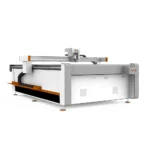
| Model | RT-D2516/RT-S2516 |
| Working Area | 1600×2500 mm |
| Machine Size (L×W×H) | 3450×2300×1250 mm |
| Rated Power | 9 kW |
| Voltage | 380V ±10% |
| Control System | CNC with touch screen, HP-GL compatible |
| Translational Velocity | 800–2000 mm/s |
| Cutting Speed | 200–800 mm/s (varies with material type and density) |
| Cutting Thickness | ≤100 mm (basis to be confirmed by material test) |
| Repeated Accuracy | ≤0.1 mm |
| Transmission | Digital servo motor, linear guide, synchronous belt, ball screw |
| Servo Motor Options | Delta (Taiwan) or Panasonic (Japan), IP67-rated |
| Tool Head Options | Oscillating knife, pneumatic knife, vibrating knife, circular knife, V-cutting knife, drag knife, creasing wheel, dotted line knife, punching tool, brush |
| Visual Positioning | Small CCD mark point, panoramic camera, projection positioning |
| Table Type | Flat working table or auto feeding table |
| Vacuum Table | Magnesium-aluminum alloy, fluorocarbon PVDF coated, anodic and hard oxidation |
| Vacuum Pump | 7.5 kW, aviation aluminum shell with silencer sponge |
| Safety Devices | Infrared induction blocking, anti-collision beam sensors, emergency stop with in-situ resume |
| Software | Auto nesting; PLT, DXF, AI file support |
| Language Options | English, Russian, Italian, Chinese (customizable) |
| Assembly State | Fully assembled |
Application Suitability
| Application | Material or Output |
|---|---|
| Carton and packaging sample making | Corrugated board, honeycomb cardboard, grey board — oscillating knife for cuts, creasing wheel for fold lines, V-cutting knife for grooving |
| Gasket and sealing pad fabrication | PTFE, ETFE, rubber, silicone — oscillating and drag knife with vacuum hold-down |
| Automotive interior trimming | Foam, non-woven fabric, composite panels — tool head matched to density and compressibility |
| Signage and display production | PVC board, foam board, acrylic sheet — contour cutting via CCD positioning |
| Footwear and leather goods | Leather, PU, EVA, shoe sole material — nested cutting for material yield |
| Composite and insulation panels | Fiberglass, carbon fiber, foam core — oscillating knife to prevent delamination |
Why Tool Head Selection Decides Edge Quality on Your Board
A V-cutting knife that grooves standard B-flute cleanly will crush high-density grey board unless the oscillation frequency, blade angle and downforce are specified for that exact stock.
Most packaging sample makers discover the mismatch after the machine arrives. The board fibres tear rather than shear, creasing lines crack on the fold, and the entire sample batch is rejected by the brand client. The root cause is almost always a tool head chosen from a generic catalog page instead of being matched to the buyer’s actual material stack [NEED_CITE: CNC cutting tool head selection by material density]. The RT-D2516/RT-S2516 addresses this by offering a full tool head range — oscillating knife, high-power vibrating knife, V-cutting knife, creasing wheel, drag knife and punching tool — each specified per material before the order is confirmed.
Matching the Oscillating Knife to Flute Profile and Board Grade
Corrugated packaging samples demand different cutting behaviour depending on whether the stock is single-face E-flute or double-wall BC-flute. The oscillating knife on the RT-D2516/RT-S2516 runs at adjustable frequency and stroke, letting the operator dial in clean shearing on thin facing paper without crushing the internal flute structure. When the job switches to dense grey board for luxury box prototyping, the high-power vibrating knife or V-cutting knife takes over, scoring rather than slicing to produce foldable grooves without splintering.
CCD Contour Tracking for Printed Packaging Layouts
When packaging samples carry pre-printed graphics, the cutting path must align with the printed contour rather than the file origin. The panoramic camera recognition option on the RT-D2516/RT-S2516 scans the entire sheet, locates registration marks, and adjusts the cut path accordingly [NEED_CITE: CCD camera contour recognition accuracy on printed packaging]. This eliminates the manual offset adjustments that slow down short-run sample production and cause cumulative registration drift across a sheet with multiple layouts.
Reading the Spec Sheet Against Your Production Reality
The 1600×2500 mm working area handles most full-sheet packaging formats, but the real production variable is cutting speed relative to material resistance. At 200–800 mm/s cutting speed, dense honeycomb board will demand the lower end of that range to maintain edge integrity, while single-layer corrugated allows higher travel. The ≤0.1 mm repeated accuracy, driven by the linear guide and digital servo system, ensures that nested sample layouts stay dimensionally consistent from the first piece to the last — a tolerance that matters when die-line dimensions must match downstream auto-gluing equipment. The 7.5 kW vacuum pump with zoned magnesium-aluminum table holds small offcuts flat without requiring manual taping, which is where most registration errors originate on competitive flatbed tables [NEED_CITE: vacuum table zoning requirements for small packaging components].
The Hidden Cost of Unverified Material Compatibility
Buyers who specify a CNC cutting table on working area and price alone typically encounter three problems within the first production month. First, the blade wears prematurely on abrasive stock like fiberglass-laminated board because the oscillation amplitude was never matched to fibre density. Second, small die-cut pieces lift off the table mid-cut because the vacuum zoning covers only large-format zones, forcing the operator to tape every layout manually. Third, the nesting software cannot import the buyer’s existing DXF die-line library, requiring re-drawing of every standard carton template [NEED_CITE: software file format compatibility in packaging sample workflows]. Each of these issues adds unplanned downtime and scrap that never appeared in the purchase evaluation.
Why Source This Configuration Here
The RT-D2516/RT-S2516 is built by a manufacturer that produces both knife and laser cutting systems in-house, meaning the cutting method is matched to the material rather than forced into a single technology. Tool head and vacuum table configurations are specified in writing against the buyer’s material sample before order confirmation. Sample cutting runs on the buyer’s own board stock verify edge quality, groove depth and cycle behaviour prior to shipment. Voltage, plug type and control panel language are confirmed against the destination market’s electrical standards. Software licences and file format compatibility notes ship with the machine, eliminating post-installation disputes over whether existing die-line libraries will open.
Documentation & Verification
- Machine specification sheet listing every configured tool head and table zone
- Electrical schematic confirming voltage, frequency and plug type for your facility
- Tool head and vacuum configuration list matched to your tested material samples
- Sample cutting report on your actual board grade showing edge and groove quality
- Software licence documentation with supported file format compatibility list
- Factory test record verifying repeated accuracy across a nested packaging layout
Installation, Commissioning & Support
- Floor space planning based on the 3450×2300×1250 mm machine footprint plus material infeed clearance
- Dedicated 380V circuit with appropriate breaker rating for the combined 9 kW machine and 7.5 kW vacuum pump load
- Machine ships fully assembled; positioning and leveling on your prepared floor
- First-run parameter tuning on your specific board stock — knife stroke, vacuum zone mapping, CCD calibration
- Operator training covering tool head changeover, nesting software workflow and file import procedures
- Spare blade and creasing wheel inventory sized to your daily cutting volume and material abrasiveness
- Scheduled maintenance checklist covering linear guide lubrication, belt tension and vacuum pump filter cleaning
How to Structure Your Inquiry
Send your primary board types with flute profile or caliper, typical sheet dimensions and daily sample volume so we can specify the correct tool head and vacuum zoning. Confirm your facility voltage, frequency and preferred control panel language early in the conversation. If you have an existing library of die-line files, share a sample so we can verify software compatibility and nesting workflow before the order is finalized.
Frequently Asked Questions
Q: How do I know which tool head is right for my packaging material?
A: The correct tool head depends on board grade, flute profile and thickness. We run sample cuts on your actual material — testing oscillating knife, V-cutting knife and creasing wheel — and document edge quality and groove depth before confirming the configuration in your order specification.
Q: Can the CCD system track printed marks on short-run packaging samples?
A: The panoramic camera option scans the full sheet and adjusts the cut path to match printed registration marks. We verify tracking accuracy on your printed stock during the pre-order sample run, confirming that contour alignment holds at production cutting speeds.
Q: Will small die-cut parts stay flat on the vacuum table?
A: The magnesium-aluminum vacuum table supports zoning so suction is concentrated under the active cutting area. We configure zone layout based on your typical sample dimensions to prevent small pieces from lifting during the cut cycle.
Q: What electrical and language customization is available before shipment?
A: Voltage, plug type and control panel language are confirmed against your facility specifications before production begins. Standard options include English, Russian, Italian and Chinese, with other languages configurable per order requirements.
Q: Will my existing die-line files work with the nesting software?
A: The software supports PLT, DXF and AI formats. We request a sample file from your existing library during the inquiry stage to verify import, nesting behaviour and dimension accuracy before the machine ships.


商品评价
Clear filtersThere are no reviews yet.