

Fast Shipping
Carrier information

20k products
Payment methods

24/7 Support
Unlimited help desk

2-day Delivery
Track or off orders
In-house cutting method design — tool head and table configuration matched to fabric type and production volume, avoiding the common failure of forcing one method across incompatible materials.
Technical Specifications
| Parameter | Value |
|---|---|
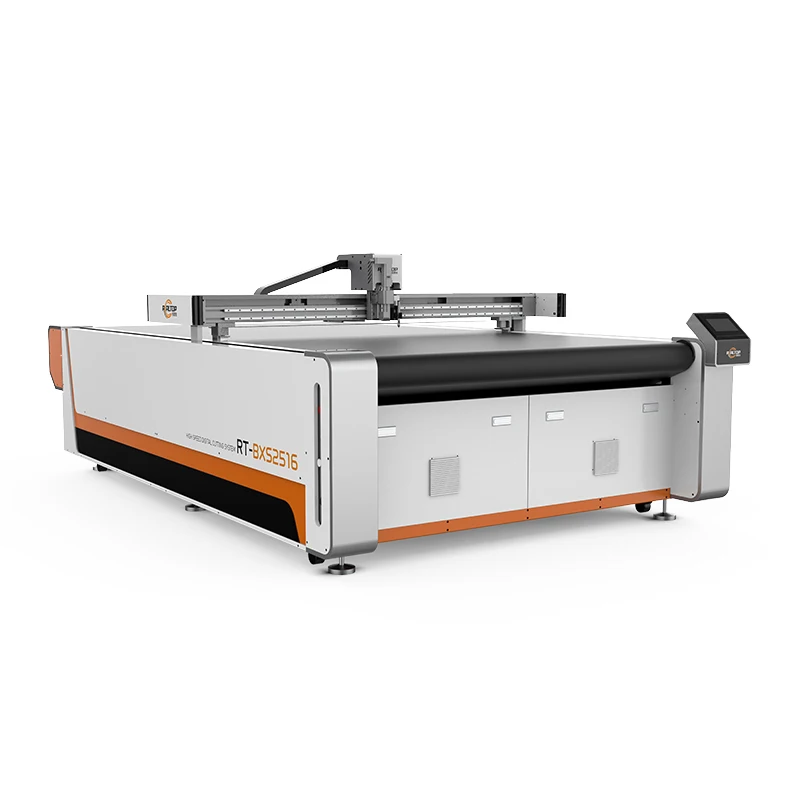
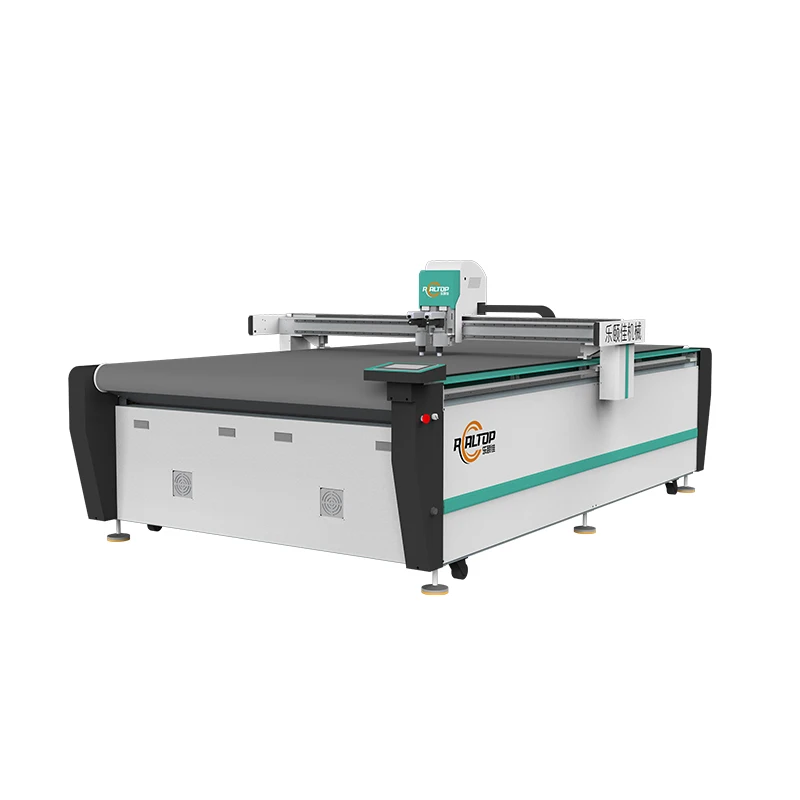
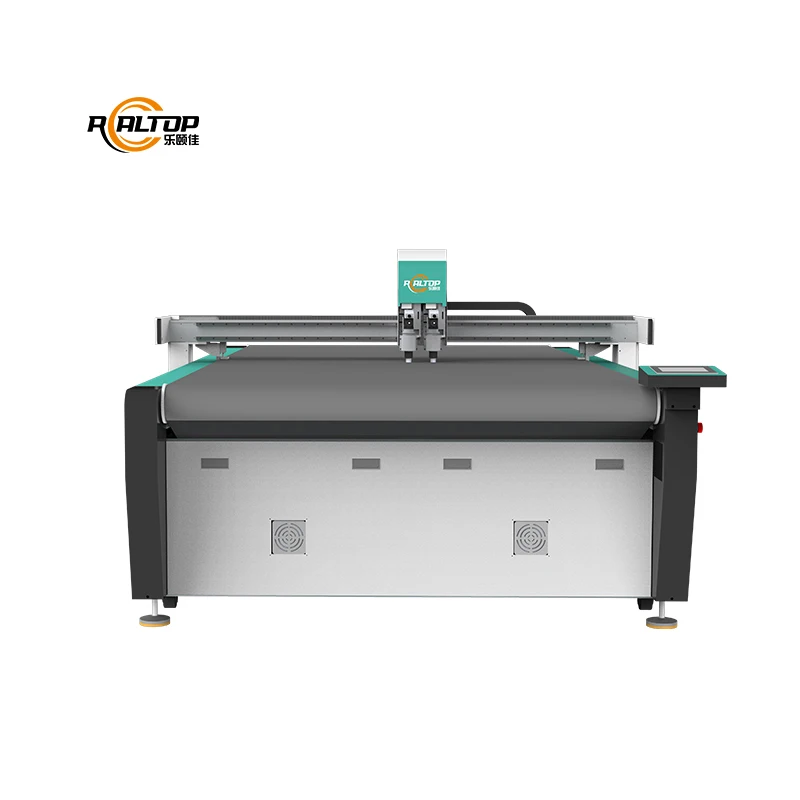
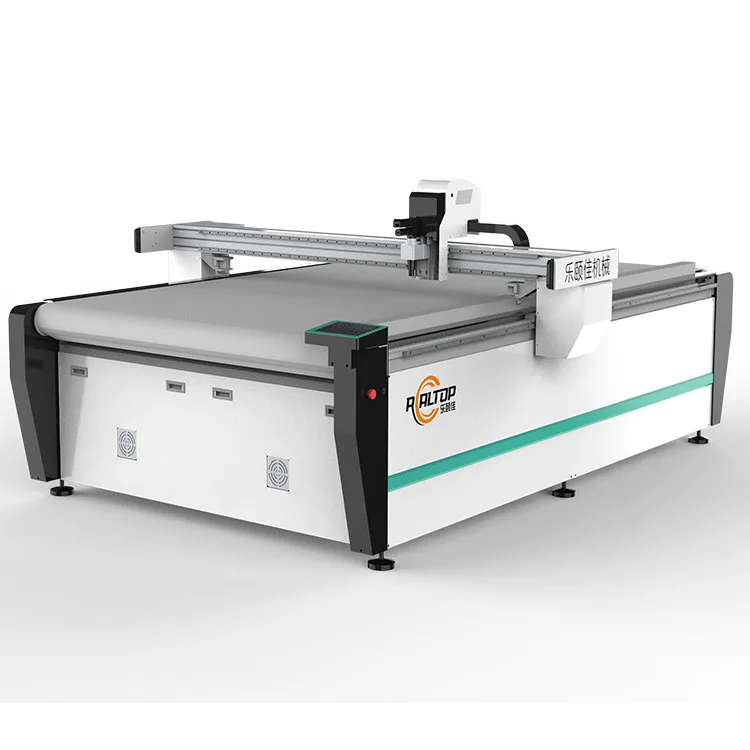
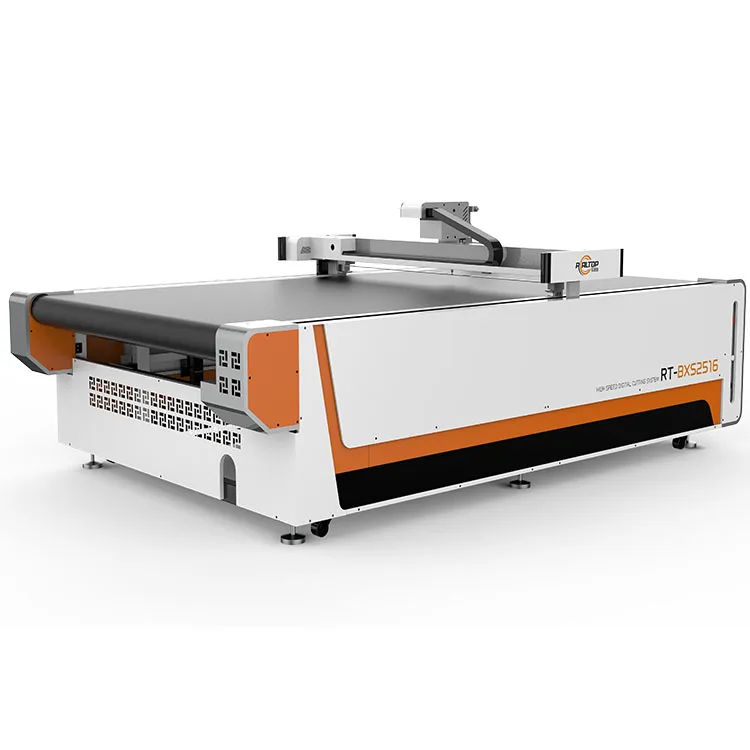
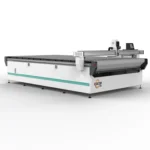
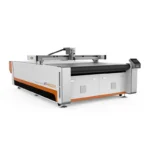
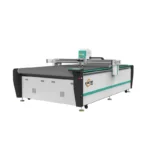
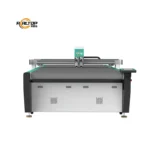
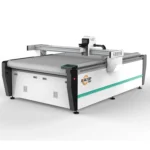
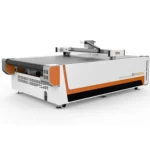
| Product Type | CNC Oscillating Knife Cutting Machine |
| Model | RT-D2516/RT-S2516 |
| Working Area | 1600×2500 mm |
| Machine Size | 3450×2300×1250 mm |
| Rated Power | 9 kW |
| Cutting Thickness | ≤100 mm (varies with material; basis to be confirmed) |
| Cutting Speed | 200–800 mm/s (according to different cutting materials) |
| Translational Velocity | 800–2000 mm/s |
| Repeated Accuracy | ≤0.1 mm |
| Transmission System | Imported digital servo motor, linear guide, synchronous belt, ball screw |
| Platform Options | Aluminum air box platform, integrated box adsorption platform, split box supported |
| Vacuum Pump | 7.5 kW |
| Tool Head Options | Oscillating knife, pneumatic knife, high-power vibrating knife, circular knife, V cutting knife, drag knife, creasing wheel, dotted line knife, punching, brush |
| Visual Positioning Options | Small CCD camera mark point positioning, panoramic camera recognition positioning, projection positioning |
| Control Panel | Touch screen, multiple languages supported |
| Software Compatibility | PLT, DXF, AI formats via auto typesetting software |
| Voltage | 380V±10% |
| Instruction System | HP-GL compatible format |
| Table Configuration | Flat working table or auto feeding table |
| Servo Motor Options | Made in China or made in Japan |
| Safety Device | Infrared sensors |
| Conveyor Belt | Germany imported |
Application Suitability
| Application | Material or Output |
|---|---|
| Garment and footwear production | Fabric, clothing cloth, shoe material, luggage material, non-woven fabric |
| Carpet and floor mat manufacturing | Carpet, sponge, EVA, XPE with auto feeding table for continuous roll processing |
| Automotive interior and gasket fabrication | Sponge composite leather, PU, EVA, XPE, composite materials, gasket material |
| Soft home furnishings | Textile, foam board, cloth, PU, PE, PTFE |
| Packaging sample and graphic advertising | PVC sheet, soft glass, sticker, film, corrugated cardboard, plastic box |
| Sports and outdoor product cutting | Carbon fiber, fiberglass, ETFE, composite panels |
Why the Wrong Tool Head Choice Sabotages Fabric Cutting Quality
Matching the oscillating knife frequency and blade geometry to actual material density prevents ragged edges and crushed layers that no amount of software correction can fix.
A buyer specifies a CNC oscillating knife cutting machine based on working area and assumes the standard vibrating head will handle every fabric in the shop. The first test cut on short-pile sample material looks clean. Months later the machine arrives and the production floor loads high-density long-nap carpet or multi-layer foam composite — and the blade tears through the face while crushing the backing. The vacuum table zones were planned for large panels, so small garment pieces lift and shift mid-cut, producing scrap instead of sellable parts [NEED_CITE: vacuum zoning requirements for small-part fabric cutting].
Vacuum Table Zoning and Small-Part Stability
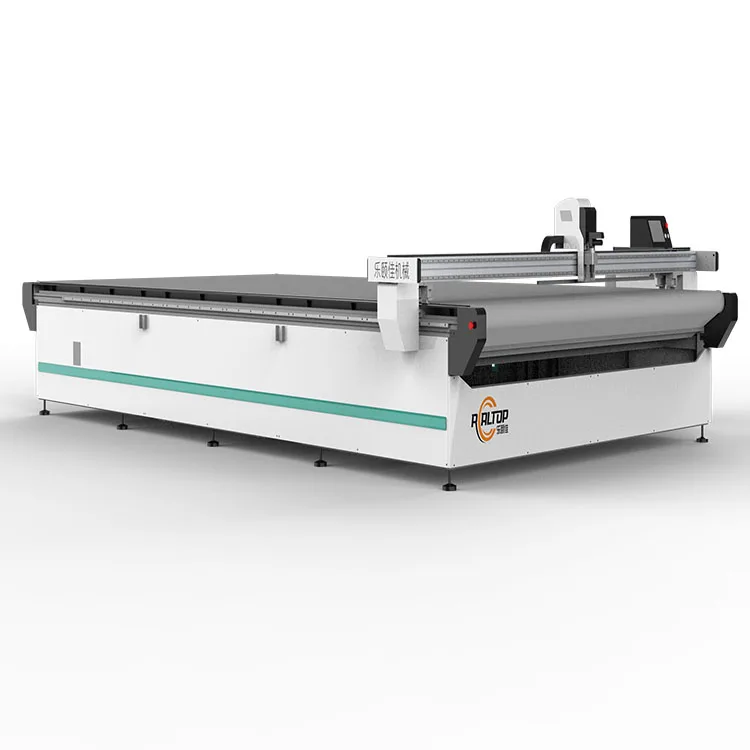
The RT-D2516/RT-S2516 offers integrated box adsorption and split box platform configurations driven by a 7.5 kW vacuum pump. For large carpet panels or automotive interior hides, the full-platform suction holds the material flat across the entire 1600×2500 mm bed. When the same machine shifts to cutting small gaskets or shoe upper components, split-box zoning directs vacuum only to the active cutting region so edge material does not flutter into the blade path.
Blade Frequency and Fabric Thickness Matching
Cutting speed across the 200–800 mm/s range depends directly on how the tool head interacts with material density. A high-power vibrating knife slices through dense carpet and multi-layer sponge composite leather without delamination, while a circular knife handles single-layer woven textile at higher translational speeds. Choosing the wrong oscillating frequency for the fabric thickness produces frayed edges on synthetics or incomplete cuts on rubber-backed materials — defects that downstream sewing or bonding stages cannot conceal.
CCD Camera Positioning for Printed Contour Work
Small CCD mark point positioning and panoramic camera recognition allow the machine to locate printed registration marks on pre-printed fabric and follow the contour automatically. This capability matters for garment panels with sublimation prints, advertising banners, and textile labels where the cut path must track the graphic rather than a fixed coordinate. The camera reads the mark and adjusts the tool path in real time, which is essential when fabric stretches or distorts during feeding [NEED_CITE: CCD registration accuracy on stretchable textile substrates].
Servo Motor Selection and Cutting Repeatability
The repeated accuracy of ≤0.1 mm relies on the full transmission chain — imported digital servo motor, Taiwan Hiwin linear guide, synchronous belt, and ball screw. Buyers can choose between Chinese-made and Japanese-made servo motors depending on the precision demands of their production. For high-volume automotive gasket cutting where every piece must match a die pattern within tight tolerance, the Japanese servo option maintains positional consistency across thousands of cycles. For garment batch cutting with wider tolerances, the domestic servo keeps the machine cost aligned with the application.
The Hidden Cost of Incorrect Table and Feed Configuration
Selecting a flat working table when production volume demands continuous roll processing forces operators to load and unload each sheet manually, creating bottlenecks that multiply labor without improving cut quality. The auto feeding table with Germany-imported conveyor belt allows carpet and non-woven fabric rolls to feed continuously through the cutting zone. Conversely, specifying auto feed for thick rigid foam board that cannot bend over a conveyor causes material jamming and blade damage — a mismatch that surfaces only after the machine is installed and the first production run begins [NEED_CITE: auto-feeding table limitations for rigid composite materials].
Why Procurement From This Facility Works
The design team engineers both oscillating knife and drag knife cutting technologies in-house, so buyers match the cutting method to their actual material rather than adapting the material to a single available tool. Every tool head and vacuum table configuration is specified against the buyer’s material sample and daily production volume before the order is confirmed. CCD camera positioning is validated on the buyer’s printed fabric to confirm mark-tracking speed matches line throughput. Software file format compatibility — PLT, DXF, AI — and nesting workflow integration are confirmed before shipment. Voltage, plug type, and control panel language are locked in during the specification review so the machine arrives ready for the target electrical standard.
Documentation & Verification
- Sample cutting report run on buyer-supplied fabric, carpet, or composite material before order commitment
- Tool head and vacuum table configuration list specifying selected tools for each material type and thickness
- Electrical schematic confirming 380V±10% wiring, servo motor origin, and vacuum pump circuit allocation
- Software licence with confirmed PLT, DXF, AI file format compatibility and nesting workflow notes
- Factory test record documenting cutting accuracy and edge quality on buyer’s material batch
- Packing photographs showing platform configuration and tool head assembly before crate closure
Installation, Commissioning & Support
- 3450×2300×1250 mm footprint requires level concrete floor with clearance for auto feeding table conveyor extension
- 9 kW rated power plus 7.5 kW vacuum pump need dedicated three-phase 380V circuit with ±10% tolerance
- Split box vacuum platform assembled on-site with zone mapping calibrated to buyer’s smallest cutting pattern
- First-run commissioning includes cutting speed validation across the 200–800 mm/s range on buyer’s actual material
- Touch screen control panel configured to buyer’s language preference before operator training begins
- Spare parts list covers Swiss-imported knife blades, conveyor belt segments, and vacuum seals
What to Include in Your Inquiry
Provide the specific fabric or composite material type, maximum thickness in block or layered form, and the sheet or roll dimensions you run daily. State your local voltage standard and preferred control language so the electrical configuration is confirmed before production. If your workflow uses printed registration marks for contour cutting, supply a sample print for CCD camera validation.
Frequently Asked Questions
Q: How do I choose the right tool head for my fabric and composite materials?
A: Tool head selection depends on material density, thickness, and whether the cut involves single-layer or multi-layer stacks. High-power vibrating knives handle dense carpet and sponge composite leather, while circular knives suit single-layer woven textiles. The configuration is confirmed after sample cutting on your actual material before the order proceeds.
Q: What cutting thickness is achievable on carpet and foam materials?
A: The machine handles up to 100 mm depending on material composition and density. Actual achievable thickness on carpet, EVA, or XPE foam varies with the specific product formulation. A sample cutting test on your material batch confirms the practical depth and edge quality before configuration is finalized.
Q: How does CCD camera positioning work for printed textile cutting?
A: The small CCD or panoramic camera locates printed registration marks on fabric and adjusts the cutting path in real time. This is critical for sublimation-printed garments and banners where fabric stretch distorts the graphic position. Camera performance is validated on your printed sample before shipment.
Q: What voltage and software customization options are available?
A: The machine supports 380V±10% with configurable plug types and a touch screen control panel in multiple languages. Software accepts PLT, DXF, and AI formats. File format compatibility and nesting workflow integration with your existing design system are confirmed during the pre-order specification review.
Q: How is vacuum table zoning configured for small fabric parts?
A: Split box and integrated box platform options allow vacuum to be concentrated in the active cutting zone. This prevents small garment pieces or gaskets from lifting during cutting. Zone configuration is mapped to your smallest production pattern during commissioning to ensure consistent material hold-down.


商品评价
Clear filtersThere are no reviews yet.