



Fast Shipping
Carrier information

20k products
Payment methods

24/7 Support
Unlimited help desk

2-day Delivery
Track or off orders
Knife-to-Material Matching — Every oscillating knife head is specified against your sample, not a catalog guess, because blind cutting on coated blackout fabric once cost a client two full rolls of material.
Technical Specifications
| Parameter | Value |
|---|---|
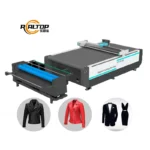
| Product Type | CNC Oscillating Knife Cutting Machine |
| Working Area | 1600 × 2500 mm |
| Overall Dimensions | 3450 × 2300 × 1250 mm |
| Rated Power | 9 kW |
| Voltage | 380V ±10% (customizable) |
| Cutting Speed | 200–800 mm/s (varies with material) |
| Cutting Thickness | Up to 100 mm (material dependent) |
| Repeated Accuracy | ≤0.1 mm |
| Translational Velocity | 800–1200 mm/s |
| Vacuum Table | Magnesium-aluminum alloy, fluorocarbon PVDF powder sprayed |
| Vacuum Pump | 7.5 kW, integrated aviation aluminum shell with built-in silencer |
| Transmission System | Imported digital servo motor, linear guide, synchronous belt, ball screw |
| Guide Rail | Taiwan Hiwin |
| Conveyor Belt | Germany imported |
| Servo Motor | Delta (optional Panasonic) |
| Instruction System | HP-GL compatible format |
| Safety Device | Infrared sensors |
| Language Options | English, Russian, Italian, Chinese (special languages customizable) |
| Assembly State | Fully assembled |
Application Suitability
| Application | Material or Output |
|---|---|
| Soft home furnishings cutting | Blinds textile, curtain fabric, blackout cloth, upholstery fabric |
| Garment and footwear production | Multi-layer clothing cloth, shoe material, non-woven fabric |
| Automotive interior fabrication | Sponge composite leather, carpet, PU and EVA foam gaskets |
| Packaging sample making | Corrugated cardboard, plastic box, film with creasing and kiss-cut |
| Signage and graphic finishing | Sticker, vinyl, PVC foam board with contour recognition |
| Composite and sealing work | PTFE, ETFE, rubber, XPE gasket material |
Why Tool Head Choice Matters More Than Working Area Size
A 2500 mm table means nothing if the knife crushes your coated fabric on contact.
I learned this the hard way on a blinds textile job last year. The client sent photos of perfect edges from our standard test fabric, but their own blackout material carried a polymer coating that grabbed the vibrating blade and dragged it sideways. Two rolls destroyed before we switched to a high-frequency oscillating head with a narrower stroke. When buyers evaluate CNC oscillating knife cutting machine specifications, the working area gets all the attention while the tool head decision — the part that actually touches the material — gets treated as an afterthought. That imbalance causes most of the edge-quality complaints I handle after delivery. [NEED_CITE: oscillating knife frequency and stroke selection for coated textiles]
Matching Knife Type to Your Material Stack
The system supports a wide tool head range — oscillating knife, pneumatic knife, high-power vibrating knife, circular knife, V-cutting knife, drag knife, creasing wheel, dotted line knife, punching, and brush. Each serves a distinct material behavior. Coated blinds textiles need high-frequency oscillation with a short stroke to avoid delamination, while uncoated garment fabrics cut cleanly under a standard drag knife. The CNC oscillating knife cutting machine specifications list the cutting speed as 200–800 mm/s, but that range only holds when the correct head is matched to the material density and surface treatment.
Vision Positioning for Printed Contour Work
Small CCD camera mark-point positioning, panoramic camera recognition, and projection positioning are available as options. When your production involves pre-printed fabric — curtain panels with registered patterns or signage with contour lines — the camera must track marks at actual cutting speed, not just at a slow demonstration pace. Panoramic recognition captures the full sheet layout in one pass, which matters when you run nesting jobs across the 1600 × 2500 mm working area. The positioning choice depends on your print registration tolerance and daily throughput requirements. [NEED_CITE: CCD contour recognition accuracy at production cutting speeds]
Reading the Specifications That Actually Affect Your Output
Repeated accuracy of ≤0.1 mm comes from the combination of imported digital servo motors, Hiwin linear guides, and ball screw transmission — each component contributes to positional stability over long cutting runs. The 7.5 kW vacuum pump with built-in silencer sponge maintains adsorption pressure across the magnesium-aluminum table, but zoning configuration determines whether small cut pieces stay flat or lift at the edges. The 9 kW total rated power at 380V ±10% means your facility must supply a dedicated circuit; voltage fluctuation beyond the tolerance band causes servo drift that accumulates across a full sheet. HP-GL compatible instruction format dictates which nesting and design files import directly — confirming this against your existing workflow prevents a situation where the machine arrives but cannot read your production files.
The Hidden Cost of Specifying a Machine on Table Size Alone
Buyers frequently select a cutting system based on working area dimensions, then discover the vacuum zoning cannot hold small parts, or the standard tool head tears their specific material. A zoned vacuum table with insufficient segment control lets small gasket or label pieces lift during the final cut pass, producing ragged edges that fail quality inspection. Voltage mismatches — ordering a 380V machine for a facility running 220V three-phase — lead to motor overheating and premature servo failure, problems that surface weeks after commissioning rather than during the factory test. [NEED_CITE: industrial voltage tolerance standards for CNC equipment export]
Why Source This CNC Knife Cutting System Here
In-house design covers both knife and laser technologies, so you choose the cutting method that suits your material rather than forcing one approach. Tool head and table configuration are specified per your material sample and production volume, not selected from a default package. CCD camera positioning options are confirmed against your actual printed samples before the order is finalized. Software compatibility — file formats, nesting integration, and license scope — is verified during the pre-order stage. Voltage, plug type, and control panel language are customized to your facility before production begins. Sample cutting on your own material happens before commitment, so edge quality and cutting speed are validated on the fabric you will actually run.
Documentation & Verification
- Machine specification sheet listing every tool head and table option confirmed for your material
- Electrical schematic with voltage and frequency matched to your facility before build
- Sample cutting report produced on your blinds textile or garment fabric with speed and edge notes
- Factory test record documenting repeated accuracy across the full working area
- Software license document with file format compatibility and nesting workflow confirmation
- Spare parts list identifying consumable blades, vacuum seals, and sensor replacements
Installation, Commissioning & Support
- Dedicated 380V ±10% circuit required for the 9 kW rated power draw at installation
- Machine ships fully assembled — no frame reassembly needed on the shop floor
- 3450 × 2300 × 1250 mm overall footprint requires clearance for auto-feeding conveyor access
- First-run parameter calibration performed on your specific fabric type and thickness
- Operator training covers tool head changeover, vacuum zoning setup, and CCD positioning workflow
- Control language set to English, Russian, Italian, or Chinese before dispatch per your specification
What to Include in Your Inquiry
Provide your material type, thickness, and sheet dimensions so the tool head and vacuum zoning can be matched before quotation. Specify your local voltage and frequency, along with the preferred control language, to avoid electrical and interface issues at commissioning. If your production involves printed contours, send a sample sheet so camera positioning can be validated against your actual registration marks.
Frequently Asked Questions
Q: How do I select the right tool head for my blinds textile or garment fabric?
A: Send a material sample first. We test cut using different head options — oscillating, pneumatic, drag knife — and document edge quality, cutting speed, and any surface damage. Coated fabrics typically need high-frequency oscillation with short stroke, while plain weaves work under a standard drag knife. The correct head depends on your specific coating, weave density, and thickness.
Q: Can the CCD camera reliably track printed marks at full production speed?
A: Panoramic camera recognition captures the entire sheet layout in one pass, maintaining positioning accuracy at cutting speeds up to 800 mm/s on standard fabric. Small CCD mark-point positioning works for simpler registration tasks. We validate camera performance on your printed sample before the order, checking whether mark contrast and spacing are sufficient for reliable detection across the working area.
Q: Will the vacuum table hold small fabric pieces without edge lifting?
A: The magnesium-aluminum vacuum table supports zoned adsorption controlled through the 7.5 kW pump. Zoning configuration is planned around your typical part sizes — small gasket or label patterns require finer segment control than large curtain panels. We specify the zoning layout based on your nesting files so suction concentrates where your cut pieces are smallest and most prone to movement.
Q: What file formats and nesting software does the system accept?
A: The instruction system supports HP-GL compatible format. Before the order, we confirm compatibility with your existing nesting software and file workflow. If your design team outputs in DXF, AI, or PLT, we verify import paths and nesting parameters so production files transfer without manual reformatting. Software license scope is documented before shipment.
Q: How are voltage and control language confirmed before the machine ships?
A: During the pre-order stage, you provide your facility voltage, frequency, and plug type. We produce an electrical schematic showing the exact configuration — whether standard 380V ±10% or a customized supply. Control panel language is set to your choice from English, Russian, Italian, Chinese, or a special language arranged in advance. Both are verified in the factory test record.


商品评价
Clear filtersThere are no reviews yet.