







Fast Shipping
Carrier information

20k products
Payment methods

24/7 Support
Unlimited help desk

2-day Delivery
Track or off orders
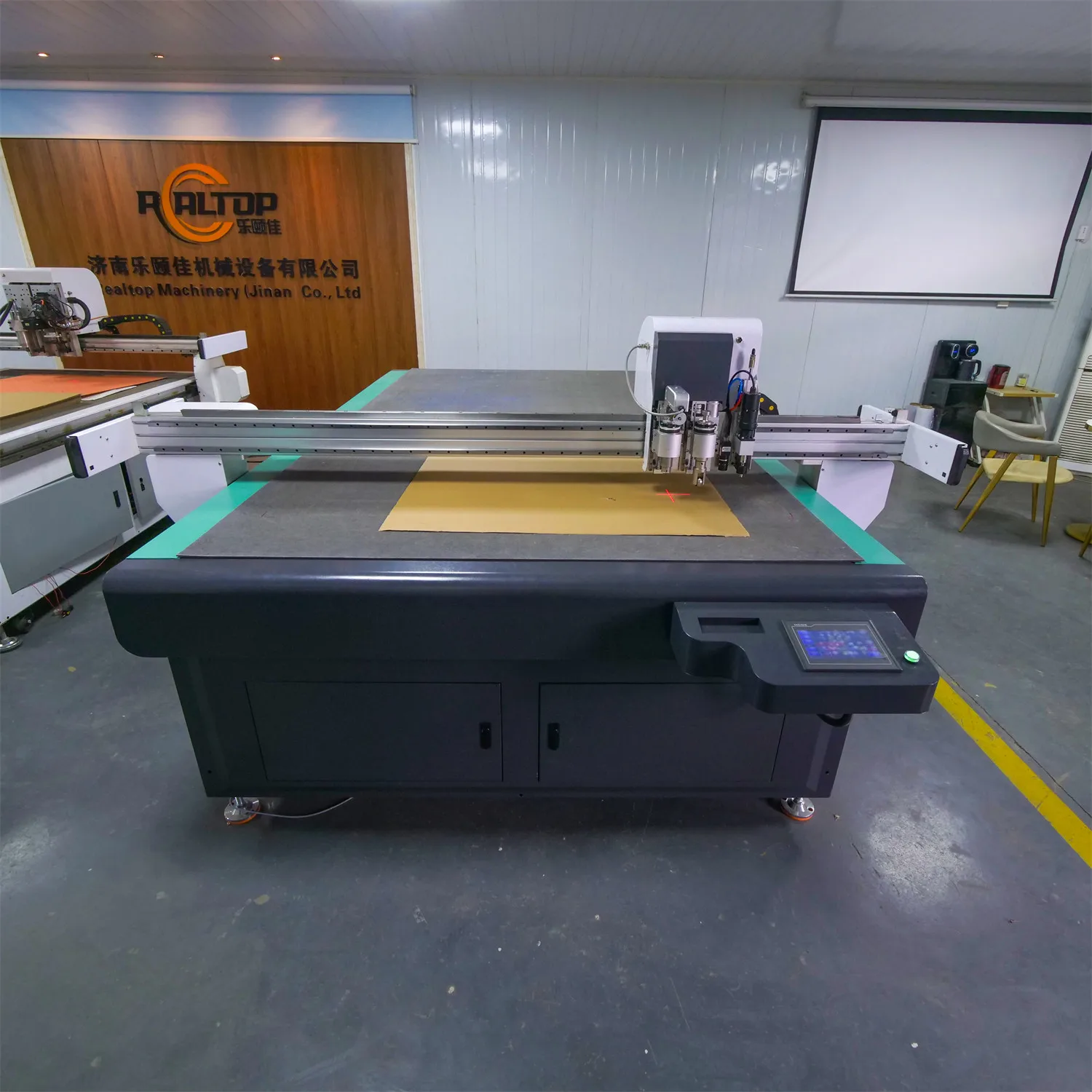
Configured per material and thickness — every RT-D2516/RT-S2516 is set up with the oscillating or drag knife head, vacuum zoning, and creasing tools matched to the buyer’s actual board grade and part geometry before shipment.
Technical Specifications
| Parameter | Value |
|---|---|
| Product Type | CNC Oscillating Knife Flatbed Cutter for Carton and Packaging |
| Model | RT-D2516/RT-S2516 |
| Working Area | 1600×2500 mm |
| Overall Dimensions (L×W×H) | 3450×2300×1250 mm |
| Rated Power | 9 kW |
| Voltage | 380V±10% (50/60 Hz confirmation required) |
| Translational Velocity | 800–2000 mm/s |
| Cutting Speed | 200–800 mm/s (varies with material) |
| Cutting Thickness | ≤100 mm (varies with material) |
| Repeated Accuracy | ≤0.1 mm |
| Servo Motor | Taiwan Delta servo motors and drivers |
| Guide Rail | Taiwan Hiwin rail |
| Transmission System | Digital servo motor, linear guide, synchronous belt, ball screw |
| Vacuum Pump | 7.5 kW |
| Vacuum Table | Aluminum alloy honeycomb structure, automatic zoned adsorption |
| Multifunctional Head | Swiss imported knife with vibration full cutting, half cutting, cursor location |
| Safety Device | Infrared sensors, emergency stop |
| Instruction System | HP-GL compatible format |
| Conveyor Belt | Germany imported conveyor belt (basis to be confirmed) |
| Auto Feeding | Yes |
| Software | Professional carton nesting and cutting design software; multi-format import; automatic cutting, marking, creasing |
| Language Options | English, Russian, Italian, Chinese (other languages customizable) |
| Assembly State | Fully assembled |
| Standards | CE (declaration where applicable; specific certification for this model to be confirmed) |
Application Suitability
| Application | Material or Output |
|---|---|
| Carton sample making and short-run packaging | Corrugated board, grey board, folding carton stock |
| Express and e-commerce box production | Single and double-wall corrugated, kraft liner |
| High-end gift box and display packaging | Grey board, PVC sheets, composite panels |
| Sticker and label contour cutting | Adhesive-backed vinyl, printed label stock |
| Flexible packaging and gasket prototypes | Leather, sponge composite, soft glass, silicone, rubber |
Why Working Area Alone Does Not Define a Packaging Cutter
A cutting table chosen only by bed size will underperform the moment material density changes.
I have watched buyers specify a flatbed cutter on its 1600×2500 mm working area, then discover that dense grey board crushes rather than cuts because the knife head was selected for standard corrugated. The vacuum zoning may also fail to hold small die-cut shapes flat, causing material lift mid-cut. These mismatches surface only after the machine arrives, and resolving them means retrofitting tool heads or rewriting vacuum zone logic — delays that compress production schedules. [NEED_CITE: vacuum hold-down requirements for small-format die cutting]
Tool Head Selection Dictates Edge Quality on Board and Vinyl
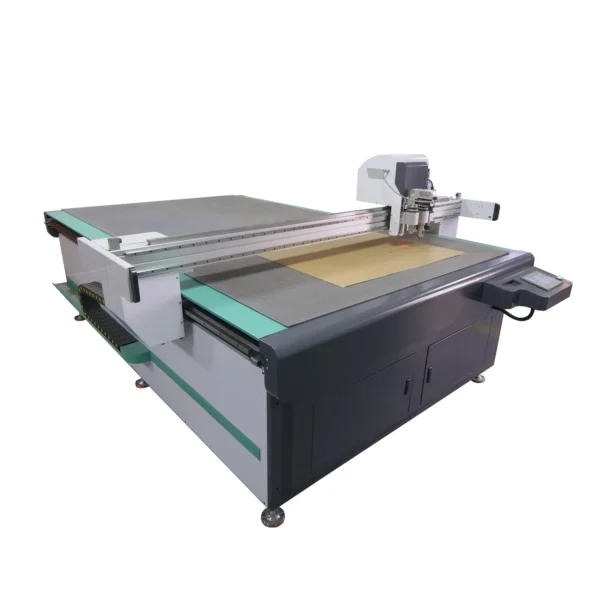
The RT-D2516/RT-S2516 ships with a Swiss imported oscillating knife head capable of full cutting, half cutting, and cursor location. For corrugated carton sample making, the oscillating action slices through fluted layers without crushing the flute structure, preserving the compression strength that packaging engineers specify. When the job shifts to creasing fold lines on grey board, a creasing wheel can be added to the multifunctional head so that the same CNC oscillating knife cutting table for carton and packaging handles both cutting and scoring in a single pass.
Vacuum Zoning Must Match the Smallest Part in the Nest
The aluminum alloy honeycomb vacuum platform on this machine divides into zones that activate based on where material sits on the bed. This matters when a nesting layout includes small sticker contours or narrow carton tabs — if the full table pulls vacuum uniformly, air leaks around the edges of small parts and reduces hold-down force. Automatic zoned adsorption directs suction only beneath occupied areas, maintaining grip on parts that would otherwise lift at cutting speeds approaching 800 mm/s. [NEED_CITE: vacuum table zoning effects on small part retention]
Drive Components and the ≤0.1 mm Repeat Tolerance
Taiwan Delta servo motors paired with Hiwin linear guides form the motion system. In packaging sample making, repeat accuracy at ≤0.1 mm ensures that a crease line lands precisely where the cut contour expects it — a misalignment of even half a millimetre on a folding carton means the box will not close square. The ball screw and synchronous belt transmission eliminates the backlash that cheaper rack-and-pinion setups introduce over long travel distances across the 2500 mm axis.
When the Wrong Specification Costs a Month of Production
A Dubai packaging facility once ordered a carton sample cutter rated for standard corrugated, then ran high-density grey board on it. The knife head lacked the downward pressure to penetrate the material cleanly, leaving ragged edges and crushed fibres. The tool head had to be swapped for a high-torque servo oscillating unit, and the machine was offline for weeks during the retrofit. That outcome is avoidable when the buyer sends actual production material for sample cutting before the order is finalized. [NEED_CITE: material density variation in packaging board grades]
Why Buyers Source This Machine From Realtop
The design team at Realtop specifies knife type, vacuum zone layout, and software configuration per buyer material rather than shipping a fixed catalog build. In-house production covers the full assembly from frame welding to motion calibration, so configuration changes are handled on the factory floor rather than through third-party integrators. Every RT-D2516/RT-S2516 undergoes a sample cutting test on the buyer’s own material before dispatch, documented in a test report that accompanies the shipment.
Documentation & Verification
- Machine specification sheet listing confirmed knife head and vacuum zone layout
- Electrical schematic with voltage and frequency matched to destination market
- Sample cutting report on buyer’s own carton or corrugated board stock
- Software licence and file format compatibility note for nesting workflow
- Operation and maintenance manual in chosen control language
- Spare parts list covering knife blades, creasing wheels, and vacuum seals
Installation, Commissioning & Support
- Fully assembled delivery; requires floor space of at least 4000×3000 mm for the 3450×2300 mm frame and operator clearance
- Dedicated 380V±10% circuit with capacity for 9 kW machine plus 7.5 kW vacuum pump
- Factory-trained technician available for first power-on and servo parameter calibration
- Operator training covers knife head changeover, vacuum zone mapping, and nesting software workflow
- Preventive maintenance schedule for Hiwin rail lubrication and synchronous belt tension checks
- Spare knife blades and vacuum seals included for initial production run
What to Prepare Before Requesting a Quote
Share the specific board grades, flute types, and thickness range you run, along with typical sheet dimensions and the smallest part in your nesting layouts. Specify your local voltage and frequency, preferred control language, and whether your existing design files use DXF, AI, or PLT formats so that software compatibility can be confirmed before order. If your production includes both corrugated carton and flexible materials like PVC or leather, note the full material list so the multifunctional head can be configured accordingly.
Frequently Asked Questions
Q: How is cutting thickness capability determined for my specific carton or corrugated board grade?
A: Maximum cutting depth depends on material density, not just thickness. Standard corrugated cuts cleanly at greater depths than high-density grey board. We determine actual capability by running your material on the RT-D2516/RT-S2516 and documenting the result in a sample cutting report before you commit to the order.
Q: How do I confirm vacuum table zoning is sufficient for my smallest part size?
A: Share the dimensions of the smallest contour in your typical nesting layout. The automatic zoned adsorption system on the honeycomb platform activates only beneath occupied areas. We verify during the sample cutting test that small parts remain flat at production cutting speed without lifting or shifting.
Q: Can the nesting software import my existing DXF/AI/PLT files and match my current workflow?
A: The professional carton nesting software supports multiple file format imports. Before order, we confirm compatibility with your specific file types and nesting workflow, including crease line recognition and automatic marking. The software licence and a compatibility note ship with the machine.
Q: What voltage, plug type, and control language options are available for my market?
A: The RT-D2516/RT-S2516 operates on 380V±10% with frequency configurable to 50 or 60 Hz. Control language options include English, Russian, Italian, and Chinese, with additional languages available on request. Voltage, plug type, and language are confirmed and documented before shipment.
Q: Can I send my own material for sample cutting before placing the order?
A: Yes. Send a representative sample of your actual production material — including the thickest and densest grade you run. We perform cutting, creasing, and contour tests on the RT-D2516/RT-S2516, then provide a detailed sample cutting report showing edge quality, cutting speed achieved, and recommended tool head configuration.


商品评价
Clear filtersThere are no reviews yet.