




Fast Shipping
Carrier information

20k products
Payment methods

24/7 Support
Unlimited help desk

2-day Delivery
Track or off orders
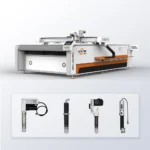
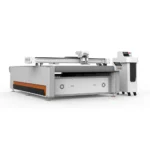
Tool head configuration specified per material — a 1600×2500 mm oscillating knife table with interchangeable rotary, creasing and kiss-cut heads, set up for your fabric weight and layer count before dispatch.
Technical Specifications
| Parameter | Value |
|---|---|
| Product Type | CNC Oscillating Knife Cutting Table |
| Working Area | 1600 × 2500 mm |
| Tool Head Options | Oscillating knife, Driven rotary knife, Creasing wheel, Kiss cutting tool, Pneumatic knife, Milling tool, V groove knife |
| Cutting Thickness | Up to 30 mm (basis to be confirmed for specific material and layer count) |
| Cutting Speed | 0–2000 mm/s |
| Positioning Accuracy | ±0.1 mm |
| Vacuum Pump | 9 kW |
| Vacuum Table | Aluminum bellows with full-surface adsorption |
| Control System | PLC control panel |
| Servo Motor Options | Panasonic, Delta, Dorna |
| Voltage Options | 110V, 220V, 380V |
| File Format Compatibility | PLT, DXF, AI, PDF |
| Language Options | English, Russian, Italian, Chinese (customizable) |
| Safety Devices | Infrared sensor device and emergency stop device |
| Overall Dimensions | 3300 × 2100 × 1350 mm |
| Certification | CE (implied by documentation, explicit certificate to be confirmed) |
Application Suitability
| Application | Material or Output |
|---|---|
| Apparel Manufacturing | Suits, knitwear, lace and complex woven fabrics with pattern-matching layouts |
| Automotive Interiors | Seat cover fabrics, carpet and PVC mat cutting with burr-free edge requirements |
| Home Textiles | Sofa upholstery, curtain panels and rug materials processed in multi-layer stacks |
| Composite Processing | Carbon fiber prepreg and aramid fabrics cut without delamination or thermal deformation |
| General Flexible Materials | Knits, plush, leather and foam across a 0.1–50 mm thickness range |
Why Your Small Pattern Pieces Keep Lifting Off the Table
A CNC oscillating knife cutting table for fabric and textile relies on vacuum hold-down, and undersized vacuum zoning is the most common reason small garment panels shift mid-cut and produce unusable edges.
When the table is zoned as one large area, air rushes to wherever the sheet is missing — typically the edges — leaving the center with less suction. I watched a workshop cut lace collar pieces that kept curling at the corners because the vacuum zones were too coarse for the pattern layout. The operator slowed the head down to compensate, which stretched the cycle time and still left a reject rate they had to sort out by hand afterward [NEED_CITE: vacuum zone sizing for small pattern pieces on digital cutting tables]. Specifying zone count and bellows construction to match your nesting output is not a luxury detail — it is what separates clean production runs from constant rework.
Vacuum Table Construction That Matches Your Nesting Density
The aluminum bellows vacuum table on this system provides full-surface adsorption rather than relying on a few isolated suction ports. With a 9 kW pump feeding t*nnels to hold fabric flat across the entire 1600 × 2500 mm working area. This matters when your nesting software places dozens of small pieces between larger panels — every zone must pull evenly or the smallest parts will be the first to drift during the knife pass.
Tool Head Interchangeability for Mixed Fabric Runs
Garment workshops rarely run a single material all week. The system supports seven interchangeable tool heads — oscillating knife, driven rotary knife, creasing wheel, kiss cutting, pneumatic knife, milling and V-groove — so a single table handles everything from heavy denim stacks to delicate lace without forcing one blade type across incompatible materials. Changing the head takes minutes on the shop floor rather than requiring a service call, which keeps production moving when the next job involves a different fabric weight or edge finish requirement [NEED_CITE: tool head selection for textile cutting edge quality].
Specifying for Real Production Conditions
The ±0.1 mm positioning accuracy supports pattern-matching layouts in premium apparel, where collar and cuff pieces must align with the fabric print within tight tolerances. The PLC control panel with customizable language options means operators read instructions and error messages in their own working language — not a detail that matters on day one, but one that prevents mistakes on day three hundred when a new operator takes over the night shift. Servo motor options from Panasonic, Delta or Dorna let buyers balance cost against the response speed their production volume demands.
What Happens When the Wrong Head Meets the Wrong Fabric
Picking an oscillating knife for a material that actually needs a driven rotary blade produces frayed edges on knits and puckered seams on coated synthetics. I have seen a batch of automotive seat covers scrapped because the head was set to oscillate through a multi-layer stack that required a straight pneumatic cut — the vibration separated the layers just enough to leave visible steps in the finished cover [NEED_CITE: cutting defects from incorrect tool head selection on composite textiles]. The cost is never just the ruined fabric. It is the sewing line standing idle while replacement panels get cut and sorted.
Why Buyers Source This Equipment From Jinan
In-house design and production covering knife cutting systems means the table frame, vacuum layout and head configuration are engineered together rather than bolted together from catalog parts. Buyers receive a sample cutting report run on their own fabric at their specified layer count before the order is finalized, so cutting capacity is demonstrated rather than quoted. Voltage, plug type and control language are confirmed per destination market, reducing the chance of a machine sitting unpowered on a factory floor while an adapter gets sourced. The documentation package includes a tool head and table configuration list specific to the buyer’s material, so the machine arrives with a clear setup baseline rather than trial-and-error instructions.
Documentation & Verification
- Sample cutting report on buyer’s fabric at specified thickness and layer count
- Tool head and vacuum zone configuration list matched to material type
- Electrical schematic with voltage and plug type confirmed for destination market
- Software license and file format compatibility note for PLT, DXF, AI and PDF workflows
- Operation and maintenance manual in confirmed control language
- Spare parts list with recommended consumables for the selected tool head
Installation, Commissioning & Support
- Floor space requirement of approximately 3300 × 2100 mm with clearance for material loading
- Dedicated electrical circuit matching confirmed voltage at 110V, 220V or 380V
- Machine ships partially assembled with vacuum table and gantry requiring on-site alignment
- First-run parameter setting calibrated to buyer’s fabric sample and nesting file
- Operator training covers tool head changes, vacuum zone control and PLC panel navigation
- Consumable blade and oscillating head bearings included in initial spare parts package
Before You Request a Quotation
Share the specific fabric types you process, including layer count per cut and whether pattern matching is required. Confirm your local voltage and frequency standard along with the preferred control panel language so the machine is built to match your shop floor from day one.
Frequently Asked Questions
Q: How do I verify the cutting capacity for my specific fabric stack?
A: Send us a sample of your actual production fabric with the layer count you intend to cut. We run it on the table with the appropriate tool head and produce a sample cutting report showing edge quality, dimensional accuracy and cycle time. This test happens before any order commitment, so you see real results on your material rather than generic specifications.
Q: Which tool head should I use for my material — oscillating, rotary or kiss cut?
A: It depends on fabric weight, coating and whether you are cutting single or multi-layer. Oscillating knives handle most woven and knit stacks cleanly. Driven rotary heads suit heavier coated textiles. Kiss cutting tools score without penetrating the backing layer. We recommend the head based on your sample cutting test, not on a catalog chart.
Q: Will the vacuum table hold my smallest pattern pieces flat during cutting?
A: The aluminum bellows table provides full-surface adsorption with a 9 kW pump. However, hold-down effectiveness depends on how your nesting software distributes pieces across the bed. We review your typical nesting layout during the sample stage and adjust vacuum zone configuration if your smallest parts show any tendency to lift at production cutting speed.
Q: How is software compatibility with my existing nesting workflow confirmed?
A: The system accepts PLT, DXF, AI and PDF file formats. Before shipment, we import a sample file from your existing nesting software and run it through the control panel to verify that layer assignments, cut paths and contour data translate without manual rework. This is documented in the file format compatibility note included with your machine.
Q: What voltage, language and safety standard does the machine ship with?
A: Voltage is configurable to 110V, 220V or 380V and confirmed per your destination market before production. The PLC control panel language is set to your preference from English, Russian, Italian, Chinese or other available options. Safety devices include an infrared sensor and emergency stop. CE documentation is addressed during the specification confirmation stage.


商品评价
Clear filtersThere are no reviews yet.