




Fast Shipping
Carrier information

20k products
Payment methods

24/7 Support
Unlimited help desk

2-day Delivery
Track or off orders
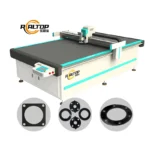
Custom tool head and vacuum configuration — the RT-D2516/RT-S2516 is configured with specific knife types and table zones matched to your gasket or foam stock, verified by sample cutting before the machine leaves the factory.
Technical Specifications
| Parameter | Value |
|---|---|
| Product Type | CNC Oscillating Knife Cutting Machine |
| Model | RT-D2516/RT-S2516 |
| Working Area | 1600 × 2500 mm |
| Machine Dimensions | 3450 × 2300 × 1250 mm |
| Rated Power | 9 kW |
| Voltage | 380V ±10% (50/60 Hz to be confirmed) |
| Servo Motor | Delta digital servo (Panasonic optional), IP67 rated |
| Transmission | Linear guide, synchronous belt, ball screw (imported) |
| Vacuum Pump | 7.5 kW with integrated silencer sponge |
| Vacuum Table | Magnesium-aluminum alloy, PVDF fluorocarbon coating, hard oxidation |
| Multifunctional Tool Head | Swiss imported knife (vibration full/half cutting, cursor location); optional oscillating, pneumatic, drag, creasing, punching heads |
| Cutting Thickness | 20–80 mm (basis not stated in source — confirm by material sample test) |
| Translational Velocity | 800–1200 mm/s |
| Repeated Accuracy | ≤0.1 mm |
| Safety Device | Infrared induction blocking, beam anti-collision, emergency stop |
| Positioning Options | Small CCD camera mark point, panoramic camera, projection positioning |
| Control Language | English, Russian, Italian, Chinese (custom available) |
| Warranty | 3 years |
Application Suitability
| Application | Material or Output |
|---|---|
| Gasket and sealing pad production | Rubber, PTFE, ETFE, silicone, composite gasket sheets |
| Foam and rubber fabrication | Foam board, sponge, PU, EVA, XPE |
| Automotive interior and floor mat | Carpet, leather, composite trim materials |
| Leather and textile cutting | Garment fabric, footwear uppers, luggage material |
| Packaging sample making | Cardboard, corrugated board, plastic box material |
| Advertising signage | Sticker, vinyl film, PVC, PP, PE sheets |
| Composite material cutting | Fiberglass, soft glass |
Why the Right Tool Head Matters More Than Working Area
A machine specified only by table size will fail the moment it meets your actual gasket stock — tool head selection and vacuum zoning are what determine whether you get a clean seal face or a crushed, burr-filled scrap pile.
When I first sent a CNC oscillating knife cutting machine to a gasket producer in the Middle East, we trialed on standard nitrile rubber and the parameters were perfect. The machine arrived, and the customer loaded steel-reinforced gasket sheet. The knife pressure could not bite through the wire mesh layer, and the edge came out torn and feathered. That entire first batch went straight to waste. Since then, I insist the buyer ships the exact production material before we lock in the tool head configuration. [NEED_CITE: gasket material composition variability across suppliers]
Mapping Each Tool Head to the Material It Actually Handles
The Swiss imported knife on the RT-D2516/RT-S2516 handles vibration full cutting, half cutting, and cursor location — this covers most standard gasket rubbers and non-metallic sealing sheets. For denser or layered materials, the optional pneumatic knife delivers greater downward force, while the high-power vibrating knife suits thick foam blocks that would crush under a standard oscillating blade. A drag knife works for thin vinyl and sticker films, and the creasing wheel scores fold lines on carton samples without cutting through. Selecting the wrong head is the single most common cause of ragged edges on CNC knife cutting tables.
Vacuum Table Zoning and Small Gasket Parts
The magnesium-aluminum alloy table is treated with PVDF fluorocarbon powder spraying and hard oxidation for surface flatness, which directly affects how evenly vacuum holds across the bed. The 7.5 kW pump with built-in silencer sponge maintains suction without excessive workshop noise. For small-profile gaskets — O-rings, flange seals, narrow strips — the table must be divided into independently controlled zones so that vacuum concentrates under the part rather than bleeding across the full 1600 × 2500 mm area. Without proper zoning, thin gasket material lifts at the edges mid-cut and the dimensional tolerance collapses. [NEED_CITE: vacuum hold-down principles for CNC flatbed cutting of small parts]
What the Specification Sheet Actually Means for Your Production
The Delta servo motors (Panasonic as an option) paired with Taiwan Hiwin linear guides deliver ≤0.1 mm repeated accuracy — for gasket producers, this means bolt-hole patterns stay concentric across a full shift of nested parts. The 800–1200 mm/s translational velocity is the carriage travel speed, not the cutting speed; actual cutting speed depends on material density and thickness. The HP-GL compatible control format accepts nesting output from most industry CAD software, but file format and nesting workflow must be confirmed before the order, not after the machine arrives. The CCD camera mark point positioning option reads printed registration marks for contour cutting on pre-printed gasket or trim materials — this is essential for automotive interior producers cutting around printed outlines on carpet or leather, and panoramic camera recognition extends this to larger format prints. [NEED_CITE: CNC motion accuracy standards for industrial cutting equipment]
The Hidden Cost of Skipping the Sample Cut
Every gasket material formulation is different — even two suppliers selling "nitrile rubber 60 Shore A" will produce different cutting behavior depending on filler content, reinforcement layers, and curing method. Skipping the sample test means you discover the mismatch on your shop floor, with raw material loaded and delivery deadlines pressing. I have seen the result: operators increasing knife pressure to compensate, which wears the blade prematurely and scores the vacuum table surface, creating a repair cost that outweighs the price of a sample shipment. Always send your actual production stock before the configuration is finalized. [NEED_CITE: industrial gasket material variability and cutting parameter requirements]
Why Buyers Source This Machine Here
In-house design covers both oscillating knife and drag knife technologies on the same platform, so the cutting method is matched to the material rather than forcing one approach on every stock type. Tool head and vacuum table configuration are specified per your material and daily production volume, documented in a configuration list before production. CCD camera positioning for printed contour work is available and tested on your actual printed stock during the sample phase. Software compatibility — file import format, nesting workflow, and control language — is confirmed and signed off before the machine ships. Sample cutting on your own material is standard procedure, not an optional extra.
Documentation & Verification
- Machine specification sheet listing every confirmed tool head and optional accessory
- Electrical schematic with voltage, frequency, and plug type locked to your plant supply
- Sample cutting report produced on your actual gasket or foam material
- Tool head and vacuum table zone configuration list matched to your part geometry
- Software license note with confirmed file format and nesting workflow compatibility
- Factory test record documenting repeated accuracy and cutting edge quality before dispatch
Installation, Commissioning & Support
- The 9 kW rated power plus 7.5 kW vacuum pump requires a dedicated circuit sized for 380V ±10% supply
- Machine arrives fully assembled at 3450 × 2300 × 1250 mm — confirm workshop door clearance and floor load capacity before delivery
- First commissioning includes tool head pressure calibration on your specific gasket or foam stock
- Operator training covers blade change intervals, vacuum zone setup, and CCD camera mark teaching for contour jobs
- Spare parts list includes Swiss knife blades, drive belts, and vacuum pump consumables matched to your configuration
- Three-year warranty covers servo motors, linear guides, and control system components
Before You Request a Quote
Tell us the exact material composition — whether it is plain nitrile, wire-reinforced, PTFE-filled, or layered composite — along with the thickness range and the smallest part profile in your nesting layout. Confirm your plant voltage and frequency so the electrical package is built correct from the start. If your work involves printed outlines, let us know the mark type and print supplier so we can verify CCD camera tracking on your actual stock.
Frequently Asked Questions
Q: How is cutting thickness verified for my specific gasket material?
A: We require you to ship a roll or sheet of your actual production material to the factory. We run sample cuts using the recommended tool head, document the achievable thickness, edge quality, and cutting speed, and send you the sample pieces along with a written test report before you confirm the order.
Q: Which tool head is right for my material?
A: Swiss oscillating knives handle standard gasket rubbers and sealing sheets. Pneumatic knives deliver higher downward force for dense or wire-reinforced materials. Drag knives suit thin films and vinyl. We map the correct head to your stock based on the sample cutting results, not on material data sheets alone.
Q: Does the CCD camera track printed marks at full production speed?
A: The small CCD camera reads printed mark points for contour positioning, and the panoramic option covers larger printed formats. Tracking reliability depends on mark contrast and size relative to the material surface. We test on your printed stock during sample cutting to confirm recognition speed and accuracy.
Q: How are vacuum zones configured for small gasket parts?
A: The table is divided into zones that can be activated independently. For small flange seals or narrow strips, only the zone under the nested part is opened, concentrating suction and preventing material lift. Zone layout is specified during the configuration stage based on your smallest part dimensions.
Q: What voltage and language settings are confirmed before shipment?
A: We verify your plant supply voltage and frequency, confirm plug type, and set the control interface language — options include English, Russian, Italian, Chinese, or a custom language. All electrical parameters are documented in the schematic and signed off before production begins.


商品评价
Clear filtersThere are no reviews yet.