







Fast Shipping
Carrier information

20k products
Payment methods

24/7 Support
Unlimited help desk

2-day Delivery
Track or off orders
Tool-to-Material Match — we configure the oscillating knife, drag knife, or creasing wheel based on your actual corrugated grade and flexible material stack before the RT-D2516/RT-S2516 leaves the factory, so the cutting method fits the job instead of forcing a single setup across every substrate.
Technical Specifications
| Parameter | Value |
|---|---|
| Model | RT-D2516/RT-S2516 |
| Product Type | CNC Flatbed Digital Cutting Machine |
| Working Area | 1600 × 2500 mm |
| Overall Dimensions (L × W × H) | 3450 × 2300 × 1250 mm |
| Rated Power | 9 kW |
| Voltage | 380V ±10% |
| Table Type | Flat working table or auto feeding conveyor table |
| Vacuum Pump | 7.5 kW integrated aviation aluminum pump with built-in silencer |
| Transmission System | Digital servo motor, linear guide, synchronous belt, ball screw |
| Servo Motor Option | Delta or Panasonic |
| Translational Velocity | 800–2000 mm/s |
| Cutting Speed | 200–800 mm/s depending on material |
| Cutting Thickness | Up to 100 mm varies with material density and tool head |
| Repeated Accuracy | ≤0.1 mm |
| Multifunctional Tool Head | Swiss imported knife with vibration full cut, half cut, and cursor location |
| Tool Head Options | Oscillating knife, pneumatic knife, high-power vibrating knife, circular knife, V-cutting knife, drag knife, creasing wheel, dotted line knife, punching, brush |
| Visual Positioning Options | Small CCD mark point, panoramic camera recognition, projection positioning |
| Control System | CNC with HP-GL compatible format |
| Software File Formats | PLT, DXF, AI |
| Auto Typesetting | Included nesting software for material yield |
| Control Panel | Touch screen, multi-language including English, Russian, Italian, Chinese, customizable |
| Safety Devices | Infrared sensors, beam anti-collision on both sides, emergency stop |
| Vacuum Table Surface | Magnesium-aluminum alloy with PVDF fluorocarbon powder spray, anodic and hard oxidation |
| Guide Rail | Taiwan Hiwin |
| Conveyor Belt | Germany imported |
| Assembly State | Fully assembled, split box platform supported for transport |
| Warranty | 1 year parts coverage |
Application Suitability
| Application | Material or Output |
|---|---|
| Carton and packaging sample making | Corrugated cardboard, honeycomb board, plastic corrugated sheet |
| Folding carton creasing and slotting | Grey board, coated carton stock, micro-flute |
| Gasket and sealing pad production | Rubber, PTFE, compressed fiber, composite sheet |
| Automotive interior trimming | PU foam, EVA, XPE, synthetic leather, carpet |
| Footwear and leather goods | Genuine leather, PU leather, textile lining, insole board |
| Signage and graphic display | PVC foam board, sticker film, non-woven fabric, self-adhesive vinyl |
| Composite and foam fabrication | Carbon fiber prepreg, sponge, PE foam, PP honeycomb |
What "Cutting Thickness Up to 100mm" Actually Depends On
The number only holds when the correct tool head, blade stroke, and vacuum zone are matched to your specific material density and sheet construction.
I have stood next to a packaging line where the machine was sold on working area and maximum thickness alone. When the customer loaded a denser double-wall corrugated board, the oscillating knife stalled mid-sheet and the creasing wheel left crushed fibers instead of clean fold lines. The CNC oscillating knife cutting machine specifications on the nameplate were technically correct — for a lighter flute profile tested at the factory [NEED_CITE: material density variance in corrugated board grades]. Buyers who skip the sample-cutting step often discover that cutting depth is a function of material resistance, not just blade length.
Multi-Tool Head Strategy for Packaging and Flexible Materials
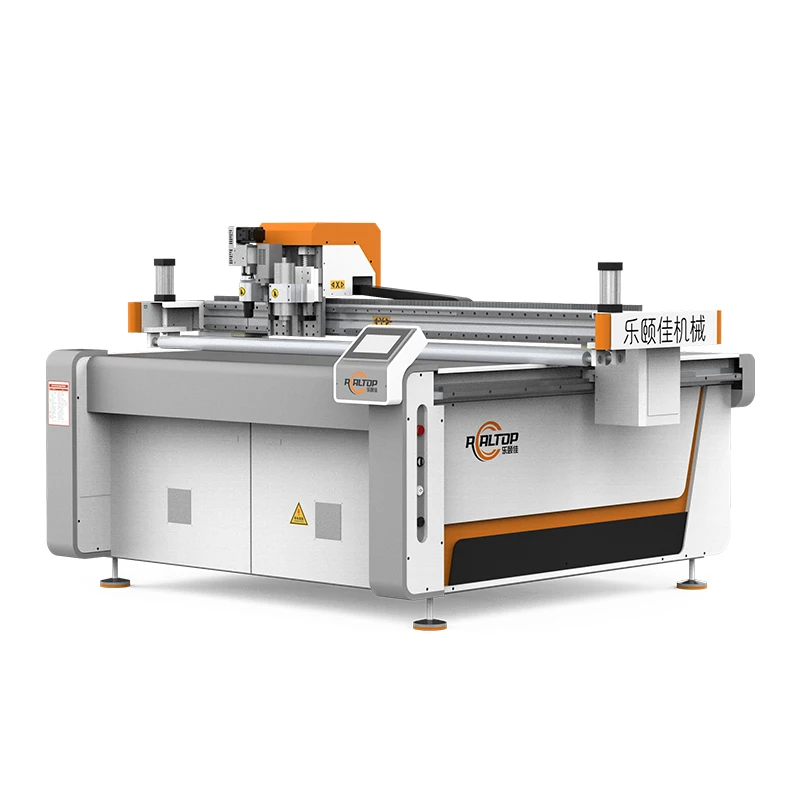
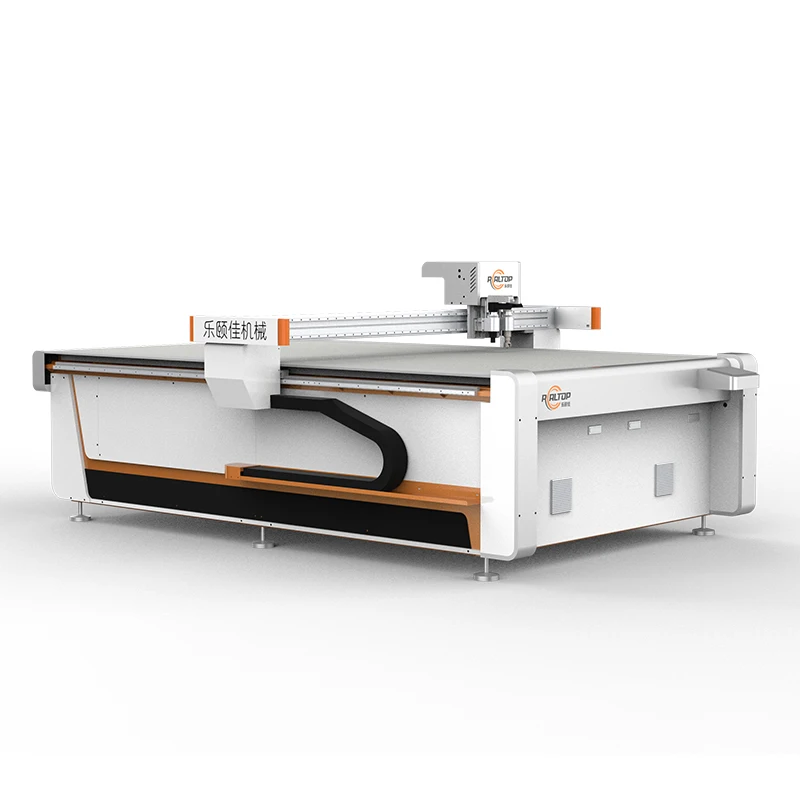
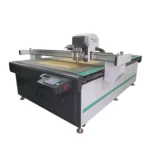
The RT-D2516/RT-S2516 carries a multifunctional tool head that accepts an oscillating knife for through-cutting corrugated board and honeycomb core, a creasing wheel for fold lines on carton stock, and a V-cutting knife for slotting and bevel work. Switching between tools on the same bed means a packaging sample maker can produce a fully finished carton prototype — cuts, creases, and perforations — without moving the sheet to a second machine. The Swiss imported blade assembly provides vibration full cutting and half cutting modes, which lets operators score kiss-cut sticker sheets or fully penetrate 15 mm foam gasket stock on the same setup.
Vacuum Table Zoning That Holds Small Parts Flat
A frequent failure point on flatbed cutters is the vacuum table: large zones pull unevenly on small carton blanks or gasket pieces, causing lift and drift at the trailing edge of the cut. The RT-D2516/RT-S2516 table is machined from magnesium-aluminum alloy with PVDF fluorocarbon coating and divided into selectable zones, so the operator can concentrate suction under a 200 × 150 mm sample carton rather than evacuating the full 1600 × 2500 mm surface. The integrated 7.5 kW aviation aluminum pump with built-in silencer sponge keeps noise down in enclosed sample rooms [NEED_CITE: workplace noise regulations for finishing departments].
Reading the Specs That Matter for Your Material
Translational velocity of 800–2000 mm/s tells you how fast the head moves between cuts, but the actual cutting speed of 200–800 mm/s is governed by material resistance and tool head choice. On single-face E-flute corrugated board, the oscillating knife runs toward the upper end of that range; on 30 mm EVA foam for automotive door panels, the high-power vibrating knife is selected and speed drops to maintain edge compression. The ≤0.1 mm repeated accuracy, driven by Delta or Panasonic servo motors on Taiwan Hiwin rails, matters most when nesting dozens of gasket profiles from a single sheet — a cumulative drift of even half a millimeter across a nesting layout wastes material and forces manual sorting.
The Cost of Skipping Configuration Verification
Choosing a machine on working area and headline thickness, then receiving it with a single fixed tool head, creates a cascade of problems. Ragged edges on honeycomb board mean the oscillating knife stroke was too short for the cell size. Crushed crease lines on grey board mean the creasing wheel pressure was set for lighter stock. Vacuum lift on small gasket blanks means the table zoning was never mapped to the buyer’s nesting layout [NEED_CITE: common CNC knife cutting defects in flexible material processing]. These issues are rarely machine defects — they are specification gaps that surface only when the first production batch runs.
Why Buyers Source This Configuration Here
The design team specifies both knife and laser cutting technologies in-house, which means the recommendation is based on material behavior rather than pushing one method. Tool head and table configuration are documented per material type and thickness before order confirmation, not left as a surprise at delivery. CCD camera positioning — available as small mark-point, panoramic, or projection — is tested against the buyer’s actual printed artwork file to confirm contour tracking at production speed. Software compatibility with PLT, DXF, and AI formats is verified against the buyer’s existing nesting workflow. Voltage, plug type, and control language are confirmed in writing before the RT-D2516/RT-S2516 enters assembly.
Documentation & Verification
- Machine specification sheet listing selected tool heads and vacuum zone layout for your material
- Electrical schematic with confirmed voltage and plug standard for your facility
- Sample cutting report on your corrugated grade or gasket stock with edge photographs
- Factory test record documenting cycle times on your actual file format
- Software licence and file format compatibility note for PLT, DXF, AI integration
- Spare parts list covering blades, creasing wheels, and vacuum pump consumables
Installation, Commissioning & Support
- Requires a level concrete floor rated for the 3450 × 2300 mm footprint and 9 kW load
- Dedicated 380V ±10% circuit with confirmed plug type before dispatch
- Fully assembled delivery with split box platform option for narrow door access
- First-run parameter setting on your material by commissioning engineer
- Touch screen control panel configured in your selected language at startup
- Included spare blade and creasing wheel set for initial production weeks
What to Share Before Requesting a Quote
Send a sample of your most demanding material — the densest corrugated flute you run, or the thickest gasket stock — along with your typical sheet size and daily volume. Confirm your facility voltage, frequency, and the language your operators need on the touch screen. If you already use nesting software, share a sample DXF or AI file so the auto typesetting module can be tested against your layout before the RT-D2516/RT-S2516 is configured.
Frequently Asked Questions
Q: How is cutting thickness verified for my specific material and which tool head is recommended?
A: You send a sample sheet of your actual material — corrugated grade, foam density, or gasket composition — and we run it on the RT-D2516/RT-S2516 with candidate tool heads. The sample cutting report documents which blade type, stroke setting, and cutting speed produced a clean edge, so the configuration is locked before your machine enters production.
Q: How do I confirm voltage, plug standard, and control panel language before shipment?
A: During the specification confirmation stage, you provide your facility voltage, frequency, and plug type. The electrical schematic is sent for your approval before assembly begins. Control panel language — English, Russian, Italian, Chinese, or a custom language — is set and verified in the factory test record included with shipment documentation.
Q: Can the software import my existing DXF or AI files and work with my nesting workflow?
A: The included auto typesetting software reads PLT, DXF, and AI natively. Before order confirmation, you share a sample production file and we generate a nesting layout on the RT-D2516/RT-S2516 to confirm file compatibility, kerf compensation, and part spacing match your current workflow without manual re-drawing.
Q: What does vacuum table zoning look like and will it hold small carton parts flat?
A: The magnesium-aluminum alloy table is divided into selectable vacuum zones. For a small carton sample or narrow gasket strip, the operator activates only the zones beneath the nested parts, concentrating the 7.5 kW pump suction where it is needed and preventing lift on pieces smaller than the full working area.
Q: How does the sample cutting process work before I commit to an order?
A: You ship or courier representative material to the factory. We cut it on the RT-D2516/RT-S2516 using the recommended tool head and vacuum zone configuration, then send you a sample cutting report with edge photographs, cycle time, and the confirmed specification list. You approve or request adjustments before the production order is placed.


商品评价
Clear filtersThere are no reviews yet.