







Fast Shipping
Carrier information

20k products
Payment methods

24/7 Support
Unlimited help desk

2-day Delivery
Track or off orders
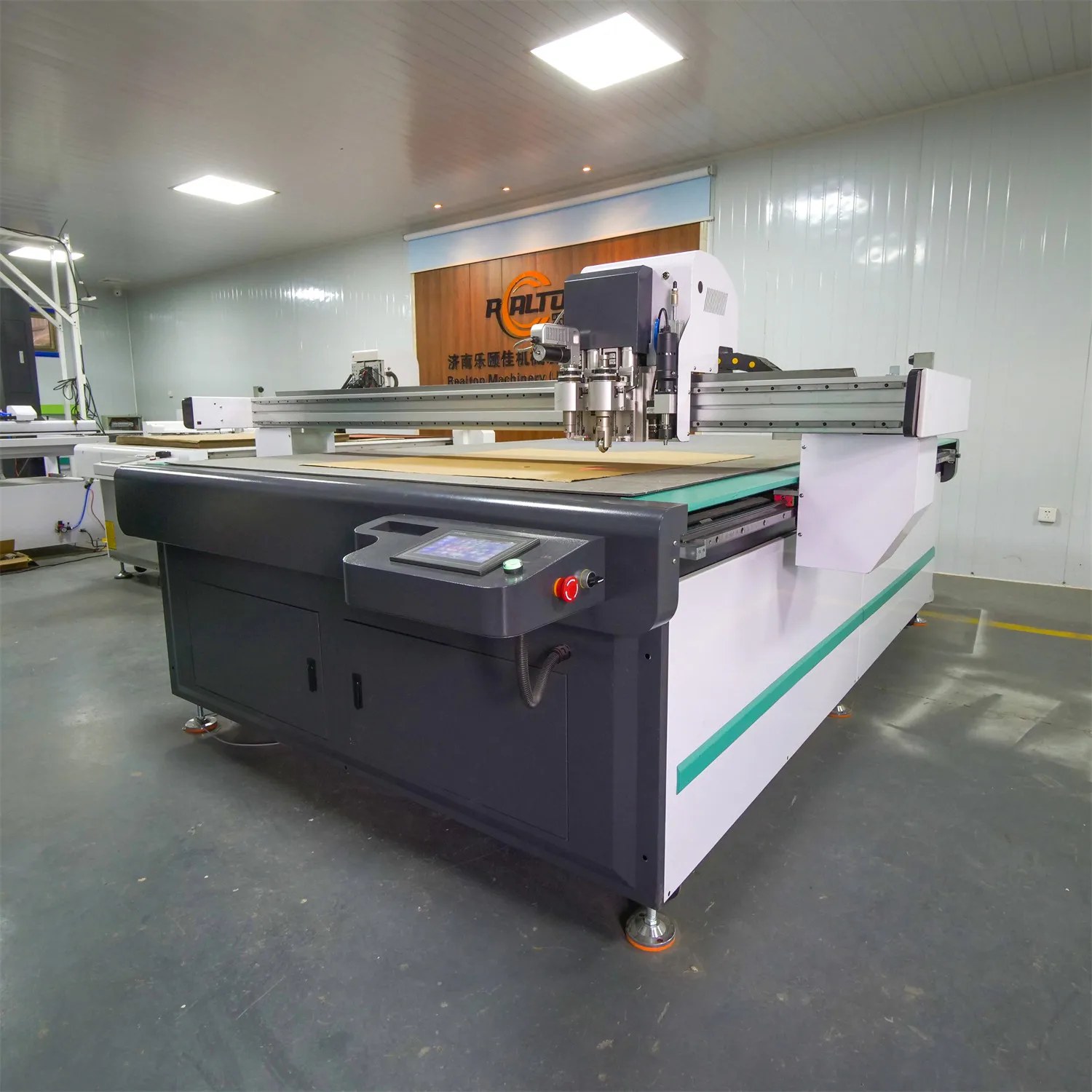
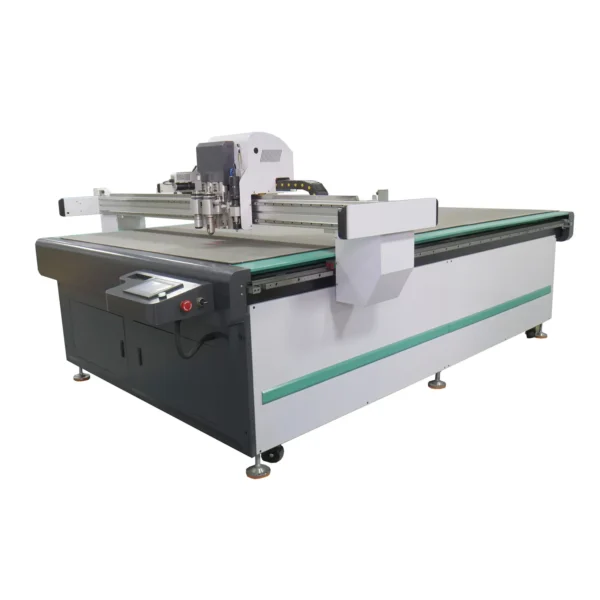
Swiss Knife Head Configured Per Board Flute — A carton cutting system matched to your corrugated profile and sheet thickness before the order is confirmed, not a generic flatbed sold on working area alone.
Technical Specifications
| Parameter | Value |
|---|---|
| Product Type | CNC Oscillating Knife Digital Cutting Table |
| Working Area | 1600 × 2500 mm |
| Machine Dimensions (L × W × H) | 3450 × 2300 × 1250 mm |
| Rated Power | 9 kW |
| Voltage | 380V ±10% (50/60 Hz to be confirmed for destination market) |
| Transmission System | Digital servo motor with linear guide, synchronous belt and ball screw |
| Servo Motor | Delta |
| Linear Guide | Taiwan Hiwin rail |
| Translational Velocity | 800–2000 mm/s |
| Cutting Speed | 200–800 mm/s (varies according to board flute, thickness and material) |
| Repeatability | ≤0.1 mm |
| Tool Head | Swiss imported knife with vibration full cut, half cut and cursor location |
| Maximum Cutting Thickness | Up to 100 mm (basis to be confirmed against specific board flute and density) |
| Working Table | Aluminum alloy honeycomb structure vacuum adsorption flatbed |
| Vacuum Pump | 7.5 kW |
| Conveyor Option | Germany imported belt for auto feeding |
| Safety Device | Infrared sensors and emergency stop |
| Control / Instruction System | HP-GL compatible format |
| Software | Professional carton nesting software included; supports cut, crease, mark and contour positioning |
| Language Options | English, Russian, Italian, Chinese; custom languages supported |
| Certification | CE (to be verified per model and destination) |
Application Suitability
| Application | Material or Output |
|---|---|
| Corrugated carton and packaging box production | Cutting and creasing short-run, custom format corrugated board without hard tooling |
| Packaging and carton sample making | Iterating structural box designs in-house before committing to production dies |
| Sticker, label and display finishing | Contour-cutting printed graphics, vinyl and self-adhesive materials |
| Signage and point-of-purchase display | Routing, scoring and cutting billboard stock, PVC foam board and acrylic sheet |
| Flexible material processing | Leather, PVC, sponge composite, soft glass, silicone, rubber and garment textiles |
Why "Working Area" Is the Wrong Starting Point for Corrugated Packaging
A flatbed cutter specified only by table size will fail on the first run of double-wall board if the tool head and vacuum zoning were not matched to the actual flute profile.
I have seen packaging producers bring in a machine that handled single-face stock in the sample test, then fail to hold down small fluted parts during a real production run. The vacuum table lacked sufficient zoning for the nested layout they were using, and small carton blanks lifted into the knife path. The CNC oscillating knife cutting table for packaging must be evaluated on tool head selection, vacuum layout and board density before the purchase order is signed. Buyers who skip this step end up with ragged edges, incomplete creases and stopped lines. [NEED_CITE: vacuum hold-down requirements for nested corrugated layouts]
Tool Head Selection Against Flute Profile
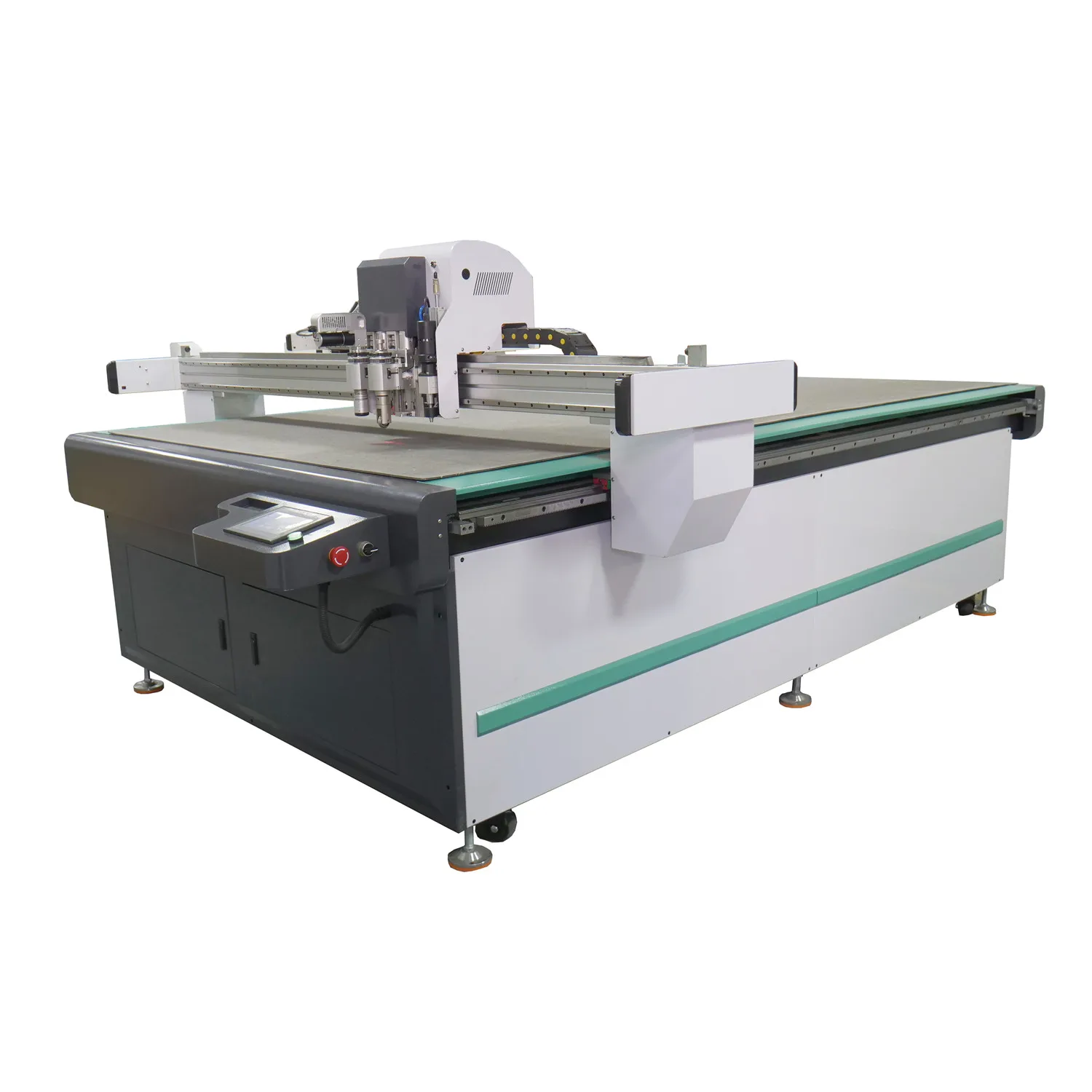
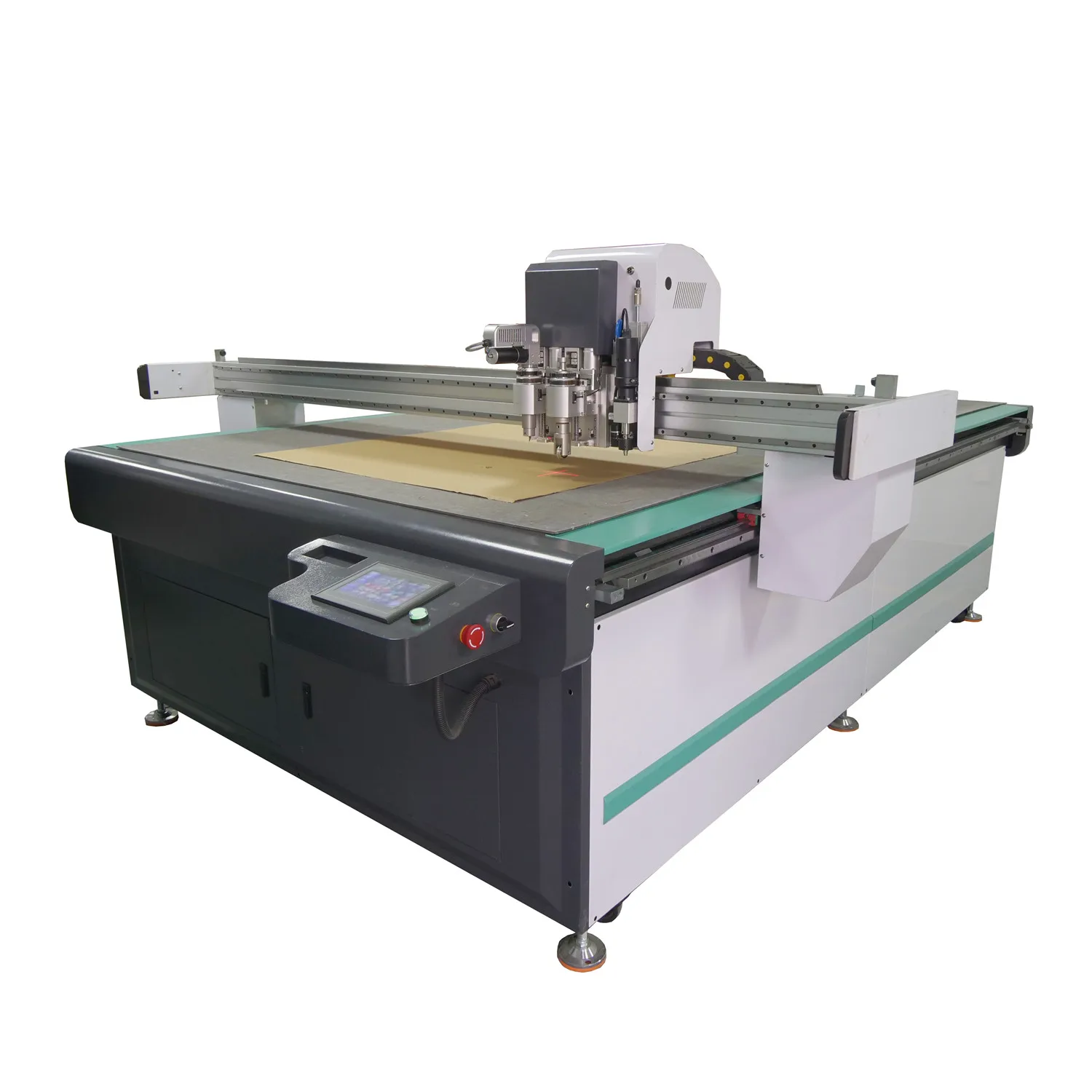
The Swiss imported oscillating knife head on this system supports full cut, half cut and cursor location functions. For single-wall B-flute, a standard high-frequency vibration blade delivers a clean shear through the liner and medium. For double-wall or thick honeycomb core stock, the tool head configuration changes: blade angle, vibration amplitude and feed rate all shift to prevent crushing the flutes before the cut completes. A CNC oscillating knife cutting table for packaging must be tested on the buyer’s exact board grade before the configuration is locked.
Vacuum Table Zoning for Nested Carton Layouts
The 1600 × 2500 mm aluminum honeycomb flatbed is divided into independently controlled vacuum zones. When a nesting software lays out small carton blanks across the sheet, only the zones under active cutting need full suction. This follow-cut approach prevents small parts from lifting when adjacent areas are already cut through. The 7.5 kW vacuum pump maintains hold-down force across the working area even on porous corrugated stock where air leakage is constant. [NEED_CITE: zoned vacuum adsorption principles for flatbed cutting tables]
Drive System and Crease-to-Cut Registration
Delta servo motors drive the cutting head along Taiwan Hiwin linear guides with synchronous belt and ball screw transmission. Positioning repeatability of ≤0.1 mm matters when a crease line must register against a printed contour or a half-cut score must align with a fold axis. On a carton layout where crease, cut and mark operations happen in the same pass, any drift in the drive system compounds across the sheet and shows up as misaligned flaps. Translational velocity ranges from 800 to 2000 mm/s for positioning moves, with cutting speed between 200 and 800 mm/s depending on board density and flute structure.
When the Wrong Configuration Costs a Production Shift
A machine set up for standard B-flute will tear through E-flute coated stock if the knife frequency and blade geometry are not adjusted. The ragged edge then requires manual trimming or causes rejection at the packing line. Vacuum zoning that works for large carton blanks may leave small divider inserts lifting mid-cut, forcing the operator to slow the feed rate or add mechanical fixturing. These downstream problems trace back to a configuration that was never validated against the buyer’s actual material range. [NEED_CITE: edge quality variables in oscillating knife cutting of corrugated board]
Why Source This Cutter Through a Knife-and-Laser Manufacturer
The in-house design team covers both knife and laser cutting technologies, so a packaging producer can match the cutting method to the material rather than force one approach. The tool head and table configuration are specified per board flute and production volume, with CCD camera positioning available for printed contour work. Software compatibility is confirmed before order — file formats, nesting workflow and UI language are tested against the buyer’s existing setup. Sample cutting runs on the buyer’s own corrugated stock before commitment, with edge quality, crease definition and throughput recorded in a formal report.
Documentation & Verification
- Machine specification sheet detailing knife head type, blade depth and vacuum zone layout per material
- Electrical schematic with voltage and frequency confirmed for the destination market
- Sample cutting report on the buyer’s corrugated or cardboard stock before order confirmation
- Software licence note with file format compatibility and nesting workflow verification
- Factory test record and packing photographs shipped with operation and maintenance manual
- Spare parts list specifying consumable blades, vacuum cups and drive belt part numbers
Installation, Commissioning & Support
- Foundation requires level concrete floor capable of supporting the 3450 × 2300 mm footprint and dynamic vibration loads
- Dedicated 380V three-phase circuit with confirmed 50/60 Hz frequency matching the servo and vacuum pump ratings
- Assembly state to be confirmed before shipment — fully built or semi-knocked-down for container loading
- First-run commissioning includes tool head calibration, vacuum zone mapping and nesting software setup on buyer material
- Operator training covers blade change procedure, vacuum zoning adjustment and crease wheel depth setting
- Wear parts inventory includes Swiss knife blades, vacuum cups and synchronous belt sections
What to Prepare Before Requesting a Quotation
To specify this CNC oscillating knife cutting table for packaging correctly, the buyer should provide corrugated flute type, board thickness range, maximum sheet size and daily production volume. Confirming the local voltage and frequency, the preferred control language and any existing nesting software workflow avoids rework after shipment. If the application involves printed carton stock, specify whether contour recognition from printed registration marks is required so the CCD option can be included in the configuration.
Frequently Asked Questions
Q: How is cutting speed and throughput verified for my board grade?
A: Cutting speed is tested on the buyer’s actual corrugated stock before the order is confirmed. The sample report records edge quality, crease definition and throughput at the tested feed rate, so the buyer sees real numbers for their material rather than a generic specification.
Q: Which tool head is right for my coated cardboard and fluted stock?
A: The Swiss oscillating knife head is configured per board flute and thickness. Blade geometry, vibration frequency and feed rate are matched to the material in the sample test, and crease quality is validated against the buyer’s folding and glue-line requirements.
Q: Does the vacuum table hold small carton parts during nested cutting?
A: The honeycomb flatbed has independently controlled vacuum zones that follow the cutting area. Small parts remain flat even when surrounding material is already cut through, preventing lift that would otherwise force a slower feed rate or manual fixturing.
Q: Can the software import my existing carton design files?
A: The included nesting software supports multi-format file import and handles cut, crease, mark and contour positioning. File format compatibility and UI language are confirmed against the buyer’s existing workflow before the machine is built.
Q: Are voltage and control language set for my country before shipment?
A: The electrical schematic confirms 380V ±10% with frequency matched to the destination market. Control language options include English, Russian, Italian and Chinese, with custom languages supported when specified before production.


商品评价
Clear filtersThere are no reviews yet.