



Fast Shipping
Carrier information

20k products
Payment methods

24/7 Support
Unlimited help desk

2-day Delivery
Track or off orders
Tool head matched to material — In-house knife and laser design means the cutting method is chosen around your fabric stack and edge requirement, not forced into a single tooling path.
Technical Specifications
| Parameter | Value |
|---|---|
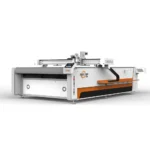
| Product Type | CNC Oscillating Knife Cutting Machine |
| Model | RT-D2516/RT-S2516 |
| Working Area | 1600 × 2500 mm |
| Machine Size | 3450 × 2300 × 1250 mm |
| Rated Power | 9 kW |
| Translational Velocity | 800–2000 mm/s |
| Cutting Speed | 200–800 mm/s (varies with material density and thickness) |
| Cutting Thickness | Up to 100 mm (basis not stated in source — confirm block format, material type and compression) |
| Repeated Accuracy | ≤ 0.1 mm |
| Transmission System | Digital servo motor, linear guide, synchronous belt, ball screw |
| Vacuum Pump | 7.5 kW |
| Instruction System | HP-GL compatible format |
| Voltage | 380V ± 10% |
| Control Panel | Touch screen, multiple language supported |
| Visual Positioning | Small CCD camera mark point positioning, panoramic camera recognition, projection positioning |
Application Suitability
| Application | Material or Output |
|---|---|
| Garment and footwear production | Woven fabric, knitted textile, non-woven fabric, shoe material, luggage material |
| Automotive interior and gasket cutting | Sponge composite leather, PU, EVA, XPE, gasket material |
| Packaging and carton sample making | Corrugated cardboard, cardboard, plastic box, sticker, film |
| Soft furnishing and carpet cutting | Carpet, foam board, sponge, soft home furnishing textiles |
| Advertising and graphic printing | PVC sheet, soft glass, silicon, rubber, vinyl |
| Composite material processing | Carbon fiber, fiberglass, PTFE, ETFE, PP, PE |
Why Cutting Depth Ratings Alone Mislead Buyers
A depth number on a brochure means nothing until it is tested against your actual material stack under vacuum hold-down.
I once watched a garment workshop accept a machine rated for thick stacks, only to find the blade drifted through layered stretch fabric because the hold-down pressure and tool head frequency were mismatched to the material’s compression behavior. The cutting depth listed in specifications is typically measured on a rigid, uniform block — not on a compressible, multi-layer layup where each ply shifts independently. Buyers who specify CNC Oscillating Knife Cutting Machine specifications on working area and maximum depth alone regularly discover that edge quality degrades well before the stated limit [NEED_CITE: oscillating knife cutting depth verification methods for layered textiles].
Knife Tooling Range and Material Pairing
The RT-D2516/RT-S2516 supports oscillating knife, pneumatic knife, high-power vibrating knife, circular knife, V-cutting knife, drag knife, creasing wheel, dotted line knife, punching, and brush tool heads. Each produces a different edge profile and suits a different material density. Selecting the correct head is the single most consequential decision in a CNC Oscillating Knife Cutting Machine purchase, because the wrong tool on layered knit fabric will crush fibers rather than shear them cleanly.
CCD Positioning Under Production Conditions
Printed contour cutting depends on the CCD camera recognizing registration marks at cutting speed, not at a slow calibration pass. The small CCD camera mark point positioning and panoramic camera recognition options on this system address different job types — mark point for repeating registered graphics, panoramic for large-format printed textile where the entire contour must be traced. If your workflow relies on printed registration, the recognition speed and mark contrast tolerance must be validated before acceptance [NEED_CITE: CCD camera contour recognition accuracy at production feed rates].
What the Spec Sheet Numbers Actually Mean for Your Floor
The 9 kW rated power covers the servo drives, vacuum pump, and oscillating head simultaneously — confirming that your workshop circuit can sustain this load without voltage drop is essential, because a 380V ± 10% supply that sags under neighboring equipment will cause servo faults mid-cut. The 7.5 kW vacuum pump paired with the aluminum air box platform and split-box zoning determines whether small pattern pieces stay flat during high-speed traversal. Repeated accuracy of ≤ 0.1 mm matters most when cutting interlocking garment panels where cumulative drift across a 2500 mm bed produces mismatched seams. The Delta servo motor and Taiwan Hiwin linear guide combination controls that drift, but only if the belt tension and rail preload are set correctly during commissioning.
The Real Cost of Skipping the Sample Cut
When a buyer commits without testing their own material, the consequences surface weeks after installation. Stretch fabric cut with a standard oscillating head instead of a high-frequency vibrating knife produces frayed edges that fail quality inspection. Small gasket parts lift off a poorly zoned vacuum table, ruining nested sheets and forcing operators to slow the feed rate. These failures are not machine defects — they are configuration errors that a sample cutting round on the buyer’s actual material would have revealed before the order was placed [NEED_CITE: material sample testing protocols for CNC flatbed cutting procurement].
Why Source This Configuration From Jinan
In-house design covers both knife and laser cutting technologies, so the cutting method is matched to the material rather than forced into one platform. Tool head and table configuration is specified per material type, thickness, and daily volume — not pulled from a standard list. CCD camera positioning for printed contour work is calibrated against the buyer’s actual print registration marks. Software compatibility with PLT, DXF, and AI file formats is confirmed alongside the auto typesetting nesting workflow before the order is placed. Voltage, control language, and plug type are locked in during the quotation stage, not discovered at unpacking. Sample cutting on the buyer’s own material is conducted and documented before commitment.
Documentation & Verification
- Machine specification sheet listing confirmed tool head and vacuum table zoning layout
- Electrical schematic with 380V ± 10% circuit requirements and servo wiring diagram
- Sample cutting report documenting edge quality on buyer-supplied fabric at stated thickness
- Tool head and table configuration list matched to material type and production volume
- Software licence note confirming PLT, DXF, AI file format and nesting compatibility
- Packing photographs showing RT-D2516/RT-S2516 crated state before container loading
Installation, Commissioning & Support
- Floor must support the 3450 × 2300 × 1250 mm machine footprint with level tolerance across the aluminum air box platform
- Dedicated 380V ± 10% circuit rated for the 9 kW total draw including the 7.5 kW vacuum pump
- Machine ships partially assembled; rail alignment and belt tension verified on site during commissioning
- Touch screen control panel configured to selected language — English, Russian, Italian, Chinese, or custom
- First-run parameter setting covers oscillating frequency, vacuum zone mapping, and CCD mark recognition thresholds
- Spare parts list includes Swiss-imported knife blades, drag knife tips, and creasing wheel inserts
What to Share With Your Inquiry
Tell us the material type, ply count, and maximum stack height you cut daily. Confirm your workshop voltage and frequency so the servo and vacuum pump are wound correctly. If you work with printed contour files, send a sample print so the CCD recognition can be validated against your actual mark density and contrast before we quote the RT-D2516/RT-S2516.
Frequently Asked Questions
Q: How do I confirm cutting thickness for my specific fabric stack?
A: Send a representative sample of your material layup at the thickness you plan to cut. We run it on the RT-D2516/RT-S2516 with the proposed tool head and vacuum zoning, then document edge quality, layer shift, and achievable feed rate in a sample cutting report you review before committing.
Q: Which tool head gives clean edges on foam versus woven fabric?
A: Foam typically requires a high-power vibrating knife at lower frequency to avoid crushing the cell structure, while woven fabric suits a standard oscillating knife at higher frequency for clean fiber shearing. The correct pairing is confirmed during the sample cutting stage against your actual material.
Q: Will the CCD camera track printed marks at full production speed?
A: The small CCD mark point and panoramic recognition options handle different job types. We test recognition reliability using your actual printed material at production traversal speed — not at a slow calibration pass — and document the result before shipment.
Q: Is the vacuum table adequate for small nested parts?
A: The aluminum air box platform supports split-box zoning, meaning suction can be concentrated under small parts that would otherwise lift during high-speed cutting. The zone layout is configured based on your typical nesting pattern and confirmed during the factory test.
Q: Will this machine import my existing nesting files?
A: The HP-GL compatible instruction system accepts PLT, DXF, and AI formats. We verify that your existing nesting software output imports correctly into the auto typesetting workflow and document file compatibility before the order proceeds.


商品评价
Clear filtersThere are no reviews yet.