


Fast Shipping
Carrier information

20k products
Payment methods

24/7 Support
Unlimited help desk

2-day Delivery
Track or off orders
Tool Head Matched to Material — In-house design team specifies oscillating, rotary, kiss cutting or V groove tool heads per fabric, leather and foam type, verified on your stock before dispatch.
Technical Specifications
| Parameter | Value |
|---|---|
| Model | 1625 |
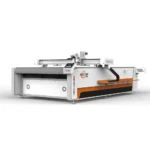
| Product Type | CNC Oscillating Knife Cutting Machine |
| Working Area | 1600 × 2500 mm |
| Cutting Thickness | ≤ 30 mm (material-dependent) |
| Cutting Speed | 0–2000 mm/s |
| Cutting Accuracy | ±0.1 mm |
| Repeat Positioning Accuracy | ±0.1 mm |
| Tools Available | Oscillating knife, Driven rotary knife, Creasing wheel, Kiss cutting tool, Pneumatic knife, Milling tool, V groove knife |
| Vacuum Table | Aluminum bellows vacuum table |
| Vacuum Pump | 9 kW |
| Servo Motor Options | Panasonic, Delta, Dorna (source value — verify against manufacturer catalog) |
| Control System | PLC control panel with intuitive interface |
| Supported File Formats | PLT, DXF, AI, PDF |
| Nesting System | Intelligent nesting with automatic defect avoidance and layout optimization |
| Voltage Options | 110V, 220V, 380V |
| Software Language Options | English, Russian, Italian, Chinese; special languages customizable |
| Safety Device | Infrared sensor device and emergency stop device |
| Machine Size | 3300 × 2100 × 1350 mm |
| Applicable Materials | Fabric, Cardboard, Carton, Mats, PVC, EVA, Leather, Acrylic, Foam, PTFE, Rubber |
| Certification | CE |
Application Suitability
| Application | Material or Output |
|---|---|
| Apparel and knitwear production | Multi-layer fabric stacks, lace, suit lining and complex woven textiles |
| Automotive interior trimming | Seat fabrics, carpets, PVC floor mats and headliner materials |
| Home textile manufacturing | Sofa upholstery fabrics, heavy curtains, area rugs and cushion panels |
| Composite material processing | Carbon fiber prepreg, aramid sheets and specialty reinforcement fabrics |
| Packaging sample making | Cardboard, corrugated carton and folding carton stock |
What the Stated Cutting Thickness Actually Means for Your Material
Maximum cutting depth is a function of material density and tool head selection, not a fixed number across all stock.
When a buyer sees "≤ 30 mm" on a CNC oscillating knife cutting machine specifications sheet, the assumption is often that any material up to that thickness will cut cleanly at production speed. I have stood on factory floors in Southeast Asia watching a machine struggle through a reinforced composite that was well under the rated thickness, simply because the oscillating knife was the wrong tool for a material with a dense core layer. The cutting depth you achieve depends on whether the stock is open-cell foam, tightly woven canvas, or a laminated PVC with a scrim reinforcement — and which tool head is mounted. [NEED_CITE: material density and cutting resistance in oscillating knife applications]
Oscillating Knife Versus Rotary Knife for Fabric Stacks
For multi-layer garment cutting, the oscillating knife delivers a vertical reciprocating stroke that slices through fabric stacks without pulling or shifting the plies. This is the correct choice when cutting nested patterns from woven or knit textiles where edge alignment across all layers matters. The driven rotary knife, by contrast, works well on single-layer or thin-ply materials where continuous shearing action produces a clean edge at high travel speed. Selecting between these two tool heads determines whether you get a usable cut or a frayed, shifted stack that sends pieces back to the sorting table. The CNC oscillating knife cutting machine specifications should always be read alongside the specific tool head installed, because swapping the head changes the effective cutting capability entirely.
Vacuum Hold-Down and Small Part Stability
The 9 kW vacuum pump paired with the aluminum bellows table provides full-surface suction across the 1600 × 2500 mm working area. In practice, this matters most when cutting small pattern pieces from lightweight fabric or thin foam, where any loss of hold-down causes the material to lift into the knife path and produce a miscut. During an installation for an automotive seat cover producer, we found that perimeter-only vacuum zones were insufficient for the small gusset pieces in their nesting layout; the material shifted once the knife broke through the last anchor point. Proper vacuum zoning matched to your typical part size and nesting density prevents this failure mode before it reaches the sewing line. [NEED_CITE: vacuum table zoning requirements for flexible material cutting]
How Accuracy and Servo Drive Translate to Edge Quality
The ±0.1 mm repeat positioning accuracy, driven by the servo motor system, means the knife returns to the same coordinate reliably across thousands of cuts. For garment producers, this consistency is what allows pattern pieces to align at the sewing stage without manual trimming or re-cutting. The PLC control panel manages acceleration and deceleration curves so the knife does not drag or deflect at corner points, which is where most edge defects originate on a CNC oscillating knife cutting machine specifications sheet that only lists maximum speed. A machine that holds ±0.1 mm at low speed but loses accuracy at production travel rates will generate more waste than a slower machine with stable motion control.
The Cost of Shipping Without Confirming Tool Head and Voltage
I once spent two weeks on-site in Jakarta recalibrating a cutting line because the wrong tool head had been specified during the quoting stage. The buyer sent sample swatches of standard polyester, but production stock included a PVC-backed composite with a woven scrim that the oscillating knife could not penetrate cleanly. The machine was not defective — it was simply configured for the wrong material. Similarly, voltage mismatches between a 380V factory supply and a machine wired for 220V result in servo motor overheating and vacuum pump failure within the first shift. These are not warranty claims; they are configuration errors that a sample cutting report on your actual stock would have prevented. [NEED_CITE: voltage and frequency standards by export market]
Why Configuration Verification Belongs in the Purchase Process
Every unit leaves the factory with a tool head and table configuration list matched to the buyer’s declared material and daily volume. The intelligent nesting system accepts DXF, PLT, AI and PDF files, but file format compatibility must be confirmed against your existing design software before the machine ships — not discovered during commissioning when the nesting layout fails to import. The software language and control interface are customizable, and this detail should be locked in at the order stage so your operators are reading prompts in a language they understand from day one. A factory test record on your material, run before dispatch, is the single most effective document for catching mismatches before they become on-site emergencies.
Documentation & Verification
- Machine specification sheet confirming 1625 working area, tool head list and servo motor brand
- Electrical schematic with voltage confirmation for your site supply (110V, 220V or 380V)
- Sample cutting report on your fabric, leather or foam stock showing edge quality and achievable depth
- Software licence and file format compatibility note for DXF, PLT, AI and PDF import
- Factory test record with cutting accuracy and repeat positioning measurements before dispatch
- CE declaration documentation for machinery import compliance
Installation, Commissioning & Support
- Requires level concrete floor to support the 3300 × 2100 mm machine footprint and dynamic cutting loads
- Dedicated electrical circuit matching confirmed voltage (110V/220V/380V) with correct frequency and phase
- Machine ships with vacuum pump and control panel pre-assembled; table leveling completed on-site
- First-run commissioning includes servo tuning, vacuum zone mapping and test cuts on your material
- Operator training covers PLC interface navigation, tool head changeover and nesting software workflow
- Spare parts list includes oscillating knife blades, rotary knife discs and vacuum table seals
What to Include With Your Inquiry
Provide the specific material types you cut — including any laminated or reinforced composites — along with typical sheet dimensions and ply count per cut. Confirm your facility voltage, frequency and available control interface language. If you have an existing nesting workflow or design software, share a sample file so compatibility with the intelligent nesting system can be verified before quotation.
Frequently Asked Questions
Q: How do I choose between oscillating knife, rotary knife and kiss cutting for my materials?
A: The oscillating knife suits multi-layer fabric stacks and dense foam where vertical slicing prevents ply shift. The driven rotary knife handles single-layer textiles and thin materials at higher travel speed. Kiss cutting is used for adhesive-backed vinyl and thin films where only the top layer is scored. Selection depends on your material composition, thickness and whether you cut single-ply or stacked — send a sample for a tool head cutting test.
Q: Can the machine actually cut 30 mm thick material in production?
A: The ≤ 30 mm rating applies to softer, uniform materials like open-cell foam or single-density rubber. Denser composites, reinforced PVC or tightly packed multi-layer fabric stacks may require a lower practical cutting depth for clean edge quality at production speed. The effective maximum depends on material density and the tool head selected. A sample cutting test on your actual stock confirms the achievable depth.
Q: Is the vacuum sufficient for lightweight fabrics and small cut parts?
A: The 9 kW pump with the aluminum bellows table provides full-surface suction across the 1600 × 2500 mm area. For very small parts or lightweight woven fabrics, vacuum zoning should be reviewed against your typical nesting layout to ensure adequate hold-down at part edges. Providing a sample nesting file allows us to assess whether standard zoning meets your requirements or if zone adjustments are needed.
Q: Will my existing DXF and AI design files import correctly into the nesting software?
A: The system supports PLT, DXF, AI and PDF file import with intelligent nesting and automatic defect avoidance. However, layer structure, line weight conventions and font handling can vary between design platforms. We recommend sending a sample file from your production workflow so file compatibility and nesting output can be verified before the machine ships.
Q: Can the voltage and control language be configured for my facility?
A: Voltage options include 110V, 220V and 380V, and the correct configuration must match your facility supply before production begins. The control interface is available in English, Russian, Italian and Chinese, with special languages customizable on request. Confirm both electrical and language requirements at the order stage so the machine arrives ready for immediate commissioning.


商品评价
Clear filtersThere are no reviews yet.