







Fast Shipping
Carrier information

20k products
Payment methods

24/7 Support
Unlimited help desk

2-day Delivery
Track or off orders
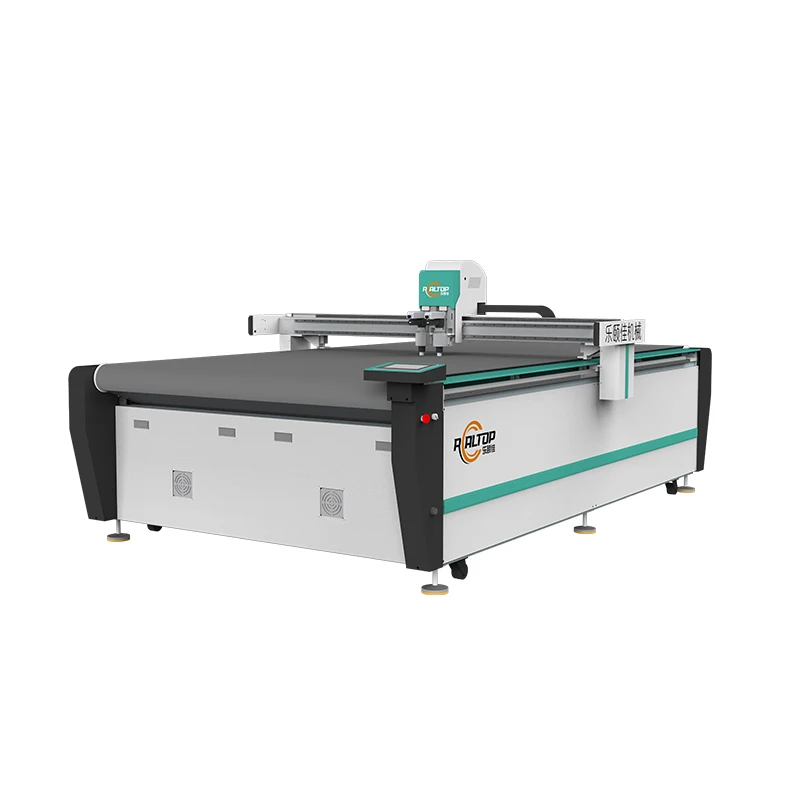
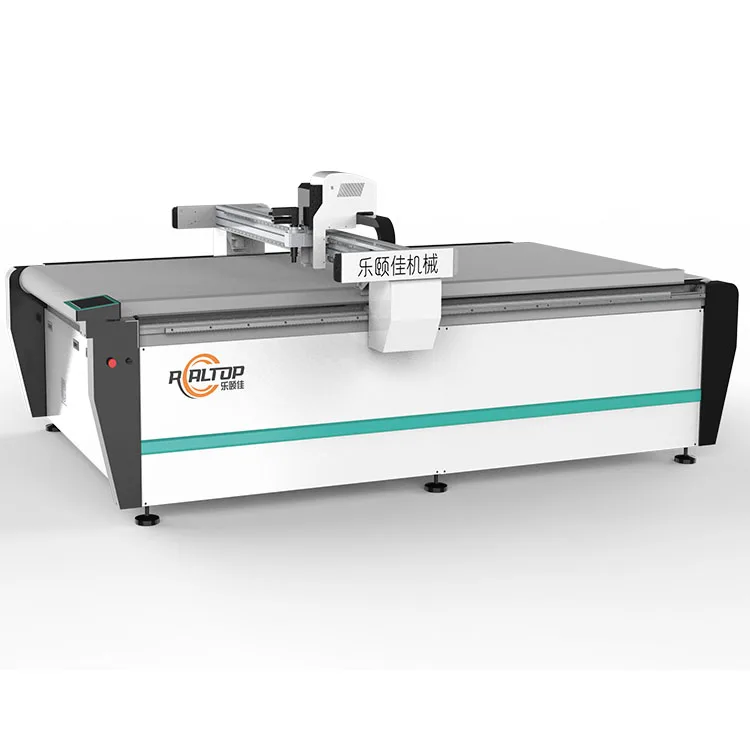
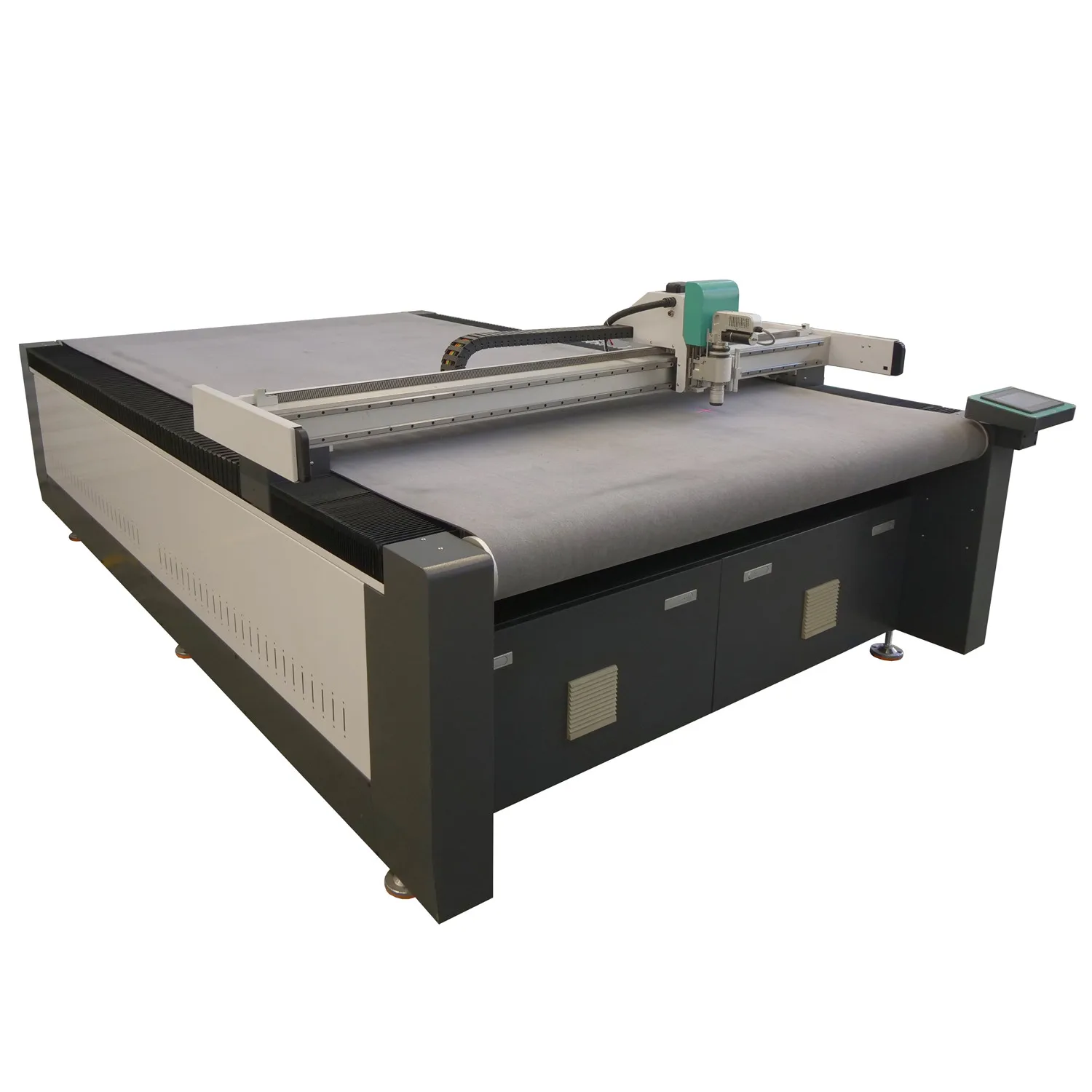
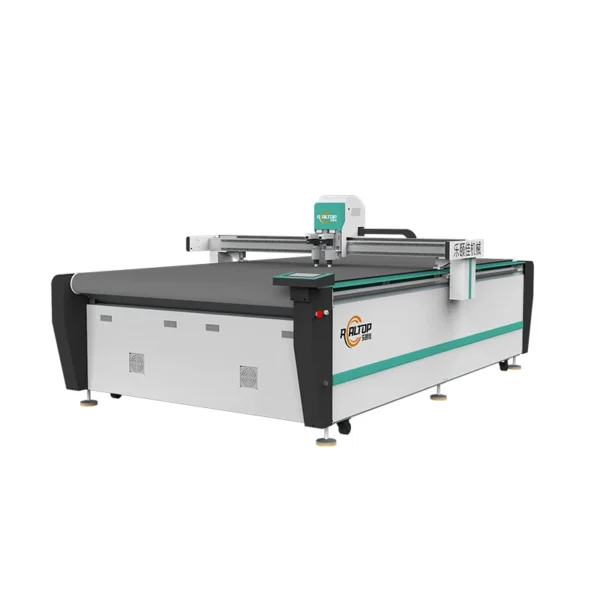
Swiss Knife and Zoned Vacuum Engineering — The RT-D2516/RT-S2516 oscillating knife head and magnesium-aluminum vacuum table are configured together after sample cutting on your actual roll or sheet stock, not sold as a default package.
Technical Specifications
| Parameter | Value |
|---|---|
| Model | RT-D2516 / RT-S2516 |
| Product Type | CNC Oscillating Knife Cutting Machine |
| Working Area | 1600 × 2500 mm |
| Machine Footprint | 3450 × 2300 × 1250 mm |
| Rated Power | 9 kW |
| Cutting Thickness Capacity | Up to 100 mm (varies with material density) |
| Translational Velocity | 800 – 2000 mm/s |
| Cutting Speed | 200 – 800 mm/s (material dependent) |
| Repeated Positioning Accuracy | ≤ 0.1 mm |
| Servo Drive | Delta (Panasonic IP67 optional) |
| Linear Motion | Taiwan Hiwin guide rails, ball screw and synchronous belt |
| Vacuum Pump | 7.5 kW, aviation aluminum housing with integrated silencer |
| Table Surface | Magnesium-aluminum alloy, PVDF fluorocarbon powder coated, hard anodized |
| Conveyor Belt | German-sourced belt material |
| Vision System Options | Small CCD mark point, panoramic camera recognition, projection positioning |
| Tool Head Options | Oscillating knife, pneumatic knife, high-power vibrating knife, circular knife, V-cut, drag knife, creasing wheel, dotted line knife, punching, brush |
| Control Language | English, Russian, Italian, Chinese (others configurable) |
| Instruction Format | HP-GL compatible |
| Supply Voltage | 380 V ± 10 % (frequency to confirm per destination) |
| Safety Devices | Infrared sensors, anti-collision, emergency stop |
Application Suitability
| Application | Material or Output |
|---|---|
| Garment and Footwear Production | Multi-layer woven fabric, non-woven textile, shoe upper leather, lining |
| Automotive Interior and Gaskets | Sponge composite leather, PU foam, EVA, XPE, rubber sealing pads |
| Soft Home Furnishings | Upholstery fabric, curtain textile, carpet, floor mat stock |
| Packaging and Sample Making | Corrugated cardboard, sticker film, vinyl, adhesive sheet |
| Sports and Outdoor Goods | Neoprene, composite foam, technical textile laminates |
| Advertising and Signage | Self-adhesive vinyl, reflective film, printed banner stock |
What "Cutting Thickness Up to 100 mm" Actually Means on the Shop Floor
A 100 mm rating is a ceiling for low-density foam, not a blanket guarantee for every fabric stack.
In my years commissioning lines across the Middle East, the most common dispute starts right here: a buyer reads the headline thickness and assumes their dense non-woven roll will cut cleanly at that depth. The RT-D2516/RT-S2516 CNC oscillating knife cutting machine specifications list up to 100 mm, but that figure holds for soft, low-density media. A dense automotive gasket stack or a multi-layer non-woven bundle behaves entirely differently under the blade. When the actual material density exceeds what the test sample showed, the knife deflects, the bottom ply shifts, and edge quality degrades from the top sheet down [NEED_CITE: material density effects on oscillating knife cutting depth].
Swiss Knife Architecture and Multi-Function Cutting
The multifunctional head on this platform carries a Swiss-sourced oscillating blade that handles full-depth cutting, kiss cutting and cursor-based positioning within a single tool station. That means a garment marker with internal drill marks, perimeter cuts and partial-depth score lines can run without a tool change mid-sheet. For footwear producers running leather with intricate contour work, the cursor location function places reference points that downstream stitching jigs rely on.
Zoned Vacuum and Small-Part Holding
A 1600 × 2500 mm table area is only useful if the vacuum holds the work down across the entire zone. The magnesium-aluminum alloy table surface is finished with a PVDF fluorocarbon powder coat and hard anodized layer, giving a flat reference plane that resists scratching from repeated knife passes. The 7.5 kW pump sits in an aviation aluminum shell with internal silencer sponge, which matters when the cutting cell sits next to a sewing line and ambient noise affects operator communication. Small parts — gaskets, insoles, label shapes — are where vacuum zoning earns its keep; without adequate segmentation, these pieces lift at the trailing edge and the knife drags them across the table [NEED_CITE: vacuum table zoning principles for CNC flatbed cutters].
Reading the Specs That Matter for Fabric and Composite
The 0.1 mm repeated positioning accuracy is driven by Delta servo motors running on Taiwan Hiwin linear guides with ball screw transmission. In practical terms, this tolerance band keeps nested pattern pieces within the allowance that garment grading requires — a few tenths of a millimeter accumulated error across a 2.5-meter table length can push a size-L panel out of spec. The 200 to 800 mm/s cutting speed range reflects real material behavior: a single-ply vinyl film cuts fast and clean near the upper end, while a multi-layer non-woven stack forces the blade to work slower to avoid ply shift. The HP-GL compatible instruction system accepts nested markers from common CAD platforms, which is worth confirming against your existing nesting software before the machine ships.
The Cost of Skipping the Material Test
I have watched a Middle East garment factory take delivery of a multi-layer cutter specified on working area alone. Their actual non-woven fabric was denser than the sample the vendor tested, and throughput dropped noticeably from the quoted figure. Edge fraying on the bottom plies forced a second-pass trim, which doubled labor per marker. That outcome is preventable with a sample cutting report run on the buyer’s own roll stock, documenting the knife frequency, blade type and vacuum pressure that produced an acceptable edge. Without that report in hand before the purchase order, the CNC oscillating knife cutting machine specifications on paper and the output on your floor will diverge [NEED_CITE: sample cutting validation in CNC knife procurement].
Why the Build Details Matter at This Table Size
In-house design covers both the knife tooling and the vacuum table engineering, which keeps the tool head selection and the table zoning mapped to one material profile rather than sourced from separate vendors who will not troubleshoot together. The thick-walled seamless steel frame goes through high-temperature tempering and finishes on a CNC machining center, which controls the flatness that the vacuum surface depends on. Tool head options — from oscillating knife to creasing wheel to punching tool — are specified against your material list at order, not swapped in the field as an afterthought. CCD camera options, including mark-point and panoramic recognition, are calibrated for the contour work you actually run, and the software license and file format note ships with the machine so your nesting workflow is verified before installation week.
Documentation & Verification
- Machine specification sheet listing your confirmed tool head and table zone layout
- Electrical schematic with voltage and frequency matched to your facility supply
- Sample cutting report run on your fabric, leather or composite roll stock
- Software license document with HP-GL file format compatibility confirmed
- Factory test record showing positional accuracy across the 2500 mm axis travel
- Spare parts list identifying blades, belts and vacuum seals by part number
Installation, Commissioning & Support
- 3450 × 2300 mm footprint requires a level concrete floor with clear access on three sides for material loading
- 380 V ± 10 % three-phase supply with dedicated breaker; confirm 50 or 60 Hz before dispatch
- 9 kW rated draw plus 7.5 kW vacuum pump may require separate circuits depending on panel capacity
- First-run calibration covers servo tuning, vacuum zone mapping and CCD camera mark-point registration
- Operator training addresses tool head changeover, nesting file import and daily blade inspection
- Consumable spares package includes oscillating knife blades, conveyor belt sections and vacuum seal strips
What to Have Ready Before You Request a Quote
Send your material type, ply count or stack height, and the largest sheet or roll width you run. Include your daily marker volume and the nesting software you currently use so the file format handoff can be verified. Confirm your facility voltage, frequency and the control language your operators need on screen.
Frequently Asked Questions
Q: How do I match the tool head to my specific fabric or composite?
A: Oscillating knife handles most woven and non-woven textiles cleanly. Pneumatic knife suits thicker sponge and foam. Drag knife works on vinyl and thin film. Creasing wheel scores corrugated board for folding. The correct choice depends on your material density, thickness and the edge finish your downstream process requires, so a sample cut on your stock is the only reliable way to confirm.
Q: Which file formats does the control software accept?
A: The system reads HP-GL compatible format, which covers output from most mainstream nesting and CAD platforms. Before order confirmation, your existing nesting files are tested on the control software to verify layer recognition, cut order and mark-point placement, and a compatibility note ships with the documentation package.
Q: How does vacuum zoning handle small gasket or insole pieces?
A: The magnesium-aluminum table is segmented into zones so suction concentrates under the area where cutting is active. Small parts near the edge of a nest receive enough hold-down force to prevent lift at the trailing knife pass. Zone configuration is documented in your table layout drawing before the machine enters production.
Q: What cutting speed should I plan for on my material?
A: The published 200 to 800 mm/s range reflects the span from dense multi-layer stacks to thin single-ply films. Your actual speed depends on ply count, material density, knife frequency and the contour complexity of the marker. The sample cutting report gives you a realistic number for your production planning rather than a catalog maximum.
Q: How is the CCD camera calibrated for printed contour cutting?
A: The camera reads printed registration marks on your material and offsets the cut path to match any stretch or distortion from the printing process. Calibration parameters are set during commissioning using your actual printed stock, and the panoramic camera option extends this to full-sheet recognition for high-volume contour jobs [NEED_CITE: CCD camera calibration for printed contour CNC cutting].


商品评价
Clear filtersThere are no reviews yet.